Support

2026 US midterm election results: Democrats win Congress in major setback for Trump
Democrats have captured both chambers of Congress in a sweeping midterm victory, threatening Trump's legislative agenda and triggering a reassessment of US political and market risks.
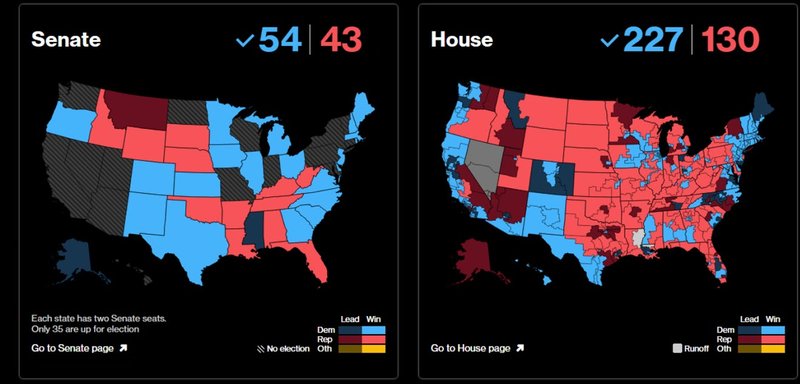
Democrats secured control of the House of Representatives and Senate, flipping at least seven Republican-held Senate seats.
An early projection puts Democrats on course for 255 House seats against 180 for Republicans, although final results remain subject to outstanding counts.
Rising living costs, the economic consequences of the Iran war and dissatisfaction with Trump helped drive Democratic victories across traditionally Republican states.
S&P 500 futures fell as much as 1.4%, while Treasury prices rose and the dollar weakened as investors assessed the prospect of political gridlock.
The new Congress, taking office on January 3, 2027, could block Trump's legislative priorities, restrict appointments and intensify investigations into his administration and business relationships.
Democrats win both chambers as voters reject Trump's economic agenda
The 2026 US midterm elections delivered a sweeping Democratic victory, giving the party control of both chambers of Congress and fundamentally changing the political outlook for the final two years of President Donald Trump's second term.
Democrats captured at least seven Republican-held Senate seats and won House districts that had strongly supported Trump in the 2024 presidential election. The scale of the result exceeded expectations of a narrower Democratic recovery, with an early House projection suggesting the party could finish with approximately 255 seats against 180 for Republicans.
The outcome reflects growing voter dissatisfaction with persistent inflation, elevated energy prices and the economic consequences of the US conflict with Iran. Those concerns proved especially damaging in traditionally Republican states, where Democrats secured victories despite significant financial and organizational disadvantages.
The election also represents a major institutional shift. Since returning to the White House in January 2025, Trump has benefited from Republican control of both chambers. Democratic majorities will now give the opposition authority over congressional committees, federal spending negotiations and the Senate's confirmation process.
For financial markets, the immediate uncertainty is how divided government will affect fiscal policy, regulation and the investment climate supporting the US economy.
Source: Bloomberg
Why the economy and Iran war cost Republicans support
The cost of living emerged as the defining economic issue of the election.
Republicans struggled to defend the administration's record as households faced rising consumer prices and higher energy costs. The prolonged conflict involving Iran has intensified those pressures, particularly through oil prices and the resulting increases in transportation and business expenses.
The political problem extended beyond inflation statistics. Higher fuel costs affected farmers, trucking companies and consumers across states where Republicans had previously enjoyed comfortable electoral advantages.
Trump acknowledged that price increases associated with the Iran war contributed to Republican losses, although he defended the decision to launch the conflict and rejected the suggestion that the election represented a personal repudiation of his presidency.
The president also attributed some defeats to Republican candidates and indicated that he did not intend to change his Cabinet in response.
The results nevertheless revealed a significant deterioration in Republican support. Democrats were competitive in districts Trump had carried easily two years earlier, demonstrating that economic dissatisfaction had spread beyond conventional swing voters.
Their success was particularly notable because Republicans entered the election with a substantial campaign funding advantage and benefited from mid-decade congressional redistricting efforts in several states.
Those advantages proved insufficient to overcome the broader shift in voter sentiment.
Senate results reveal the scale of the Democratic breakthrough
The Senate outcome was particularly striking because Democrats needed a net gain of four seats to overturn the Republican majority.
They ultimately flipped at least seven, winning in Texas, Kansas, Maine, North Carolina, Iowa, Ohio and South Carolina.
Texas produced one of the election's most consequential results. Democrat James Talarico defeated Republican Ken Paxton, ending nearly three decades without a Democratic statewide election victory in the state.
The contest attracted almost $600 million in political advertising, reflecting its national importance. Republican divisions also played a role after Trump's feud with longtime Senator John Cornyn contributed to Cornyn's primary defeat by Paxton, a candidate regarded by some Republican strategists as more vulnerable in the general election.
In Kansas, Adam Hamilton defeated Republican Senator Roger Marshall, delivering the state's first Democratic Senate victory since 1932. Economic concerns, including expensive diesel and the consequences of trade tariffs, weighed on Republican support in the traditionally conservative state.
Former Senator Sherrod Brown returned to the Senate in Ohio, defeating Republican Jon Husted, while Democrat Josh Turek won Iowa's open seat against Republican Representative Ashley Hinson.
Maine's five-term Republican Senator Susan Collins lost to Democrat Troy Jackson, who entered the race after replacing Graham Platner as the Democratic nominee.
Democrats also secured major victories in the South. Former North Carolina Governor Roy Cooper defeated Michael Whatley, while Annie Andrews won South Carolina's Senate contest against Republican Darline Graham.
Democrats additionally retained important seats, including Jon Ossoff's in Georgia and Chris Pappas's victory in New Hampshire.
The breadth of these results suggests the election was driven by a national political shift rather than isolated local contests.
Democrats also deliver historic victories in governor races
The Democratic gains extended beyond Congress, with several gubernatorial contests producing major political changes.
In Georgia, Keisha Lance Bottoms was projected to become the first Black woman elected governor in US history, ending a lengthy period of Republican control of the governor's office.
Texas delivered another major surprise as Democrat Gina Hinojosa defeated three-term Republican Governor Greg Abbott, reinforcing the scale of the political shift in a state long considered a Republican stronghold.
Democrats also won governorships in Ohio and Iowa, adding to evidence that the election results reflected broader dissatisfaction with Republican governance.
These victories carry economic significance because state governments influence business regulation, infrastructure development, taxation and energy policy.
Texas is particularly important given its expanding role in technology manufacturing, data centers and artificial intelligence infrastructure. Changes in state leadership could alter permitting decisions and the regulatory environment surrounding major investment projects.
The gubernatorial results therefore reinforce the possibility that the election will reshape business conditions beyond federal policy alone.
What Democratic control of Congress means for Trump
The incoming Democratic majorities will substantially restrict Trump's ability to advance legislation without opposition support.
The new Congress takes office on January 3, 2027, ending the period during which Republicans could pursue major legislative initiatives through unified control of Washington.
In the House, Democratic leader Hakeem Jeffries is expected to become speaker, potentially making history as the first Black American to hold the position.
Democrats would gain control of congressional committees and the authority to issue subpoenas, summon witnesses and launch investigations into administration decisions.
Expected areas of scrutiny include government contracts, merger approvals, relationships between businesses and administration officials, and financial arrangements involving Trump's companies and family.
Corporate donations to presidential projects, including the proposed White House ballroom, could also attract attention.
For businesses, the implications extend beyond political controversy. Companies with close relationships to the administration may face greater disclosure requirements, legal expenses and uncertainty around government contracts or regulatory approvals.
Democratic control of the Senate also gives the party considerable influence over judicial nominations and appointments to senior government positions.
However, the election does not transfer executive authority away from Trump.
The president retains his veto power and significant authority over trade, immigration and foreign affairs. He has already indicated that he intends to reject legislation he considers unacceptable, meaning major Democratic policy initiatives could face substantial obstacles.
The likely result is a more confrontational political environment in which congressional oversight expands while the prospects for significant bipartisan legislation remain limited.
Why US stocks fell while Treasury yields declined
Financial markets reacted negatively to the Democratic sweep as investors reassessed the implications for corporate regulation, fiscal spending and Washington's legislative outlook.
S&P 500 futures declined as much as 1.4%, while technology shares came under additional pressure amid concerns that Democratic control could result in closer scrutiny of artificial intelligence companies and the infrastructure investment supporting the sector.
The market reaction reflects an important distinction between political stability and policy predictability.
A change in congressional control can create uncertainty over the regulatory environment, particularly for industries that have benefited from government support, favorable approvals or close relationships with policymakers.
AI-related businesses may face additional examination of data-center development, competition, energy consumption and government contracts.
Treasuries, meanwhile, attracted demand as investors considered the possibility that a divided government could limit additional federal spending and tax reductions.
Lower expectations for fiscal expansion can reduce concerns about future Treasury issuance, potentially supporting government bond prices and pushing yields lower.
The dollar weakened alongside Treasury yields, reflecting a reduction in the interest-rate support available to US assets.
These market movements do not necessarily imply that Democratic control is structurally negative for equities or positive for bonds. Much will depend on the legislation that ultimately becomes possible, the scale of regulatory changes and whether the administration can negotiate fiscal agreements with Congress.
Fiscal policy and AI regulation become the next market risks
The most immediate economic consequence of the election could be a significant reduction in Trump's legislative flexibility.
Republicans had been expected to pursue additional tax reductions, increased defense expenditure and changes to federal spending programs. Democratic control of both chambers makes those proposals substantially harder to enact.
That could moderate expectations for future deficits, but political gridlock also raises the probability of prolonged negotiations over government funding and the federal debt ceiling.
For bond investors, the distinction is important. Reduced fiscal spending expectations can support Treasuries, while repeated budget confrontations may increase uncertainty and market volatility.
Technology companies face a different set of risks.
Democrats are expected to examine the relationships between major corporations and the administration, particularly where businesses have received government contracts, regulatory benefits or merger approvals.
The scrutiny could extend to the AI investment boom, which has become a major source of US capital expenditure and equity-market performance.
For companies operating data centers, supplying advanced semiconductors or depending on government-related technology contracts, the consequences will depend on whether investigations lead to actual regulatory changes.
In the near term, uncertainty over those changes may be enough to keep investors cautious.
The 2026 midterms reshape Washington, but Trump retains significant power
The Democratic victory represents the most substantial institutional challenge Trump has faced since returning to the presidency.
Republicans lost control of Congress after suffering defeats across traditional battlegrounds and states that had appeared securely Republican only two years earlier. The scale of the result suggests that dissatisfaction with living costs and the Iran war has become a powerful political force.
The incoming Congress will have greater authority to investigate the administration, influence federal appointments and block major legislative initiatives. Trump, however, retains substantial executive powers and the ability to veto legislation, setting the stage for difficult negotiations throughout 2027 and 2028.
For financial markets, the consequences will depend on how quickly the new political balance translates into changes in fiscal expectations, corporate regulation and government spending.
The immediate response of falling equities, rising Treasury prices and a weaker dollar reflects those uncertainties.
The central market question is whether divided government reduces fiscal risks enough to support bonds, or whether political confrontation and tighter regulatory scrutiny create greater pressure on corporate investment and equity valuations.
That balance will become increasingly important as investors assess the outlook for the US economy during the final two years of Trump's presidency.