Support
US private payrolls rise by just 38,000 as labour market slows
US private-sector hiring slowed to its weakest pace since January, raising concerns ahead of Friday’s jobs report.

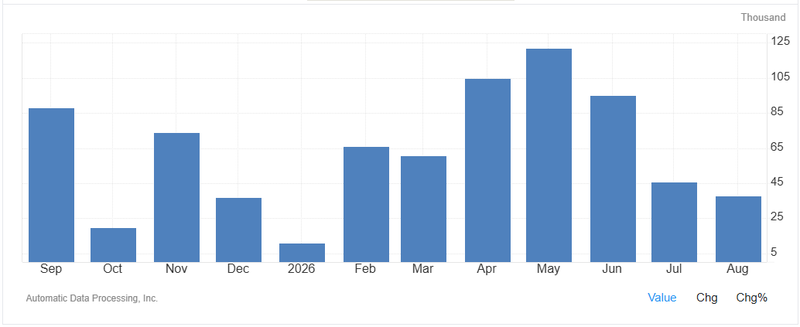
Private payrolls rose by 38,000 in August, below the 47,000 forecast.
Manufacturing lost 17,000 jobs, while professional and business services shed 16,000.
Weak hiring could reinforce expectations for easier Federal Reserve policy.
US private-sector hiring misses forecasts
US private companies added just 38,000 jobs in August, offering fresh evidence that the labour market is losing momentum ahead of the government’s closely watched employment report.
The increase fell short of the 47,000 jobs expected and slowed from an upwardly revised 46,000 in July, according to ADP. It was the weakest monthly private payroll gain since January.
Hiring was also concentrated in a small number of sectors. Education and health services added 45,000 positions, while leisure and hospitality gained 16,000 and construction added 12,000.
Source: TradingEconomics
Weakness was visible elsewhere. Manufacturing employment declined by 17,000, professional and business services lost 16,000, and both natural resources and mining and trade, transportation and utilities shed 5,000 jobs.
Large companies accounted for nearly all the increase. Businesses employing at least 500 workers added 34,000 jobs, compared with only 3,000 among companies with fewer than 50 employees.
Wage growth remains steady
Pay growth showed little change despite the slowdown in hiring. Base pay for workers remaining in their jobs increased 3% from a year earlier, while gross pay, including bonuses, commissions and tips, rose 4.4%.
Across all workers, base and gross pay increased by 3.2% and 4.7%, respectively.
Focus shifts to the US jobs report
Markets will now turn to Friday’s US nonfarm payrolls report. Economists expect the economy to add 53,000 jobs after payrolls declined by 23,000 in July. The unemployment rate is forecast to remain at 4.1%.
A weak government report would confirm that labour demand is cooling and could strengthen expectations for Federal Reserve policy easing. That scenario would likely put downward pressure on Treasury yields and the US dollar, while supporting gold and other rate-sensitive assets.