Support
 ECB policy faces a difficult balancing act
The European Central Bank (ECB) enters Q4 facing renewed inflation pressure, driven largely by rising energy prices. With interest rates already increasing, policymakers must decide whether further tightening is necessary or whether higher energy costs and weaker demand will do some of the work for them.

Most analysts expect one final increase in December.
If the OAT-Bund spread reaches 125 basis points, it could reduce French GDP growth and pushing the economy closer to contraction.
The CDU's performance in German state elections and potential political paralysis in France could add further downside pressure on the euro.
Energy inflation puts further rate hikes in focus
The ECB raised its deposit rate to 2.50% on 10 September, its second increase of 2026, reversing the easing cycle that had brought rates to 2.0% in mid-2025. The main driver is energy, with eurozone headline inflation reaching 3.2% year on year in August and energy prices rising 14.3%. Inflation is expected to peak at 3.6% in Q4 before gradually easing to 2.1% by 2028.
Markets currently assign a 78% probability to a 25-basis-point hike on 17 December, implying a year-end deposit rate of around 2.67%–2.75%. An October hike is considered less likely, with a probability of just 13%.
Most analysts expect one final increase in December, taking the deposit rate to 2.75%, while a more hawkish minority anticipates hikes in both October and December, bringing rates to 3.00%. An alternative outlook favours a final hike in October, with December remaining possible if energy inflation persists and begins feeding into wages and underlying prices.
The ECB keeps its options open
Recent Governing Council comments suggest the ECB is avoiding any commitment to a specific rate path. On 7 October, Dolenc said current rates provide sufficient flexibility to respond to developments, while Rehn warned that forecasts remain subject to exceptionally high uncertainty. The December decision will therefore depend heavily on October inflation figures and Q3 GDP data.
The challenge is that the ECB cannot directly resolve inflation caused by supply disruptions. Chief Economist Philip Lane has acknowledged that higher energy prices could weaken demand enough to reduce the need for further rate hikes. Widening yield spreads between eurozone government bonds are also tightening financial conditions, potentially reducing the pressure on the ECB to raise rates further.
The key question for Q4 is whether inflation remains persistent enough to justify another hike, or whether weaker demand and tighter financial conditions begin to limit the need for further action.
European bond yields face growing pressure
Three factors are pushing European bond yields higher: ECB rate hikes lifting short-term yields, the return of higher term premiums after years of quantitative easing (QE), and increased German government borrowing. German sovereign issuance is expected to reach €512 billion in 2026, up from €425 billion in 2025.
However, the greater risk lies in widening yield spreads between eurozone countries. The gap between French and German 10-year bond yields (OAT-Bund spread) has approached levels last seen in 2012, driven by France's difficult budget negotiations and fiscal concerns. Italian and Greek spreads have widened even more significantly, while German Bunds have benefited from safe-haven demand.
These concerns have intensified following the presentation of the French budget. If the OAT-Bund spread reaches 125 basis points, it could reduce French GDP growth by a further 0.1 percentage points, pushing the economy closer to contraction.
Fiscal risks could limit further ECB tightening
The German two-year yield is likely nearing its peak, as widening bond spreads could limit the ECB's ability to raise rates further. This was evident when markets sharply reduced expectations of additional hikes following the surge in French bond spreads.
German Bunds face competing pressures. Higher government issuance and inflation are pushing yields up, while safe-haven demand linked to French fiscal uncertainty is helping contain them. This could place a natural limit on further increases in the 10-year Bund yield, which is projected to reach 3.40% by the end of 2026 before rising above 3.50% by mid-2027.
EUR/USD has peaked, with sideways trading expected through year-end
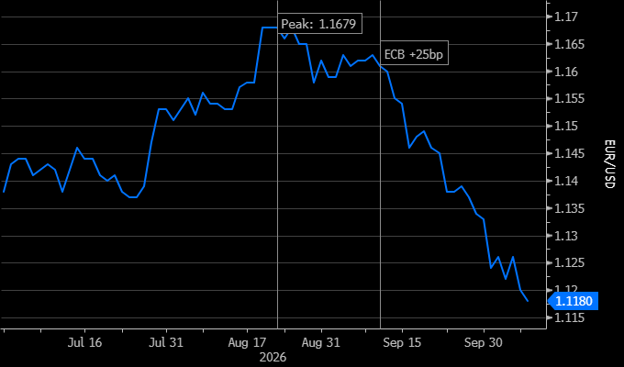
EUR/USD reached a high of 1.1679 on 21 August, supported by the ECB's hawkish stance and stronger risk appetite over the summer. Since then, the pair has fallen 4.3% to 1.1183, with the sharpest decline occurring in early October as widening European bond spreads and weaker global risk sentiment weighed on the euro.
The outlook for Q4 remains mixed, with several possible scenarios:
- Bearish case (target 1.12): The US dollar could continue to benefit from AI-driven US economic growth and potentially higher oil prices.
- Constructive case (target 1.15 in Q4 2026): EUR/USD is expected to trade within a range over the coming months, before potentially rising to 1.17 in Q1 2027.
- Constructive case (target 1.1450 in Q4 2026): Despite the ECB's hawkish stance, risks to the euro remain balanced, making sustained moves in either direction less certain.
- Political risks: The CDU's performance in German state elections and potential political paralysis in France could add further downside pressure on the euro.
The recent EUR/USD decline is not primarily driven by interest rates, as the ECB is still tightening policy. Instead, it reflects growing concerns about economic growth. Markets are increasingly viewing the energy shock as a threat to economic activity rather than simply an inflation problem that could support the euro through higher ECB rates.
This shift is important for Q4. If third-quarter GDP disappoints, the euro could weaken even if the ECB raises rates in December, as investors may reduce expectations of further hikes beyond that meeting.
Key risks to watch in Q4
- October CPI (flash, ~Oct 31): A print above 3.5% would cement December hike expectations and likely push Bund yields back toward 3.60%+. Inflation is projected to remain above 3% until spring 2027.
- Strait of Hormuz / energy prices: The ECB must be ready for various inflation outcomes as the situation in the Middle East continues to dominate the outlook for consumer prices; a sustained reopening of the Strait of Hormuz would ease pressure, while renewed escalation could send oil and gas materially higher.
- French budget (Oct–Nov): OAT-Bund spread trajectory is the single most important intra-European risk asset signal for Q4. A broader risk-off sentiment could increase the likelihood of ECB intervention in bond markets, especially since the issue is no longer solely a French concern.
- Eurozone PMI durability: The eurozone composite PMI reached 53.1 in September 2026, the fastest expansion since April 2023, with services at 53.0 and manufacturing at 52.7. Sustainability into Q4 is the key growth swing factor.