Support
 Gold caught between central banks and the Fed
Gold enters Q4 caught between two competing forces. Central bank demand continues to provide support, while expectations of higher US interest rates limit its recovery. After a volatile third quarter, the question remains whether gold can regain momentum or face further pressure.

The Council's 2026 survey found that 45% of central banks plan to increase gold reserves over the next year.
Any indication that rate hikes are coming to an end could lower real yields and weaken the dollar, giving gold the momentum it lacked in Q3.
A break below the summer low of $3,942 could push gold towards $3,500.
Gold's recovery struggles to gain momentum
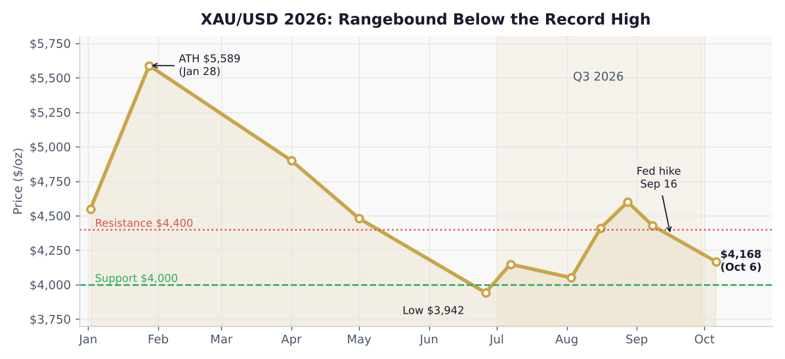
The Q3 report questioned whether gold's rebound from its June low marked a genuine trend reversal or a temporary recovery within a broader correction. The outcome was mixed. After falling around 14% in Q2, gold recovered roughly 6.4% in Q3 through 25 September but remained largely within a $4,000–$4,500 per ounce range.
Gold briefly reached a quarterly high near $4,600 in late August, after weaker-than-expected July US inflation data reduced the probability of a September Fed rate hike from around 55% to 35%. However, prices fell roughly 4% in September. By 6 October, XAU/USD was trading near $4,168, down more than 5% over the month and around 25% below its January record high.
Higher US rates continue to weigh on gold
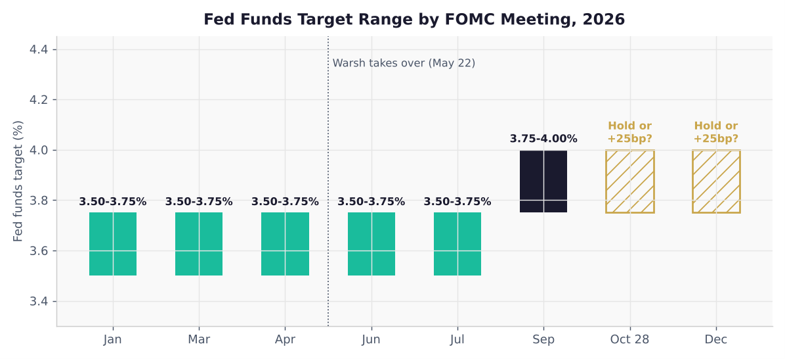
US monetary policy remains the biggest influence on gold. On 16 September, the Federal Reserve unanimously raised rates by 25 basis points to 3.75%–4.00%, its first increase under Chair Kevin Warsh after holding rates at 3.50%–3.75% since the start of the year.
The decision followed persistent inflation, with annual PCE inflation at around 3.7% in July. Warsh has maintained that inflation is not slowing and returning it to the 2% target remains the priority. Markets subsequently increased expectations of further hikes, pushing the 10-year Treasury yield above 5.2%, the 30-year above 5.5% and the 10-year real yield to around 1.6%.
Higher real yields make non-yielding assets such as gold less attractive. However, gold has remained relatively resilient despite rising yields and a stronger dollar, pointing to continued support from underlying demand.
The Fed's next move could be decisive
The Fed's 27–28 October meeting will be a key event for gold, taking place less than a week before the US midterm elections on 3 November. President Trump has publicly called for lower rates but says the decision rests with Warsh, who has pledged to protect the Fed's independence.
For gold, the Fed's guidance may matter more than the rate decision itself. September inflation data on 14 October could shift expectations ahead of the meeting, followed by October payrolls on 6 November, October CPI on 10 November and the final Fed meeting in December. Any indication that rate hikes are coming to an end could lower real yields and weaken the dollar, giving gold the momentum it lacked in Q3.
Central bank demand continues to support gold
Central bank buying remains a key source of support. According to the World Gold Council, net purchases reached 288.9 tonnes in Q2, up 62% year on year and the highest second-quarter total on record. This came despite gold experiencing one of its sharpest quarterly declines since 2013.
Poland's central bank added 51 tonnes, bringing reserves to 632 tonnes against a target of around 700 tonnes. China's central bank has also purchased double-digit tonnages each month since May, including roughly 20 tonnes in July.
The Council's 2026 survey found that 45% of central banks plan to increase gold reserves over the next year, the highest share since 2019. However, reported monthly purchases remain below 2025 levels, while the Council's quarterly estimates also account for unreported buying. Its Q3 report, expected in late October, will therefore be an important indicator of whether demand remains strong.
Geopolitical tensions create a dilemma for gold
Geopolitical uncertainty has not always supported gold this year. Despite the US-Iran conflict and Brent rising above $100 in September, gold fell during the same month. Higher oil prices fuel inflation, increasing pressure on the Fed to raise rates. This can weigh on gold more heavily than safe-haven demand supports it.
That creates an unusual possibility for Q4. A US-Iran peace agreement that restores normal shipping could benefit gold by lowering oil prices and inflation expectations, giving the Fed more room to pause rate hikes. President Trump has suggested the conflict could end immediately after the midterm elections, although that timeline remains uncertain.
Gold's key levels to watch in Q4
The base case is for gold to trade between $4,000 support and $4,400 resistance until the Fed's October decision provides greater clarity.
A weekly close above $4,400 could open the way towards $4,500 and potentially $4,700. This would likely require a clear signal that the Fed is pausing rate hikes or a meaningful decline in oil prices that eases inflation pressure.
On the downside, a break below the summer low of $3,942 could push gold towards $3,500, particularly if the Fed raises rates again in October or December while Treasury yields and the dollar continue rising.
In either scenario, central bank buying remains an important source of long-term support, potentially attracting demand during deeper price declines rather than signalling a reversal of gold's broader trend.