Support
The Fed is fighting the wrong war
The US economy enters Q4 looking strong on the surface, but the picture becomes less comfortable beneath the headline numbers. Growth remains solid, yet the labour market is losing momentum and inflation is increasingly being driven by pressures that higher interest rates cannot easily solve. That leaves the Fed facing a difficult question: how much further can it tighten without doing more harm than good?

Higher rates can reduce spending, credit and employment, but they cannot increase oil supply.
The biggest Q4 risk may therefore be a policy error. The Fed could be right that inflation remains too high, but wrong about what is driving it.
The US economy added just 29,000 jobs in September, while monthly payroll growth has averaged around 45,000 over the past year.
Growth remains stronger than it looks
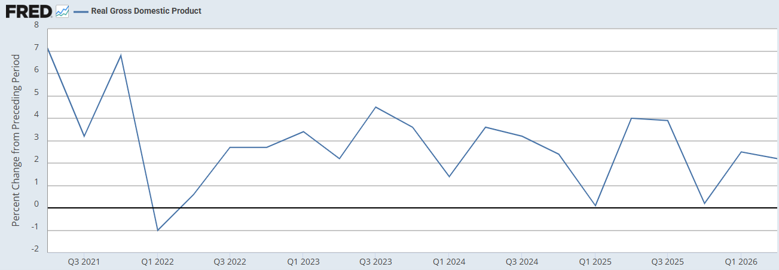
Growth is holding up, with second-quarter GDP revised to 2.2% and private domestic final demand growing at an annualised rate of 4.6%. The Atlanta Fed’s GDPNow estimate also points to growth of around 3.7% in the third quarter.
Source: FRED
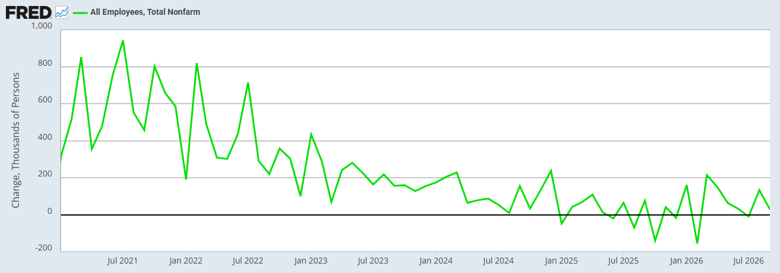
Those are not recession numbers. But the labour market tells a different story. The US economy added just 29,000 jobs in September, while monthly payroll growth has averaged around 45,000 over the past year. Hiring is clearly slowing, making the weakness harder to dismiss as short-term noise.
Source: FRED
That leaves the Federal Reserve with a difficult balance. Growth remains strong enough to keep inflation concerns alive, while a weaker labour market makes further rate hikes increasingly risky.
Inflation has changed
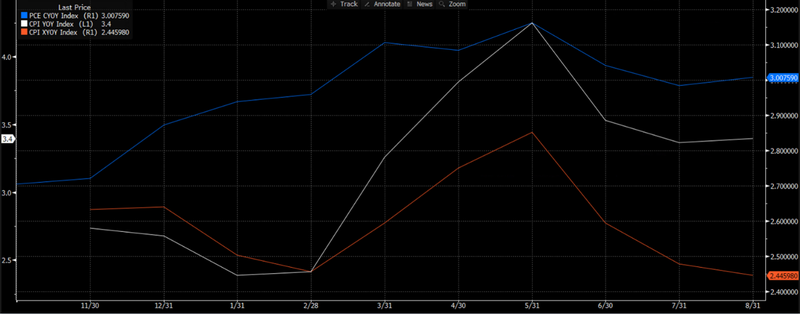
The inflation picture is becoming more mixed. Headline PCE inflation stands at 3.4%, while core PCE is at 3.0%. Headline CPI is also at 3.4%, but core inflation has eased further to 2.4%.
Source: Bloomberg
The difference matters because inflation is increasingly being driven by factors that interest rates cannot easily control. Energy prices are a clear example: the energy index is up 16.3% from a year earlier; gasoline is 27.4% higher and fuel oil has risen 52%. ISM price indicators have also moved sharply higher, pointing to renewed pressure across the supply chain.
Tariffs add another complication. Research from the New York Fed suggests around 26% of the 2025 tariff increase is passed on to consumers, with further effects potentially appearing months later through higher input costs and domestic prices. This leaves the Fed with a difficult question: what does another rate hike fix?
Higher rates can reduce spending, credit and employment, but they cannot increase oil supply, lower shipping costs or reverse tariffs. If inflation remains high in Q4 because of supply pressures rather than strong demand, monetary policy becomes a much less precise tool.
Not the 1970s. Yet.
The comparison with the 1970s is understandable. Energy shocks are back, geopolitical risk is elevated and inflation remains above target. But one important piece is still missing. Average hourly earnings are rising just 3.0% from a year earlier, while the 10-year breakeven inflation rate remains around 2.36%. Neither wages nor long-term inflation expectations suggest inflation has become embedded in the economy.
That was what made the 1970s so dangerous. Energy shocks were only the beginning, with inflation eventually feeding into wages, expectations and prices and creating a cycle that reinforced itself. That cycle is not visible today.
The Fed still has another lesson to consider. In 2021, policymakers waited too long because they expected supply-driven inflation to fade. The risk now is going too far in the other direction. Treating every new inflation shock as a sign of overheating demand could become the next policy mistake.
The consumer has a clock
American consumers are still spending, but the support behind that spending is weakening. Consumption rose 0.9% in August and 0.6% after inflation, while personal income increased just 0.2%, real disposable income was flat and the saving rate fell to 4.1%. That gap cannot continue indefinitely.
Consumer confidence has already fallen to 81.9, while 30-year mortgage rates are above 7%. Borrowing is becoming more expensive just as income growth is slowing. The main Q4 risk is therefore not a sudden drop in spending, but a gradual loss of consumer strength.
Consumers may be able to keep the economy moving through another quarter. The bigger question is how much of that strength can carry into 2027.
December matters more
The Fed raised rates to 3.75%–4.00% in September, and its projections still point to another quarter-point increase before the end of the year. October looks increasingly straightforward, but December is less certain.
The 10-year Treasury yield is already near 5.3%, meaning financial conditions are tightening even without another Fed move. Mortgage rates are above 7%, credit remains expensive and higher long-term borrowing costs are already doing some of the Fed’s work.
History offers a useful reminder.
In 1994, the Fed raised rates aggressively from around 3% to 6%, before beginning to cut them by July 1995. The lesson was not that the tightening was unnecessary, but that monetary policy works with a lag. Knowing when to stop can matter as much as knowing when to start. The Fed could now be approaching a similar point.
The base case remains slower growth without a recession and no rate hike in October, while December remains open. If payroll growth stays weak, wage pressures remain contained and inflation expectations stay anchored, another hike will become harder to justify. But if higher energy prices and tariffs begin feeding into wages, services inflation and longer-term expectations, the case for another hike would become stronger.
The biggest Q4 risk may therefore be a policy error. The Fed could be right that inflation remains too high, but wrong about what is driving it. That distinction could determine whether the US economy enters 2027 with a soft landing still intact.