Support
Central banks and ETF inflows keep gold supported as inflation risks return
Gold is still being supported by one of the strongest structural stories in global markets: official demand, investor inflows, and renewed concern that inflation may not fade as smoothly as central banks had hoped.
Central banks bought 244 tonnes in Q1 2026.
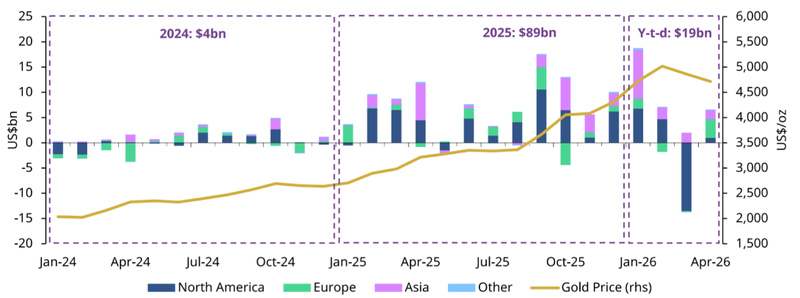
Gold ETFs recently recorded $6.6 billion in monthly inflows.
Michelle Bowman said inflation may require tighter monetary policy.
Gold demand is no longer just a fear trade
Gold’s strength is not only about short-term geopolitical fear. The deeper story is that large official buyers are still treating gold as a strategic reserve asset, not a temporary trade.
Central banks bought 244 tonnes in Q1 2026, marking a 3% year-on-year increase. That matters because the buying is continuing from already elevated levels. After years of reserve diversification, many central banks are still choosing gold to reduce exposure to currency risk, sanctions risk, and political uncertainty around the global financial system.
This does not mean every central bank is buying aggressively. But it does show that the broader direction has not changed. Gold is still being accumulated by institutions that usually move slowly and think in years, not weeks.
ETF inflows show investors are coming back too
The other important shift is happening in gold ETFs. Global physically backed gold ETFs recently recorded $6.6 billion in monthly inflows, showing that investor demand is starting to line up again with official-sector demand.
That is important because gold has already had strong support from central banks, but investor flows can change the short-term momentum. When ETF buyers return, the market usually becomes less dependent on one source of demand. It also suggests that investors are using gold not only as a crisis hedge, but as protection against a more complicated macro environment.
Source: Gold.org
The Fed problem is getting harder
The inflation backdrop is also becoming more sensitive. Federal Reserve Vice Chair Michelle Bowman warned that Middle East conflicts could create more persistent inflation and may require tighter monetary policy.
That warning matters because it connects geopolitics directly to the Fed outlook. If tensions in the Middle East keep energy prices elevated, inflation may not behave like a temporary shock. It could feed into transport costs, consumer prices, inflation expectations, and eventually wage pressure. That is the part markets cannot ignore. A short oil spike is one thing. A persistent inflation impulse is another.
Gold benefits from the policy trap
Gold tends to perform well when investors believe central banks are trapped between inflation risk and growth risk. That is the environment now taking shape again.
If the Fed stays hawkish because inflation risks are rising, real yields may remain a challenge for gold. But if tighter policy also raises concern about growth, debt sustainability, or financial stress, gold can still attract demand. This is why the current setup is not straightforward. Higher rates are not automatically negative for gold when the reason behind them is instability. Gold is benefiting because investors are not fully comfortable with the macro path ahead.
The market is buying insurance, not just upside
The strongest part of the gold story is that demand comes from different directions at the same time. Central banks are buying for strategic reasons. ETF investors are returning for portfolio protection. Geopolitical tensions are keeping inflation risk alive. And the Fed is being forced to sound more cautious about declaring victory.
That combination gives gold a stronger base than a simple speculative rally. Still, the market is not risk-free. If inflation cools quickly, energy prices fall, and the Fed regains room to cut without fear, some of the urgency behind gold demand could fade. But for now, that is not the environment investors are looking at.