Support
Gold heads for best week since January as dip-buyers return
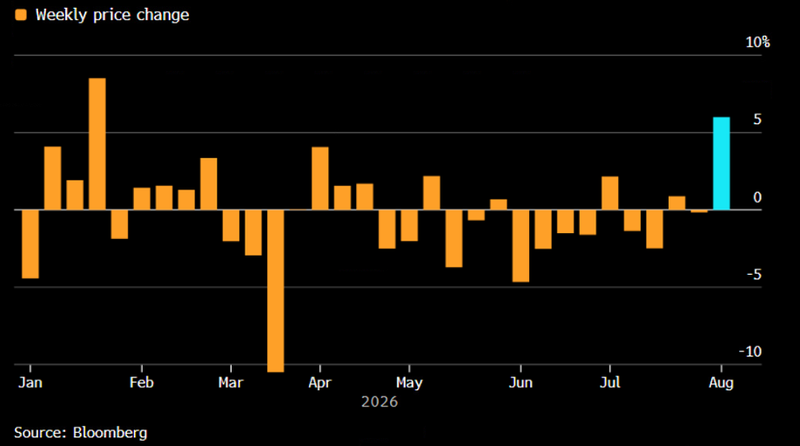
Gold is heading for its strongest weekly gain since late January after buyers returned aggressively around key technical levels. Bullion has climbed nearly 6% this week and briefly traded above $4,300 an ounce, although growing expectations of a Federal Reserve rate hike remain a major near-term risk.
Gold is up nearly 6% this week, its strongest performance in more than six months.
Bullion rose as high as roughly $4,290 and briefly exceeded $4,300.
Chinese gold ETFs have recorded 17 consecutive days of inflows.
Markets price roughly a 55% chance of a Fed rate hike in September.
Gold buyers regain control
Gold is on track for its strongest weekly gain since January as investors continue buying dips and defending important technical levels.
Bullion climbed as much as 1.2% on Friday to approach $4,290 an ounce, reversing a moderate decline from the previous session.
The metal is now up nearly 6% for the week.
Gold briefly moved above $4,300 on Thursday as investors reacted to optimism surrounding the possible reopening of the Strait of Hormuz. Some of that momentum faded later, but buyers continued stepping in on subsequent weakness.
That resilience suggests the rally is being supported by more than short-term geopolitical headlines.
The $4,000 level has become increasingly important
One of the most important developments in the current move has been gold’s ability to hold comfortably above $4,000 an ounce.
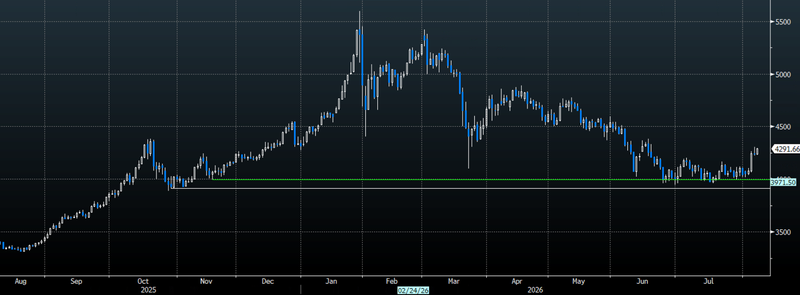
That level has become a major psychological and technical reference point after the sharp correction that followed the earlier rally.
Investors who had been waiting for lower entry points have increasingly returned as gold demonstrated that it could remain above the threshold.
The result has been a change in market behavior.
Instead of rallies being met immediately by heavy selling, declines are increasingly attracting buyers.
That shift has helped stabilize the market after several months of intense volatility.
Middle East tensions are no longer the main driver
Gold’s latest advance has occurred despite renewed tensions across the Middle East.
Iranian media reported strikes against hostile targets around the Strait of Hormuz, while Tehran has also threatened to restrict passage for US and Israeli vessels.
The Houthis separately announced a large-scale attack against forces aligned with Yemen’s Saudi-backed government.
Normally, such developments would be expected to increase demand for gold as a safe-haven asset.
The muted reaction suggests geopolitical risk is not currently the main reason investors are buying.
Gold’s earlier rally appears to have been driven partly by a technical breakout and uncertainty over the Federal Reserve’s policy outlook.
The continuation of the move despite renewed military tensions suggests buyers have regained control of the short-term trend.
China ETF demand strengthens
Chinese institutional demand is providing another source of support.
Gold-backed exchange-traded funds in China recorded additional inflows this week, extending their buying streak to 17 consecutive days.
That is the longest run of additions since a similar streak ended in March.
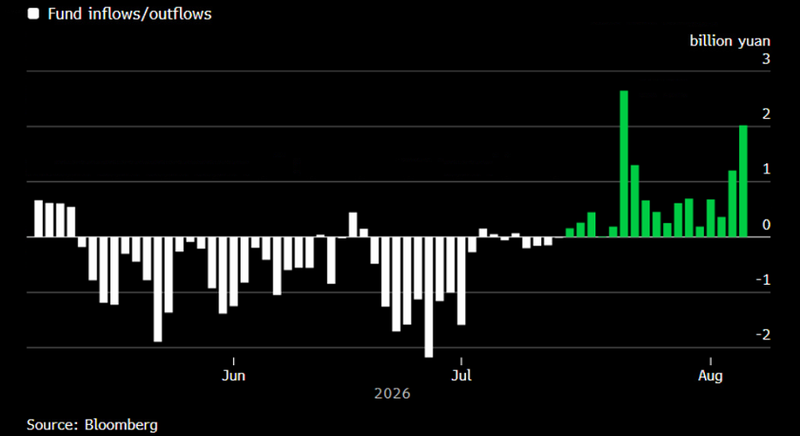
The flows suggest institutional investors increasingly see current prices as attractive following the substantial decline from earlier highs.
Gold’s ability to remain above $4,000 has also improved confidence among investors who may have been hesitant to re-enter the market during the correction.
Persistent ETF demand is especially important because it represents a more durable source of buying than short-term speculative flows.
Gold still faces a major Fed problem
The largest immediate obstacle remains US monetary policy.
Markets are pricing approximately a 55% probability that the Federal Reserve will raise interest rates in September.
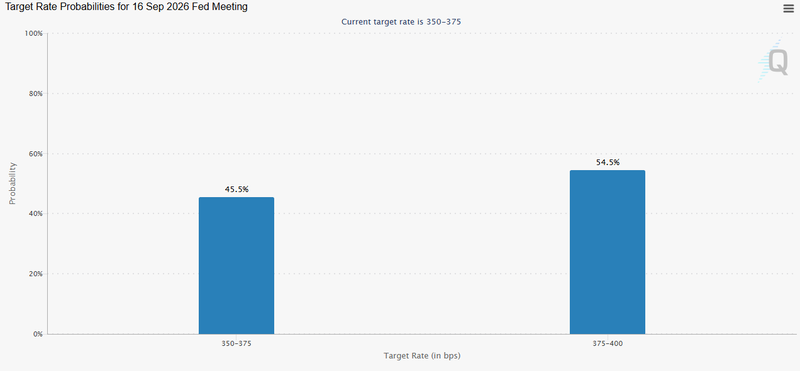
Source: CME Group
Expectations increased after Fed Chair Kevin Warsh signaled that borrowing costs could rise if incoming inflation reports remain too strong.
Other Fed officials have also stressed that policymakers cannot tolerate persistently elevated inflation while waiting for potential productivity gains from artificial intelligence and other investment.
Higher rates are generally negative for gold because the metal does not generate interest.
When Treasury yields rise, the opportunity cost of holding bullion increases, making interest-bearing assets more attractive.
This dynamic could limit the upside even if physical and ETF demand remain strong.
Energy inflation could keep rates higher
The Fed’s challenge is closely connected to developments in the Middle East.
The US-Iran conflict pushed oil and energy prices sharply higher, increasing inflation pressure and forcing investors to reconsider expectations for monetary easing.
Higher crude prices affect transportation, manufacturing and household energy costs, making it more difficult for inflation to return sustainably toward the Fed’s 2% target.
That has created an unusual environment for gold.
Geopolitical instability normally supports the metal through safe-haven demand. But when the same instability drives energy inflation and increases the probability of higher interest rates, part of that positive effect is offset.
This helps explain why gold has fallen nearly 20% since the US-Iran war began in late February despite persistent geopolitical risk.
Technical recovery becomes more important
The latest rebound therefore carries significance beyond the weekly percentage gain.
Gold has managed to recover while facing a still-hawkish interest-rate environment.
If the metal can hold above $4,000 and establish support closer to the $4,300 area, it would strengthen the argument that the correction has entered a more stable phase.
A sustained move above $4,300 could encourage additional momentum buying.
Failure to hold the current recovery would return attention to the $4,000 level, which has become the key dividing line between stabilization and renewed weakness.
Silver joins the rebound
The recovery has extended across the precious-metals complex.
Silver rose around 3% to $63.39 an ounce, while platinum and palladium also advanced.
The simultaneous rise suggests the move is not limited to gold-specific safe-haven demand.
Broader precious-metals buying could reflect improved investor appetite after the sharp corrections seen across the sector.
The Dollar Spot Index was also marginally weaker, offering modest additional support to dollar-denominated metals.