Support

Gold ETF inflows rise, but can falling yields drive a recovery?
Institutions and central banks are still accumulating gold as protection against fiscal risk, volatile sovereign bonds and geopolitical fragmentation, while high real yields continue to determine the price investors are willing to pay.

Gold ETFs attracted a record $31 billion during the third quarter.
Global ETF holdings reached an all-time high of 4,256 tonnes despite falling prices and higher bond yields.
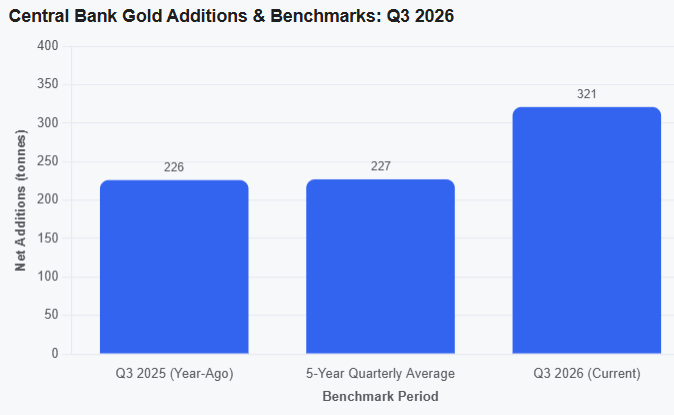
Central banks purchased 321 tonnes, their strongest quarter since late 2024.
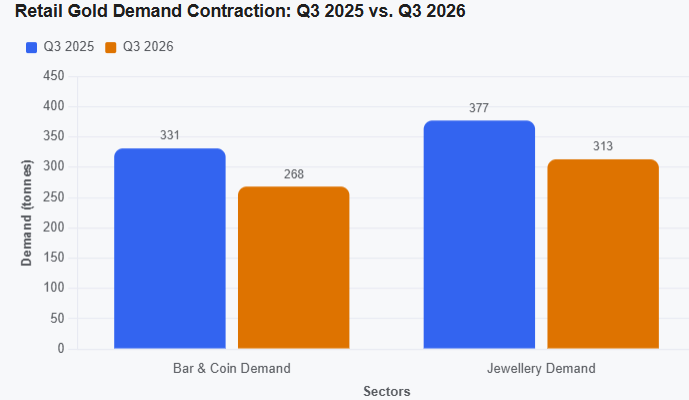
Retail bar and coin demand declined 19%, showing that the institutional inflows were not part of a broad buying wave.
ETF inflows show that the marginal buyer has changed
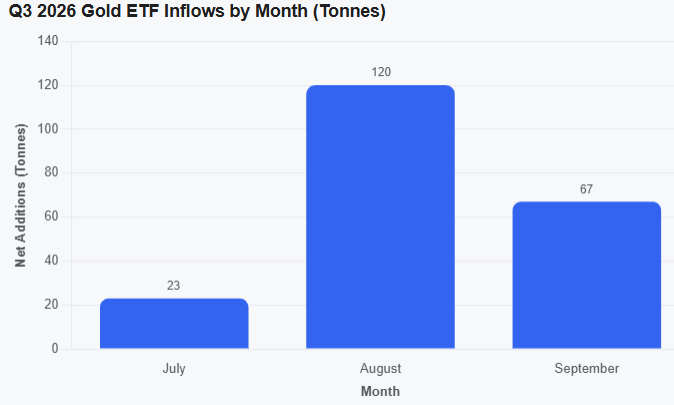
Physically backed gold ETFs added 211 tonnes during the third quarter, reversing the outflows recorded in the previous three months. Buying strengthened as the quarter progressed, with holdings increasing by 23 tonnes in July, 120 tonnes in August and another 67 tonnes in September.
The timing matters as much as the total. The Fed raised rates in September, Treasury yields moved higher and the dollar remained firm. Those forces normally weaken gold because government debt offers income while bullion does not.
ETF holdings still rose as the price declined
Institutions were therefore not simply chasing momentum they were using the correction to rebuild strategic exposure after reducing holdings earlier in the year. Concerns over government borrowing, bond-market volatility and expensive equity valuations appear to have outweighed the immediate cost of holding a non-yielding asset.
The inflows absorbed part of the selling pressure, but the price remained sensitive to real yields. This separates demand for portfolio insurance from the conditions required for a sustained rally.
Source: Google
Bond-market risk is changing the reason for owning gold
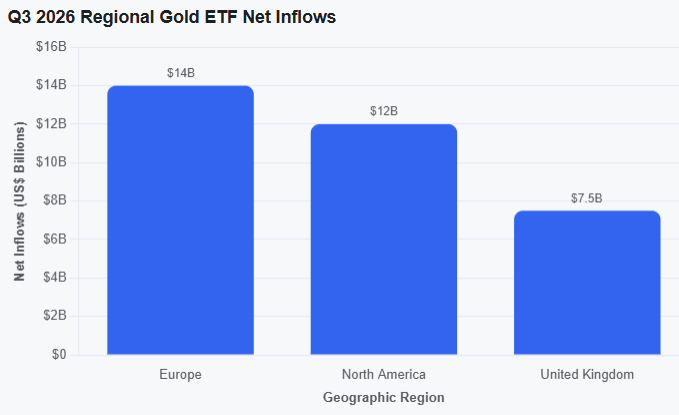
European-listed funds attracted a record $14 billion in the third quarter, while North American funds added $12 billion. UK-listed products alone received $7.5 billion, their strongest quarter on record.
The UK inflows coincided with a rising gilt term premium and renewed concern over inflation and fiscal sustainability. Investors were not only expressing a view on the dollar price of gold. They were reducing their dependence on sovereign bonds as the sole source of portfolio protection.
Government debt usually provides income and benefits when growth weakens. Gold provides no income, but it does not carry the same credit, duration or fiscal risk. When investors become less confident that bonds will protect portfolios during an inflation or debt shock, higher yields can coexist with demand for gold.
This helps explain why ETF buying survived an unfavourable rate environment. Bond volatility became part of the reason to hold gold even while the level of yields limited the price investors would pay for it.
Source: Google
Retail investors are sending a different signal
Global bar and coin demand fell 19% from a year earlier to 268 tonnes, its weakest level in four years. Jewellery demand declined 17% to 313 tonnes, the lowest third-quarter total in the World Gold Council's data series.
High prices reduced affordability, while the absence of a clear upward trend discouraged individual investors from buying the decline. Jewellery consumers shifted towards lighter products and investors in several markets waited for clearer directions.
This is not inconsistent with strong ETF demand. Institutions can accept short-term losses if gold improves the risk of a wider portfolio. Households buying jewellery or physical bars face an immediate decision about price and disposable income. A broader recovery would require either lower prices to restore affordability or enough upward momentum to make waiting more costly.
Source: Google
Central banks are strengthening strategic demand
Central banks added 321 tonnes of gold during the third quarter, 42% more than a year earlier and well above the five-year quarterly average of 227 tonnes. Purchases reached 675 tonnes during the first nine months of 2026, led by continued accumulation from China and Poland.
Their objective differs from that of ETF investors. Central banks are diversifying reserves away from currencies and sovereign debt, reducing exposure to sanctions and geopolitical fragmentation, and holding an asset that is not another government's liability.
China and Poland continued buying despite historically elevated prices, suggesting that reserve composition mattered more than identifying a short-term entry point. Their purchases can absorb supply through a correction, although they cannot prevent prices from responding to changes in yields and the dollar.
Supply has offered little offset. Mine production reached a third-quarter record, but total supply still declined slightly because recycling fell 8% to its lowest level since late 2023. High prices did not release as much scrap metal into the market as might normally be expected.
Source: Google
The oil shock turned inflation protection into a rates problem
Gold reached a record $5,595 in January before the Middle East energy shock changed the interest-rate outlook. Higher oil prices lifted inflation expectations, Treasury yields rose and markets began pricing further Federal Reserve tightening.
Gold can benefit from inflation and geopolitical uncertainty, but those same forces become negative when they raise real yields and strengthen the dollar. The benchmark US 10-year yield was close to 4.9% this week, while markets attached roughly a 75% to 80% probability to a December rate increase.
This explains why strong institutional demand has not produced a comparable price recovery, the strategic case for holding gold improved, while the return available on competing dollar assets increased at the same time.
The election matters through fiscal expectations
Gold recovered towards $4,000 as early US midterm results increased the possibility of Democratic control in Congress. Treasury yields declined and the dollar weakened, improving the immediate environment for bullion.
The result matters through its effect on borrowing and fiscal policy rather than through party labels alone.
A divided government could restrict parts of the administration's spending and tax agenda, reducing expectations for future debt issuance. Lower yields and a weaker dollar would support gold.
A prolonged confrontation over budgets, debt limits or presidential authority could produce a different response.
Fiscal uncertainty may lift the term premium on government bonds while increasing demand for protection outside the sovereign-debt market. Gold benefits most when that uncertainty weakens confidence in bonds and the dollar without forcing the Federal Reserve to tighten further.
Payrolls will decide whether demand can lift the price
Friday's employment report is the next test. Payrolls are expected to increase by around 59,000 to 60,000 after 29,000 in September, while unemployment is forecast to remain at 4.2%.
A stronger report accompanied by firm wage growth would reinforce expectations of a December hike. Real yields and the dollar could recover, making a sustained break above $4,000 difficult even if ETF holdings remain high.
A weaker report would reduce confidence in further tightening
Falling yields would allow the demand already visible in ETFs and official reserves to exert more influence over the price.
Futures positioning leaves room for that response. Managed money remains net long, but the position is not close to the most crowded level of the past year. New buying could therefore enter without recreating the concentration that accompanied previous peaks.
The issue is no longer whether gold has buyers
The ETF and central-bank data answer that question. The next move depends on whether US labour data lowers the return available elsewhere. If it does, institutional accumulation can become a price recovery; if it does not, gold may remain strategically wanted but tactically constrained.