Support

Gold price falls below $4,000 as stock market selloff triggers liquidity pressure
Gold briefly slipped below $4,000 as the stock market rout triggered liquidity-driven selling, overshadowing falling Treasury yields and reduced Fed rate hike expectations.
Gold dropped as much as 0.9% to below $3,990 an ounce, its lowest level since mid-July, after losing almost 3% on Thursday.
The metal is heading for its worst weekly performance since June, extending a decline of more than 20% since the US-Iran conflict began in late February.
Markets now assign less than a 10% probability to another 25-basis-point Federal Reserve rate hike at next week's meeting.
Brent crude has climbed above $113 a barrel amid renewed attacks on Saudi energy infrastructure, keeping inflation risks elevated.
The $3,900 level is emerging as an important downside reference for gold, while silver has fallen toward $53.90 an ounce.
Why is the gold price falling during a stock market crash?
Gold's decline below $4,000 an ounce has exposed an unusual development in global financial markets: investors are selling one of their traditional safe-haven assets while simultaneously seeking protection from a sharp downturn in equities.
Bullion fell as much as 0.9% on Friday, briefly dropping below $3,990 an ounce, its lowest level in more than three months. The decline followed a nearly 3% loss on Thursday, placing gold on course for its weakest weekly performance since June. Prices subsequently recovered above the psychological $4,000 threshold, with spot gold trading at $4,014.86, down 0.3% during the Asian session.
The selling comes as investors reassess the sustainability of the artificial intelligence investment boom, which has supported US corporate earnings expectations and economic growth. A broader retreat from AI-related stocks has intensified market volatility and prompted investors to reduce exposure across asset classes.
Gold's behavior is particularly important because US Treasuries have attracted safe-haven demand during the same period. This divergence suggests that the metal is experiencing selling pressure driven by immediate liquidity needs, while government bonds are benefiting from expectations of weaker growth and less aggressive monetary tightening.
Liquidity pressure explains gold's unusual reaction
Gold often performs well during geopolitical crises and periods of financial uncertainty, but its behavior can change dramatically when market volatility becomes severe.
During sharp equity corrections, leveraged investors may need to raise cash quickly to meet margin calls, cover losses or reduce portfolio exposure. Gold is highly liquid and can often be sold more easily than assets experiencing severe market dislocations.
That makes bullion a convenient source of cash even for investors who remain positive about its longer-term prospects.
The distinction between selling an asset because its fundamentals have deteriorated and selling it to satisfy immediate liquidity requirements is critical. In the second case, prices can decline regardless of whether the underlying investment thesis remains valid.
Similar mechanisms have appeared during previous periods of market stress, when investors initially liquidated profitable or defensive positions before returning to traditional safe havens once funding conditions stabilized.
The current decline suggests that broader portfolio deleveraging may be influencing gold more heavily than conventional inflation and interest-rate expectations.
AI stock losses are changing the market's risk outlook
The correction in technology stocks has added another complication to the precious metals market.
Investors are increasingly questioning whether the extraordinary spending on artificial intelligence infrastructure will generate sufficient returns to justify current valuations. Large technology companies have committed enormous amounts of capital to data centers, advanced semiconductors, energy infrastructure and computing capacity, with many projects requiring years before reaching their expected profitability.
As confidence in those investments weakens, the market begins reassessing both the earnings outlook for technology companies and the broader contribution of AI-related expenditure to US economic growth.
The consequences extend beyond equities. Declining risk appetite can force hedge funds and other institutional investors to reduce positions in commodities and other assets, increasing the likelihood that gold becomes caught in a wider liquidation.
At the same time, concerns about slower economic growth have encouraged buying in the Treasury market, helping lower bond yields and changing expectations for the Federal Reserve's next policy decision.
This creates a complicated environment for gold, which is receiving potential support from lower interest-rate expectations while remaining vulnerable to selling associated with market volatility.
Why lower Treasury yields are failing to support gold
Under normal conditions, declining Treasury yields should improve gold's relative attractiveness. Bullion generates no interest income, making it more competitive when returns on government bonds fall.
That relationship has become less reliable during the latest selloff.
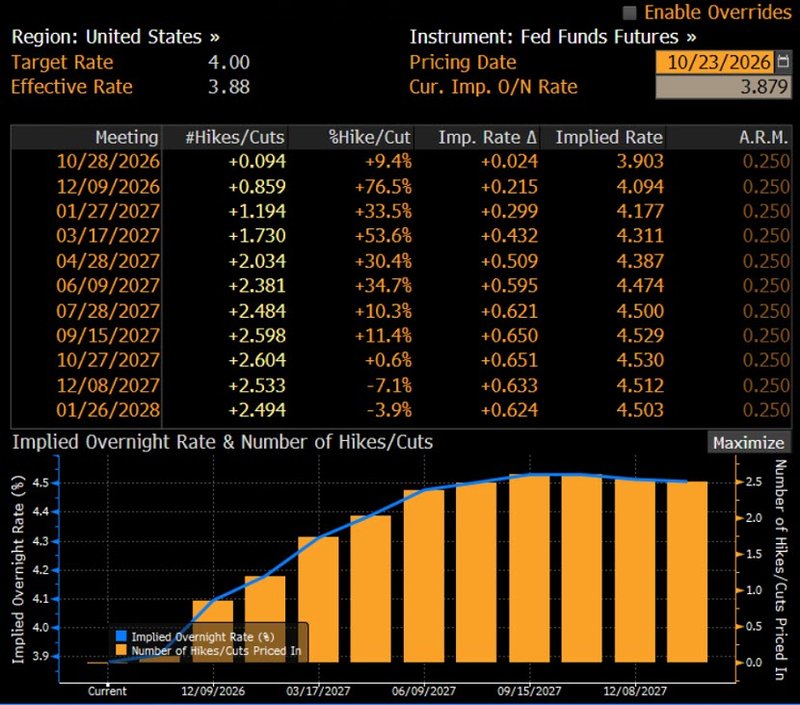
Treasuries have held gains as investors seek protection from falling stock prices, while traders have sharply reduced expectations for additional Federal Reserve tightening. Markets now assign less than a 10% probability of a quarter-point rate increase at the Fed's October 27-28 meeting.
Source: Bloomberg
Such a significant reduction in rate hike expectations would ordinarily provide support for precious metals. Gold's failure to respond positively indicates that other forces are currently dominating price action.
One explanation is the urgency of liquidity-driven selling. Investors facing losses elsewhere may prioritize raising cash over adjusting portfolios to reflect lower yields.
Another is that inflation risks remain elevated despite growing concerns about economic growth. Even if the Fed pauses, persistent price pressures could limit the scope for future rate cuts and keep real interest rates relatively restrictive.
The distinction matters for the next phase of trading. A sustained recovery in gold may require evidence that forced liquidation is easing, alongside stabilization in broader financial markets.
Oil above $113 creates another inflation problem for the Fed
The sharp increase in energy prices is adding to uncertainty about the direction of US monetary policy.
Brent crude has risen above $113 a barrel, placing it on course for a weekly gain of approximately 3%, as renewed attacks on Saudi Arabia raise concerns about further supply disruptions across the Middle East.
Iran-backed Houthi militants have claimed attacks on the Saudi Red Sea port of Yanbu, along with strikes on an oil field and an airport in the kingdom. These developments have renewed concerns over the security of regional energy infrastructure as the US-Iran conflict continues.
Higher oil prices create an uncomfortable combination for financial markets. They can increase inflation by raising transportation, manufacturing and household energy costs, while simultaneously weakening economic growth by reducing consumer purchasing power and increasing business expenses.
For the Federal Reserve, this creates a difficult policy environment. Slower economic activity and falling equity markets strengthen the argument for pausing monetary tightening. Persistent energy inflation, however, makes it harder to declare that price pressures are under control.
Gold is consequently exposed to two competing forces: weaker growth expectations that could eventually support lower interest rates, and inflation concerns that may constrain the Fed's ability to ease monetary policy.
Gold has lost more than 20% since the US-Iran war began
Perhaps the most striking feature of the recent selloff is the scale of gold's decline during a prolonged geopolitical conflict.
Bullion has fallen more than 20% since the US-Iran war began in late February, challenging the assumption that escalating military tensions automatically translate into higher gold prices.
Geopolitical uncertainty can strengthen safe-haven demand, but its impact depends on how the conflict affects the broader economy and financial system.
In the current environment, higher oil prices have reinforced inflation concerns, supporting restrictive monetary policy expectations for much of the conflict. Elevated bond yields have also increased the opportunity cost of holding bullion.
More recently, the stock-market correction has introduced a different source of pressure as investors liquidate positions to raise cash.
These developments illustrate why gold can struggle during a geopolitical crisis even while demand for financial protection remains elevated. The market is responding to the economic consequences of the conflict as well as the uncertainty surrounding it.
Gold price outlook: Why $4,000 and $3,900 matter
The decline below $4,000 brings attention to an important psychological level that could influence near-term trading.
Gold's recovery above that threshold during Friday's session suggests buyers remain willing to respond to lower prices. However, the rebound has not yet established that selling pressure has ended, particularly with equity-market volatility still elevated.
The next important downside reference is around $3,900 an ounce, a level identified by market analysts as a potentially critical test if liquidation continues.
A sustained move below $4,000 would increase the risk of another attempt to reach that area. The significance of $3,900 would depend on whether buyers absorb additional selling or whether financial-market stress continues to force investors to reduce exposure.
Conversely, a more durable recovery above $4,000, accompanied by stabilizing equities and easing liquidity pressures, would suggest that the most aggressive phase of forced selling may be moderating.
Price movements around these levels should therefore be evaluated alongside developments in Treasury yields, the dollar and broader market volatility rather than in isolation.
Silver faces additional pressure from growth concerns
Silver has also weakened, falling 1.2% to approximately $53.90 an ounce during Friday's Asian session, while platinum and palladium recorded modest gains.
Silver's decline reflects its dual role as a precious metal and an industrial commodity. Like gold, it is sensitive to interest rates and investment flows, but it also responds to expectations for manufacturing activity and industrial demand.
Concerns about the outlook for AI-related capital expenditure and global economic growth can therefore weigh on silver through an additional channel.
The broader currency backdrop has provided little immediate relief. The Bloomberg Dollar Spot Index was relatively unchanged during the session, reinforcing the view that the latest gold decline is being driven primarily by portfolio liquidation and wider financial-market uncertainty.
What could reverse the gold selloff?
Three developments will be particularly important for the next phase of the gold market.
First, stabilization in technology stocks could reduce the pressure on leveraged portfolios and limit the need to sell liquid assets. If forced selling subsides, gold may become more responsive to the recent decline in Treasury yields.
Second, developments in the Middle East will influence both oil prices and inflation expectations. An easing of risks to Saudi energy infrastructure could reduce the inflation premium in crude, potentially giving the Fed greater flexibility if economic growth continues slowing.
Third, the Federal Reserve's upcoming meeting will help clarify how policymakers are balancing persistent inflation against increasing financial-market volatility and a potentially weaker economic outlook.
A decision to leave rates unchanged would already be broadly consistent with market expectations. The more important signal would be whether the Fed views rising energy costs as a temporary shock or a threat to underlying inflation.
For gold, the relationship between financial stability and monetary policy is becoming increasingly important. Lower yields could support a recovery once liquidity pressures ease, while prolonged equity losses and persistent inflation would leave the metal vulnerable.
The immediate test is whether gold can maintain its position above $4,000 and prevent another decline toward $3,900. Beyond those levels, the direction of the market will depend heavily on whether the current selling reflects a temporary scramble for liquidity or a more persistent reduction in investor exposure to precious metals.