
 Support
 BoJ hikes rates and warns of further tightening; US housing starts decline steeply
The Bank of Japan raised interest rates to 1.0%, the highest level since 1995, and signalled the possibility of further tightening if inflation persists, particularly amid risks stemming from the Middle East. Despite the move, the Nikkei reached a record high and the yen changed little. In the United States, housing starts fell sharply, highlighting the pressure exerted by elevated mortgage costs.

The BoJ raised rates by 25 basis points to 1.0%, the highest level since 1995, and left the door open to further hikes if inflation remains elevated.
Markets reacted unexpectedly: the Nikkei rose by 0.22% to a record high, while USD/JPY remained near ¥160.40 despite tighter policy.
US housing starts fell by 15.4% in May to 1.18 million, the lowest level since May 2020, as high mortgage rates weighed on demand.
Australia’s Reserve Bank kept rates unchanged at 4.35%, citing elevated inflation and tight financial conditions, while the Australian dollar edged lower.
BoJ raises interest rates and leaves open the possibility of additional hikes
The Bank of Japan (BoJ) decided to raise its benchmark interest rate by 25 basis points, from 0.75% to 1.0%, in line with market expectations. The current level represents the highest since September 1995, signalling the potential for a significant impact on credit conditions in the Japanese economy. The Board’s decision was approved by a vote of 7 to 1, with the dissenting vote citing several risks to production and employment. In addition, policymakers stated that they could continue raising interest rates as needed, depending on economic conditions and the evolution of inflationary pressures if the conflict in the Middle East persists. Notably, the BoJ emphasised its focus on price pressures, indicating that it is not prepared to tolerate inflation remaining above its 2% target.
Following the BoJ’s monetary policy decision, the Nikkei 225 stock index rose marginally by 0.22% to 69,420 points, reaching a new record high. In turn, the Japanese yen depreciated by 0.03% against the US dollar to ¥160.40. In both cases, market reactions contrasted with what would normally be expected following a restrictive policy stance by the Japanese central bank.
US housing starts fall to a level not seen since May 2020
According to data from the US Census Bureau, housing starts recorded a sharp contraction of 15.4% in May on a monthly basis, falling to 1.18 million units—the lowest level since May 2020. The Census Bureau report indicated that elevated mortgage rates are weighing on demand for new homes, causing contractors to remain cautious about launching new projects. According to data from the Federal Reserve Bank of St. Louis, the average 30-year fixed mortgage rate in the United States reached 6.52% on 11 June. In addition, an analysis by Trading Economics indicated that multi-family starts fell by 41.6% during the period, while single-family starts declined by 1.9%, as a consequence of weaker domestic demand.
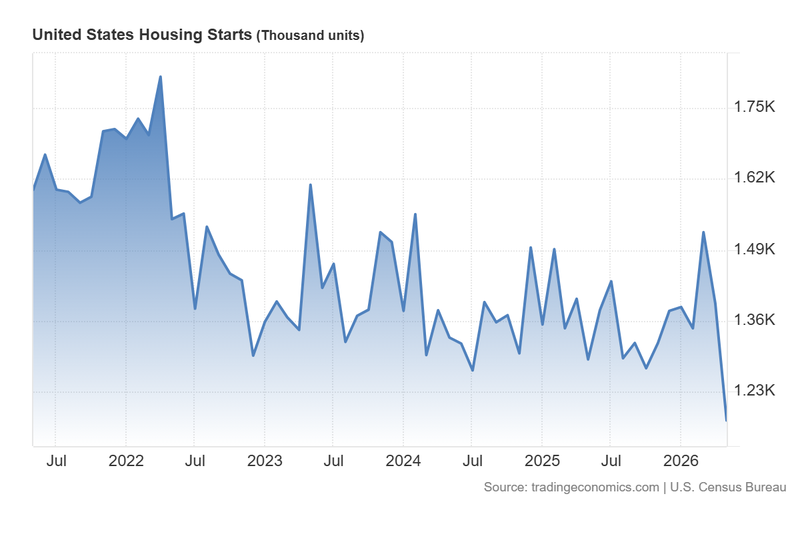
Figure 1. US Housing Starts (2021–2026). Source: Data from the US Census Bureau; figure obtained from Trading Economics.
RBA decides to keep interest rates unchanged
The Reserve Bank of Australia (RBA) decided to keep interest rates unchanged at 4.35%, in line with analysts’ expectations. The decision was unanimous, while the Board stated that financial conditions remain tight and that inflation continues to stand considerably above the central bank’s target. At present, the RBA is contending with headline inflation of 4.2% and an unemployment rate of 4.5%.
In terms of market reaction, the Australian dollar depreciated marginally against the US dollar by 0.07%, trading at $0.7065.

