
 Support
 Chinese manufacturing PMI improves; US JOLTS job openings strengthen
Chinese manufacturing PMI rose above expectations in June, signalling expansion supported by AI-related external demand, stronger orders, and improved supply conditions, despite softer employment and weak domestic demand. US JOLTS job openings unexpectedly increased, reinforcing labour-market resilience.

China’s manufacturing PMI rose to 50.3 in June, beating forecasts and remaining above the 50-point expansion threshold.
Growth was supported by AI-linked external demand, stronger production, new orders, and foreign orders, despite weaker employment.
US JOLTS job openings increased to 7.59 million, beating forecasts and signalling resilient labour demand ahead of the payrolls report.
German retail sales rebounded by 1.8% year on year and inflation eased to 2.3%, lifting the DAX 40 by 1.50%.
Chinese manufacturing activity expands above expectations
According to data from the National Bureau of Statistics of China, the manufacturing PMI advanced from 50.0 points in May to 50.3 points in June, surpassing analysts’ forecast of 50.1 points. The current PMI reading implies expansion, as it stands above the neutral 50-point threshold, and marks four months above contractionary levels. An analysis by Trading Economics suggests that the latest reading was driven by robust international demand for artificial intelligence (AI)-related products, as this sector continues to expand. In addition, production, new orders, and foreign orders reportedly increased, although employment registered a slight decline. Meanwhile, purchasing activity and supplier delivery conditions improved.
Therefore, the PMI readings suggest that the Chinese economy is undergoing a period of improvement, although domestic demand continues to show weakness. Following the economic releases, the FTSE China A50 index appreciated by 0.89% to 15,513 points. By contrast, the Hang Seng index declined by 0.47% to 22,850 points.
US labour demand remains robust
According to data from the US Bureau of Labor Statistics (BLS), JOLTS job openings—which measure new vacancies—recorded a marginal increase from 7.58 million in April to 7.59 million in May, beating the market consensus estimate, which had expected a contraction at 7.3 million. The BLS report indicated that the number of job openings increased across several sectors, including wholesale trade; accommodation and food services; and real estate, rental, and leasing. However, the health care and social assistance, as well as finance and insurance, sectors recorded contractions.
Market participants are now focused on the forthcoming BLS report due next Thursday, 2 July, when the non-farm payrolls and unemployment rate indicators will be released. As a preliminary signal, the JOLTS report points to strengthening in the labour market, although investors are awaiting complementary employment data in order to assess whether the Federal Reserve will apply more restrictive measures in upcoming meetings or adopt a more moderate stance if labour indicators show signs of weakness. At market close, the main stock benchmarks rose in tandem: the S&P 500 index increased by 0.79% to 7,499 points, the Nasdaq 100 advanced by 1.68% to 30,276, while the Dow Jones Industrial Average appreciated by 0.26% to 52,324 points.
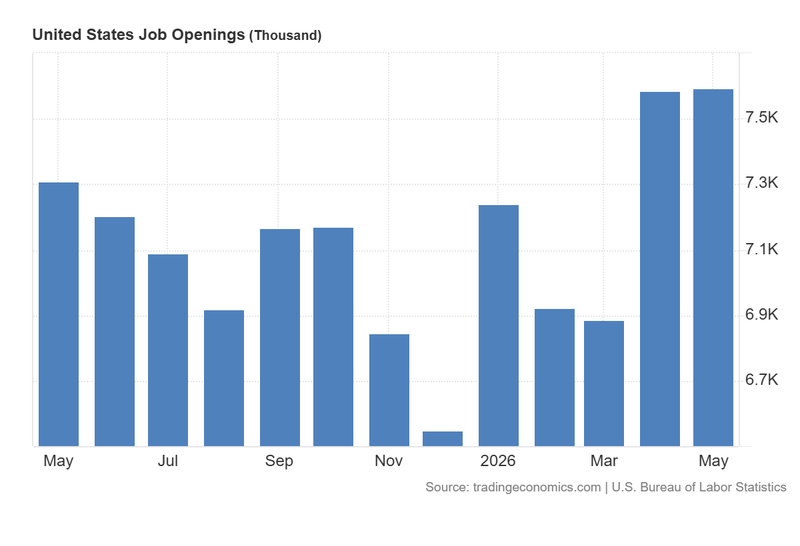
Figure 1. US Job Openings (2025–2026). Source: Data from the US Bureau of Labor Statistics; figure obtained from Trading Economics.
German retail sales increase while inflation rate decelerates
German economic indicators showed improvements in both consumption and inflation. According to data from the Federal Statistical Office of Germany, retail sales recovered from a contraction of 0.6% in April to an expansion of 1.8% in May on a year-on-year basis, surpassing analysts’ forecast of no change. Current retail sales represent the highest level since December 2025, indicating a relevant improvement in domestic consumption, which had previously remained subdued.
In addition, the Federal Statistical Office released preliminary annual inflation data showing that the inflation rate decelerated from 2.6% in May to 2.3% in June, reflecting reduced pressure on the European Central Bank (ECB), which continues to face inflationary challenges across European economies. At market close, the euro declined marginally against the US dollar, while the DAX 40 index appreciated by 1.50% to 24,995 points amid solid economic readings.
