
 Support
 Daily discussion thread for August 18, 2026
US stock markets fell as US-Iran geopolitical tensions escalated. Meanwhile, weak housing data, elevated Treasury yields, and unchanged UK unemployment figures influenced global investor sentiment.

US stocks fell as President Trump denied engaging in talks with Iran, while Tehran declared the Strait of Hormuz closed.
US housing starts dropped by 12.4% in July to 1.24 million against the backdrop of 30-year mortgage rates reaching 6.67%.
US 30-year Treasury bond yields surged to 5.31%, marking their highest level since July 2007.
UK unemployment held steady at 4.9%, while markets await the upcoming Federal Reserve meeting minutes.
Trump denies talks with Iran, while Tehran declares the Strait of Hormuz closed
According to a Reuters report, US President Donald Trump stated that no talks were taking place with Iran and that no diplomatic negotiations were scheduled. Additionally, Trump declared that the naval blockade on Iranian ports remains in force and asserted that the Strait of Hormuz remains open. Conversely, Iranian negotiator Mohammad Baqer Qalibaf stated that the Strait of Hormuz would remain closed until the US met Iran’s conditions—most notably lifting oil sanctions and the port blockade, as well as unfreezing Iranian assets.
Furthermore, a CNBC report indicated that Trump suggested the US would add a new territory in the Strait of Hormuz region, signalling renewed geopolitical frictions between the two nations despite earlier mentions of a potential peace deal.
Following this geopolitical instability, major US stock benchmarks fell in tandem. The S&P 500 index decreased by 0.69% to 7,691 points, the Dow Jones Industrial Average slipped by 0.22% to 53,348, and the Nasdaq 100 index depreciated by 1.68% to 29,490 points. This market contraction comes amid growing concerns over US national debt, as long-term government bond yields surged, with the 30-year Treasury yield reaching 5.31%—its highest level since July 2007.
Housing starts decline amid rising long-term mortgage rates
According to data from the US Census Bureau, housing starts fell sharply from 1.42 million in June to 1.24 million in July, missing analysts' expectations of 1.35 million. This represents a monthly decline of 12.4%, placing the seasonally adjusted annualised rate below the average of the past three years. This underscores the inverse correlation between housing starts and long-term mortgage rates.
Data from the Federal Reserve Bank of St. Louis (FRED) shows that the average 30-year fixed-rate mortgage reached 6.67% on 13 August, placing August as the highest level in over one year. An environment of elevated interest rates typically dampens housing demand and delays new projects, given that residential developments are long-term investments heavily reliant on debt financing. Market participants remain focused on the ongoing US-Iran conflict in the Middle East, which has triggered severe global energy supply disruptions, adding upward pressure on inflation expectations and reinforcing a potential restrictive monetary policy stance.
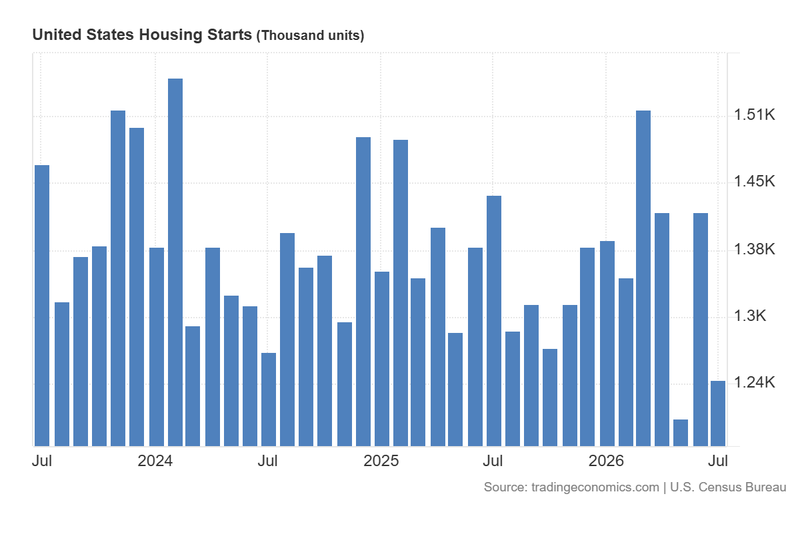
Figure 1. US Housing Starts (2023–2026). Source: Data from the US Census Bureau; figure retrieved from Trading Economics.
UK unemployment rate remains unchanged, exceeding market consensus forecast
Data from the UK Office for National Statistics (ONS) showed that the unemployment rate remained unchanged at 4.9% for the period ending in June. This result came in higher than the market consensus estimate of 4.8%, suggesting that the labour market is maintaining a neutral stance. Furthermore, employment growth decelerated from 147,000 to 83,000 over the same period, reinforcing the hypothesis of neutrality. The UK unemployment rate has now remained at this level for three consecutive months, while employment growth sits close to its six-month average.
Following the economic release, the British pound fell marginally by 0.07% to $1.3533 against the US dollar, reflecting expectations of a relatively more hawkish policy stance from the Federal Reserve compared to the Bank of England. Investors are now turning their attention to the Federal Reserve's meeting minutes, set to be published on Wednesday, 19 August.
