
 Support
 Daily discussion thread for August 28, 2026
Federal Reserve Chair Kevin Warsh indicated potential interest rate hikes to curb persistent inflation. US financial markets retreated as the US dollar strengthened, coinciding with accelerating Canadian GDP growth and a drop in Japanese unemployment.

Fed Chair Kevin Warsh signalled potential rate hikes, pushing the probability of a September rate increase to 59.7% on the CME FedWatch tool.
Major US stock indices fell, while the US Dollar Index rebounded to 99.68 points following hawkish comments from the Federal Reserve.
Canada’s Q2 2026 GDP growth accelerated to 0.8%, driven by robust exports and household expenditure.
Japan’s unemployment rate dropped to 2.4%—its lowest level in a year—as the yen depreciated further.
Fed Chair Kevin Warsh signals potential rate hikes if inflation persists
Federal Reserve Chair Kevin Warsh indicated that further interest rate hikes could be required to ease price pressures. Speaking at the Federal Reserve’s Jackson Hole Economic Symposium, Warsh emphasised that the central bank must ensure underlying inflation moves towards its target, reflecting its primary mandate—as quoted by Reuters. He added that the Federal Open Market Committee’s (FOMC) predominant focus must remain on prices, noting that whilst the labour market is stable and the economy resilient, inflation has remained above target for an extended period.
Following the Fed Chair’s remarks, the CME FedWatch tool reflected a sharp shift in market expectations. The probability of an interest rate hike at the Fed’s September meeting rose to 59.7%, up from 40.0% immediately prior to Warsh’s comments. Conversely, the implied probability of rates remaining unchanged fell to 40.3%. For the December meeting, a second rate hike emerged as the leading scenario, with an implied probability of 40.1%.
In response to the hawkish tone, major US stock benchmarks fell in tandem: the S&P 500 index dropped by 0.25% to 7,711 points, the Dow Jones Industrial Average slipped by 0.02% to 53,565 points, and the Nasdaq 100 index fell by 0.70% to 29,433 points. Meanwhile, the US Dollar Index (DXY) exhibited a significant recovery, rising by 0.55% to 99.68 points, while the 10-year US Treasury yield advanced by 5.4 basis points to 4.73%.
Canadian GDP growth rate accelerates in Q2 2026
According to data published by Statistics Canada, gross domestic product (GDP) growth accelerated from 0.1% in Q1 to 0.8% in Q2 2026, reaching its highest rate since Q3 2024. An analysis by Trading Economics indicates that this expansion was driven primarily by robust exports of metals, energy products, and industrial machinery and equipment; household expenditure on investment services, passenger vehicles, and rent; and business capital investment in engineering structures and computer products.
Consequently, despite ongoing trade and commercial pressures from the United States—particularly regarding tariffs—Canadian industry continues to demonstrate resilience.
Nevertheless, following the data release, the Canadian dollar depreciated by 0.36%, with the USD/CAD exchange rate settling at 1.3901. This movement was driven predominantly by broad US dollar strength following signals of a potential hawkish stance from the Federal Reserve should inflationary pressures persist.
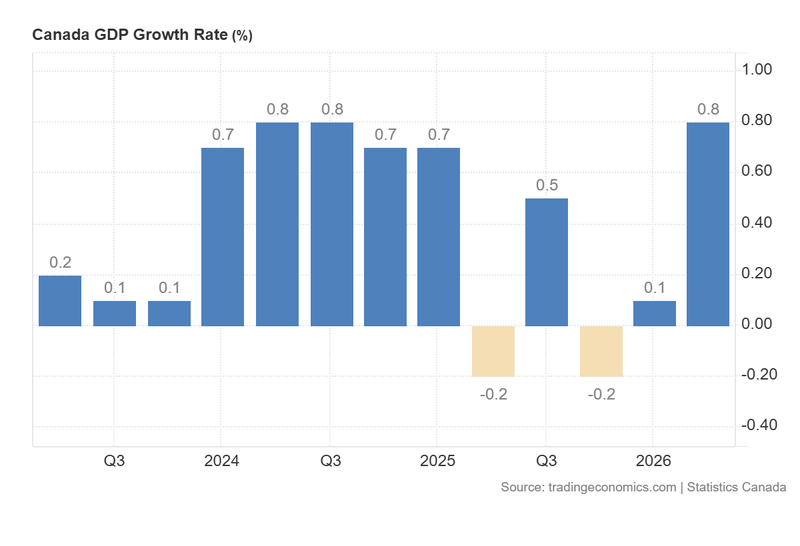
Figure 1. Canada GDP Growth Rate (2023–2026). Source: Data from Statistics Canada; chart obtained from Trading Economics.
Japanese unemployment rate decreases, defying analyst expectations
Data released by Japan’s Ministry of Internal Affairs and Communications showed that the unemployment rate fell from 2.5% in June to 2.4% in July, coming in below market consensus expectations of an unchanged rate. This represents the lowest level since July 2025 and signals continued improvement in the Japanese labour market. Additionally, the total number of unemployed individuals decreased by 80,000.
At market close, Japan's stock benchmark, the Nikkei 225, rose marginally by 0.41% to 66,405 points. Conversely, the Japanese yen depreciated against the US dollar by 0.42%, with the USD/JPY pair closing at ¥160.03. Market participants remain focused on Japan's inflation performance, which remains close to the Bank of Japan’s target (currently at 1.9%) while maintaining an upward trajectory since April. Furthermore, the US dollar gained broad momentum following Kevin Warsh’s comments.
