
 Support
 Daily discussion thread for August 7, 2026
US Non-Farm Payrolls unexpectedly contracted by 23K, lowering Federal Reserve rate-hike expectations and lifting equity markets. Concurrently, resilient Canadian labour market data and robust Chinese artificial intelligence exports highlighted selective economic stability.

US Non-Farm Payrolls contracted by 23K in July, marking the first employment decline in five months.
Lowered odds of a Federal Reserve rate hike boosted major US equity indices, led by a 1.19% gain in the Nasdaq 100.
Canadian unemployment dropped to 6.4% with 75.1K jobs added, strengthening the Canadian dollar against the US dollar.
China's trade surplus reached $112.5 billion, driven by a 23.9% surge in exports amid robust artificial intelligence demand.
US non-farm payrolls miss analysts' expectations and signal contraction
According to data released by the US Bureau of Labour Statistics (BLS), Non-Farm Payrolls (NFP) contracted by 23K in July, delivering a negative surprise compared to the anticipated addition of 80K new positions. Furthermore, the previous reading was revised downwards to 20K. This marks the first contraction in five months and reflects underlying weakness, as the indicator resumes a broader downward trend observed over the past three years.
The BLS report indicated that employment in local government education dropped by 49,600 positions, leisure and hospitality fell by 40,000, retail trade declined by 19,400, and financial activities lost 14,000 jobs—as quoted by Reuters. Conversely, the construction sector added 22,000 jobs, while manufacturing employment expanded by 5,000 positions.
However, the BLS report also showed that the unemployment rate decreased from 4.2% in June to 4.1% in July. This contrasted with the NFP contraction and suggested that the US labour sector retains elements of stability. Nevertheless, this was insufficient to sustain rate-hike expectations, which fell sharply. According to data from the CME FedWatch Tool, the market-implied probability of a 25-basis-point interest rate increase fell from approximately 54% to 44%. The dominant consensus now reflects a 56% probability that the Federal Reserve will maintain interest rates steady at the current 3.75% level during its September meeting.
Following the economic release, US equity benchmarks rose in tandem: the S&P 500 index advanced by 0.62% to 7,757 points, the Dow Jones Industrial Average increased by 0.28% to 54,042, and the Nasdaq 100 index appreciated by 1.19% to 29,722 points. Equity valuations were supported by the prospect of a lower-interest-rate environment, where corporate growth projects become more viable and market valuations face lower discount costs linked to the benchmark rate.
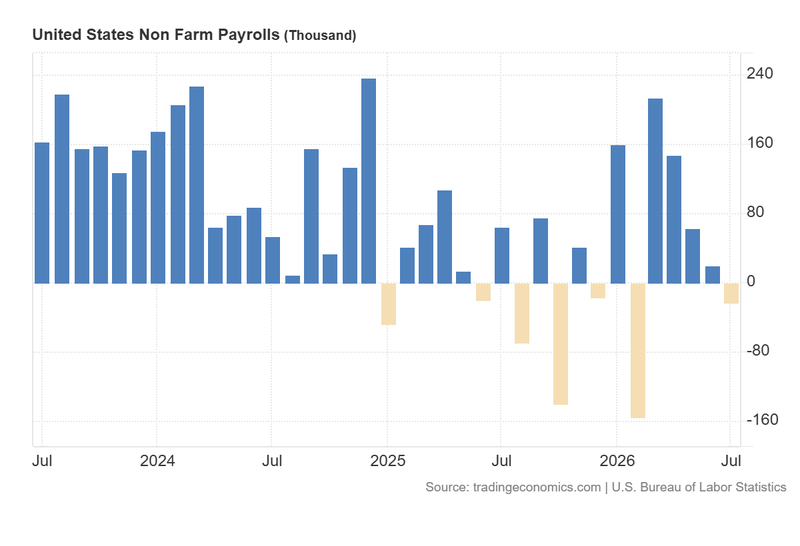
Figure 1. US Non-Farm Payrolls (2023–2026). Source: Data from the US Bureau of Labour Statistics; Figure obtained from Trading Economics.
Canadian unemployment rate exhibits a slight decrease, revealing economic resilience
According to data from Statistics Canada, the unemployment rate fell from 6.5% in June to 6.4% in July, contrasting with analyst forecasts of an unchanged reading. This represents the lowest unemployment level for Canada since July 2024. Concurrently, employment change surged from 18.2K to 75.1K during the period, comfortably exceeding the market forecast of 15K. Consequently, both metrics reflect underlying economic resilience despite broader global volatility.
At market close, the Canadian dollar appreciated firmly by 0.54% against the US dollar. The USD/CAD currency pair fell to 1.3936, influenced by diminishing expectations of a Federal Reserve rate hike as well as positive momentum in the Canadian job market.
Chinese balance of trade exceeds analysts’ estimates amid solid exports
The General Administration of Customs of China revealed a trade balance surplus of $112.5 billion, exceeding the market consensus forecast of $107 billion. This outcome was driven by robust export growth of 23.9% year-on-year, surpassing estimates of 22.2%. According to the report, strong export performance was propelled by sustained international demand for artificial intelligence (AI) related products. Conversely, while imports rose by 27.5% year-on-year, this figure came in below the projected 27.9% growth rate.
Following the trade figures release, Chinese equity benchmarks gained in parallel: the FTSE China A-50 index advanced by 0.23% to 15,079 points, while the Hang Seng index rose by 0.49% to close at 25,790 points.
