
 Support
 Daily discussion thread for October 2, 2026
Weak US non-farm payrolls boosted equity markets by cooling rate hike expectations, whilst Euro Area inflation accelerated unexpectedly to 3.8% and Japan’s unemployment rate rose slightly to 2.5%.

US non-farm payrolls slowed sharply to 29,000 as unemployment rose to 4.2%, driving record gains in the Nasdaq index.
Federal Reserve rate expectations lean towards a hold in October, with a potential 25-basis-point hike for December.
Euro Area inflation rose to a multi-year high of 3.8% in September, driven primarily by higher energy costs.
Japan’s unemployment rate increased to 2.5% amidst ongoing Bank of Japan rate hikes aimed at supporting the yen.
US non-farm payrolls decelerate sharply as unemployment rate rises; equity markets advance
According to data released by the US Bureau of Labor Statistics (BLS), non-farm payrolls eased sharply from 133,000 in August to 29,000 in September, missing analysts' forecasts of 90,000. Additionally, the BLS reported that the US unemployment rate advanced slightly from 4.1% to 4.2% over the period. Consequently, the employment report highlighted unexpected weakness in the labour market, dampening expectations of an interest rate hike at the Federal Reserve's (Fed) October meeting.
In this context, a weak employment report could raise questions for the Fed regarding how to balance its dual mandate of price stability and maximum employment. However, the BLS had reported better-than-expected figures for both non-farm payrolls and the unemployment rate in previous releases—supporting the monetary authority's assessment of a stable employment sector—which may prompt the Federal Reserve to pause in order to gather more data and recalibrate.
According to the CME FedWatch Tool, market-implied probabilities signal a 78% likelihood that the US central bank will hold its benchmark interest rate steady at the 4.00% level at its upcoming meeting. Nevertheless, indicators still mark a higher probability (68%) of a 25-basis-point interest rate increase at the December meeting, driven by persistent inflationary pressures.
The BLS employment report follows earlier data from the US Bureau of Economic Analysis (BEA) showing that the Personal Consumption Expenditures (PCE) price index—the preferred inflation metric for the Federal Reserve—remained unchanged in August at 3.4%, offering a temporary pause in inflationary pressures. However, the PCE indicator remains considerably above the Fed's 2.0% target, suggesting that the Federal Open Market Committee (FOMC) could still deliver a surprise rate hike at its October meeting to prevent a second wave of price pressures if geopolitical frictions in the Middle East persist.
Regarding market reactions, US stock benchmarks rose in tandem amidst a more favourable environment where interest rates might remain unchanged. The S&P 500 index advanced by 0.73% to 7,722 points, the Dow Jones Industrial Average increased by 0.49% to 51,182, while the Nasdaq 100 index rose by 1.00% to 30,807 points—a new record high.
Meanwhile, the US Dollar Index decreased marginally by 0.12% to 101.92 points, whereas the 10-year Treasury yield advanced by 3.2 basis points to 5.27%, suggesting that bondholders anticipate the FOMC may maintain a more restrictive stance amidst ongoing inflation pressures.
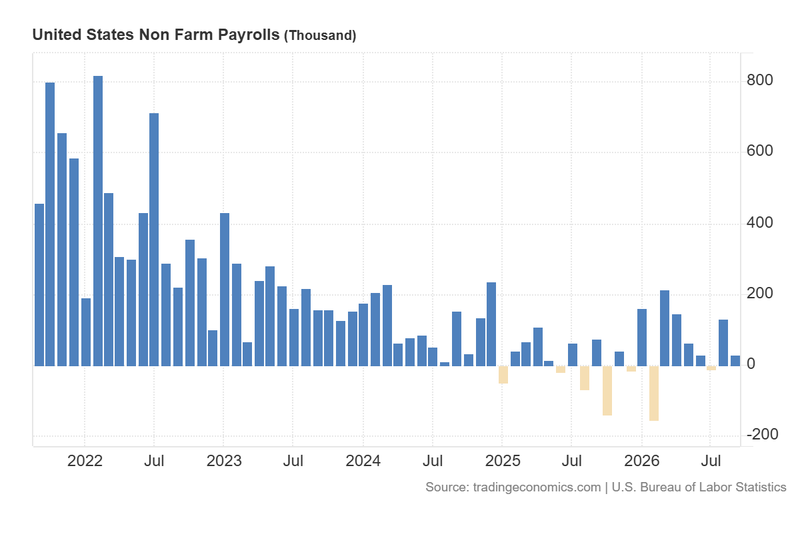
Figure 1. US Non-Farm Payrolls (2021–2026). Source: Data from the US Bureau of Labor Statistics; chart obtained via Trading Economics.
Euro Area inflation rate accelerates beyond market forecasts
Eurostat reported that the Euro Area annual inflation rate accelerated from 3.2% in August to 3.8% in September (YoY) in its preliminary assessment, overshooting the market consensus forecast of 3.6%. This represents its highest level since September 2023, indicating that inflationary pressures are gaining traction across the bloc as the current reading sits well above the European Central Bank's (ECB) 2.0% target.
Concurrently, Eurostat reported that core inflation—which excludes the volatile components of energy and unprocessed food—accelerated slightly from 2.4% to 2.5%.
An analysis from Trading Economics indicates that the surge in headline inflation was primarily driven by energy prices, which accelerated by 18.8%. Furthermore, price growth quickened in services (rising from 3.0% in August to 3.2% in September) and in unprocessed food (increasing from 2.7% to 4.0%).
Following the Eurostat inflation report, the euro appreciated by 0.11% against the US dollar, with the EUR/USD currency pair trading at $1.1250 at market close.
Japan's unemployment rate increases above analysts' expectations
Japan's Ministry of Internal Affairs & Communications reported that the unemployment rate increased from 2.4% in July to 2.5% in August, surpassing analysts' estimates of 2.4%. Nevertheless, although the uptick in unemployment reflects a modest softening in the labour market, current levels remain near decade lows.
The Japanese economy continues to display resilience, as Gross Domestic Product (GDP) growth remains positive (+0.4% in Q2), the inflation rate sits slightly below the Bank of Japan's (BoJ) 2.0% target (currently at 1.9%), and unemployment remains contained. However, the severe depreciation of the Japanese yen has raised concerns that imported costs could reignite inflationary pressures. Against this backdrop, 10-year Japanese Government Bond yields have reached multi-decade highs, prompting the BoJ to adopt a more restrictive monetary policy stance by raising its benchmark interest rate.
This tightening environment could pose headwinds for aggregate consumption and broader economic growth, although current macroeconomic drivers appear relatively well contained.
Following the Japanese unemployment report, the USD/JPY pair fell by 0.15% to ¥157.83 at market close, reflecting a modest appreciation of the yen. Conversely, the benchmark Nikkei 225 equity index declined by 0.94% to close at 68,309 points.
