
 Support
 Daily discussion thread for October 7, 2026
Federal Reserve minutes suggest a potential US interest rate hike amid persistent inflation, while the Reserve Bank of India (RBI) has raised its benchmark rate to 5.50%. Additionally, elevated borrowing costs and surging fuel prices continue to weigh on US used car demand.

The Federal Reserve has signalled a potential interest rate hike before the end of 2026, though subdued US labour data makes policy action in October unlikely.
US stock benchmarks fell following the hawkish Fed minutes, with the S&P 500 slipping 0.22% to 7,801.
The RBI raised its benchmark interest rate to 5.50% to counter headline inflation of 4.82% and a weakening Indian Rupee.
US used car prices fell by 1.1% in September as high interest rates and rising fuel costs dampened consumer demand.
Fed minutes signal potential interest rate hike amid persistent inflationary pressures
Minutes from the Federal Reserve indicate that Federal Open Market Committee (FOMC) members expect another interest rate hike before the end of the year, driven by sticky headline inflation that has remained above the central bank's 2.0% target for approximately five years. However, the document does not specify at which of the upcoming meetings a rate hike might be implemented, maintaining consistency with the Fed's stance of avoiding explicit forward guidance on future interest rates. The US central bank is scheduled to hold monetary policy meetings on 28 October and 9 December.
Furthermore, the minutes emphasise that FOMC members will continue to adopt a meeting-by-meeting approach, signalling that monetary policy decisions will remain strictly data-dependent. In this context, although the Fed's preferred inflation metric—the Personal Consumption Expenditures (PCE) Price Index—remains elevated, it held steady at 3.4% in August, somewhat alleviating immediate pressure on the central bank. Coupled with a subdued September employment report released by the Bureau of Labor Statistics, an imminent rate hike in October remains with low probability.
Against this backdrop, data from the CME FedWatch Tool reflects an 80% market-implied probability that the Fed will hold interest rates steady in October, whilst indicating a 64% probability of a 25-basis-point rate hike at the December meeting.
Following the publication of the FOMC minutes, US equity benchmarks declined in tandem: the S&P 500 index fell by 0.22% to 7,801, the Dow Jones Industrial Average dropped by 0.66% to 51,185, and the Nasdaq 100 index declined by 0.21% to 31,160 points.
Reserve Bank of India raises benchmark interest rate in line with market expectations
The Reserve Bank of India (RBI) has increased its benchmark interest rate by 25 basis points to 5.50%, matching consensus estimates. This decision marks the central bank's first rate increase since February 2023, representing a significant shift after maintaining a more accommodative monetary stance over the past two years.
The Indian central bank faces mounting pressure from headline inflation, which reached 4.82%—above the RBI's 4.0% mid-point target. This rise has been driven predominantly by surging energy prices linked to ongoing geopolitical instability in the Middle East. Simultaneously, the Indian Rupee has experienced sharp depreciation, declining by 7.5% year-to-date (YTD) against the US dollar as the Federal Reserve maintains a more restrictive monetary stance. Consequently, the RBI is taking a more restrictive policy action to curb underlying macroeconomic pressures.
However, despite the RBI's policy tightening, the USD/INR currency pair advanced by 0.42% to 96.76, indicating further daily depreciation for the Indian Rupee as the exchange rate touched a new record high.
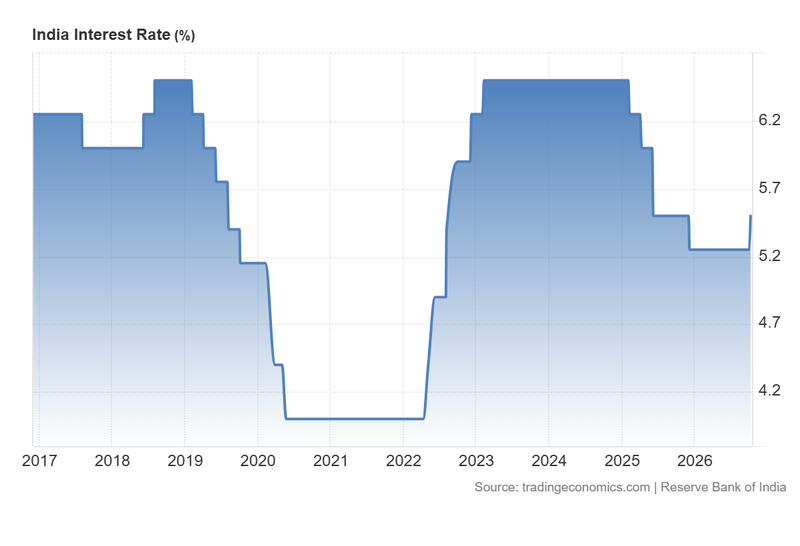
Figure 1. India Interest Rate (2016–2026). Source: Data from the Reserve Bank of India; figure obtained via Trading Economics.
US used car prices decline amid subdued demand and surging fuel costs
Reports from Manheim Consulting Inc. reveal that US used car prices fell by 1.1% in September, marking three consecutive months of contraction. Consequently, year-on-year used car prices declined by 0.6%, representing their first annual contraction since March 2025. This shift coincides with rising demand for electric vehicles, as elevated fuel prices continue to strain household finances across the US.
Furthermore, US consumer sentiment has deteriorated amidst higher Federal Reserve interest rates, which have driven up consumer credit costs—particularly for major purchases such as motor vehicles. In this environment of subdued demand, it is possible that sellers and dealership owners are being forced to lower prices to attract buyers.
