
 Support
 Daily discussion thread for October 8, 2026
Crude oil prices surged amid concerns over a prolonged Middle East conflict, while US mortgage rates reached a three-year high of 7.40%. Meanwhile, Germany’s trade surplus narrowed following a contraction in exports.

Crude oil futures rallied following comments from US President Donald Trump stating that no US attacks on Iran would occur prior to the mid-term elections.
Persistent Middle East tensions continue to fuel concerns over maritime oil transport through the Straits of Hormuz and Bab el-Mandeb.
Average US 30-year fixed mortgage rates surged to 7.40%, straining housing demand as inflationary fears persist.
Germany’s trade surplus fell to €19.5 billion in August after exports contracted by 0.8% month-on-month.
Oil prices advance as US President Donald Trump signals no attack on Iran prior to mid-term elections
Crude oil benchmarks surged in tandem following comments from US President Donald Trump regarding the ongoing conflict with Iran. According to reports by Reuters, the US President stated that Washington will not launch military strikes against Iran prior to November's mid-term congressional elections.
Although Trump signalled that both nations are engaged in productive discussions regarding a potential resolution, energy traders pushed crude prices higher on the likelihood that the conflict could persist for at least another month. By the end of October, the US–Iran conflict will have reached its eighth month, continuing to exert upward pressure not only on energy prices, but also on fertiliser and food costs.
Against this backdrop, heightened regional tensions across the Middle East sustain concerns over persistent oil supply disruptions across two critical maritime logistical corridors: the Bab el-Mandeb Strait and the Strait of Hormuz. On the one hand, the Houthi movement maintains an active confrontation with Saudi Arabian and Yemeni government forces. According to a Reuters report, Houthis launched strikes targeting Saudi Arabian airspace and oil facilities following an offensive by Yemeni government forces—backed by Saudi Arabia—aimed at reclaiming territory.
On the other hand, Iran has warned of potential actions targeting commercial vessels attempting to navigate the Strait of Hormuz, generating severe security concerns for oil tankers operating amidst heightened regional instability.
Following these geopolitical developments, Brent crude futures (BRN) jumped by 4.07% to $104.28 per barrel, whilst West Texas Intermediate (WTI) futures (CL) advanced by 3.72% to $91.50 per barrel.
US 30-year average mortgage rate reaches 7.40%, hitting a three-year high
Data from mortgage aggregator Freddie Mac, published via the Federal Reserve Bank of St. Louis (FRED) portal, indicates that the average 30-year fixed-rate mortgage in the United States has reached 7.40%, a level not recorded since November 2023. This rise reflects heightened expectations among bondholders that the Federal Reserve could adopt a more restrictive policy stance amid persistent inflationary pressures, given that mortgage rates are strongly anchored to long-term government bond yields.
In this context, the housing market faces an increasingly challenging outlook as borrowing costs escalate for US households seeking to purchase residential property. Since reaching a low in February, fixed mortgage rates have risen by 142 basis points, exhibiting a strong correlation with the broader Middle East conflict that has driven energy prices upwards. Consequently, key housing market indicators have demonstrated significant deterioration in recent months as mortgage rates rise and residential demand is suppressed.
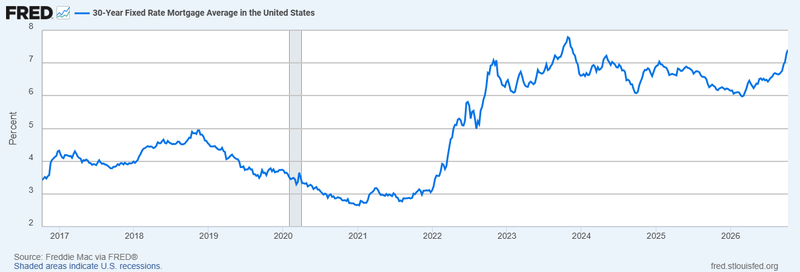
Figure 1. Freddie Mac, 30-Year Fixed Rate Mortgage Average in the United States (2016–2026). Source: Chart retrieved from FRED, Federal Reserve Bank of St. Louis.
German trade surplus narrows following monthly contraction in exports
Data released by the Federal Statistical Office of Germany reveals that the trade surplus narrowed from €21.6 billion in July to €19.5 billion in August, driven by a contraction in export volumes. Information analysed by Trading Economics indicates that German exports fell by 0.8% month-on-month to €137.6 billion, whilst imports rose by 0.9% to €118.1 billion. Nevertheless, despite the slight decline, the balance of trade remains comfortably in surplus territory. Notably, the report highlights expanding bilateral trade flows with China and the United Kingdom, whereas trade volumes with the United States contracted.
Following the economic release, Germany's benchmark DAX 40 index fell by 1.18% to 24,806 points amidst rising inflationary concerns driven by higher energy prices. These dynamics have reinforced expectations that the European Central Bank (ECB) could adopt a tighter policy stance in upcoming monetary policy decisions. Conversely, the euro appreciated by 0.13% against the US dollar.
