
 Support
 Daily discussion thread for September 1, 2026
US air strikes on Iran have driven crude oil prices higher, intensifying global inflationary risks. Concurrently, German retail sales declined sharply, while key US manufacturing and labour market data indicated moderating economic growth.

US air strikes on Iran pushed Brent crude above $94 per barrel, elevating geopolitical risk premiums.
German July retail sales dropped sharply to five-year lows, pressuring both the DAX 40 index and the euro.
US manufacturing PMI and JOLTS job openings missed consensus expectations, yet signalled underlying economic stability.
US launches new attacks on Iranian territory; oil prices increase
Oil prices surged following escalating tensions between the United States and Iran in the Middle East. At market close, the Brent crude futures contract (BRNX6) advanced by 4.60% to $94.65 per barrel, while the West Texas Intermediate (WTI) futures contract (CLV6) increased by 5.29% to $90.24 per barrel.
According to reports by Reuters, the US launched new air strikes on Iranian territory, generating a sharp escalation in the conflict and heightening concerns over potential energy supply disruptions. In response, Iranian officials warned that Tehran would act to prevent oil exports from the Gulf—a development that could compound inflationary pressures for the US as market participants digest the implications of renewed escalation and a prolonged conflict. Currently, both nations have indicated that further military actions could be deployed imminently amidst the bilateral confrontation.
Consequently, both the US and Iran demonstrate the capability to sustain the conflict despite severe underlying repercussions. On the one hand, the US economy is grappling with persistent inflation within a complex fiscal environment where national debt has breached the $40 trillion threshold. Elevated debt combined with high interest rates creates a challenging scenario in which net interest payments increasingly complicate the federal fiscal deficit. As long as inflationary pressures persist, the Federal Reserve will be unable to lower interest rates, causing net interest costs to escalate over time.
On the other hand, the Iranian economy has been severely impaired by six months of ongoing military engagements. This environment has caused substantial damage to Iranian infrastructure and citizens alike. According to data from the Statistical Centre of Iran, headline inflation reached 87.9%—its highest zone in around ten years, as reported by Trading Economics. As a result, both business confidence and domestic consumption have contracted significantly in recent periods.
German retail sales register lowest performance since July 2021
Data released by the Federal Statistical Office of Germany reveals that retail sales experienced a sharp month-on-month contraction in July, marking their weakest performance in five years. The latest reading fell well below the market consensus forecast of a 0.4% increase, driving a severe decline in year-on-year (YoY) retail performance to -2.5%. Consequently, the year-on-year figure reached its lowest level since September 2023.
An analysis by Trading Economics indicates that the contraction was primarily driven by a 5.6% drop in online and mail-order sales, alongside a 4.8% decline in non-food retail sales.
Following the economic release, Germany’s benchmark DAX 40 index fell by 1.10% to 25,970 points, while the EUR/USD currency pair depreciated by 0.26% to $1.1589. As Germany remains the largest economy in the European Union, macroeconomic weakness in the country exerts notable downward pressure on the single currency.
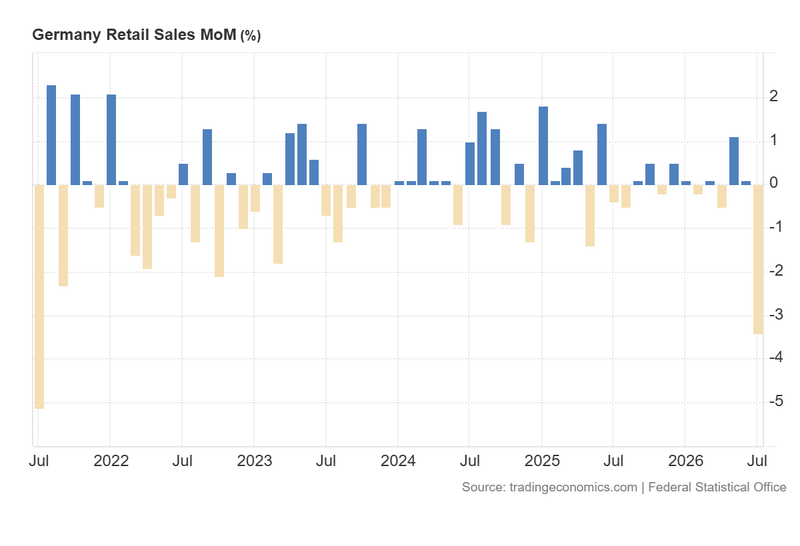
Figure 1. Germany Retail Sales MoM (2021–2026). Source: Data from the Federal Statistical Office of Germany; chart obtained from Trading Economics.
US manufacturing PMI moderates; JOLTS job openings miss expectations
US macroeconomic data fell short of analysts' expectations while continuing to reflect underlying stability. On the one hand, the Institute for Supply Management (ISM) reported that the manufacturing PMI decreased from 55.6 in July to 54.6 points in August, missing the consensus forecast of 55.2 points. Nevertheless, although the reading missed estimates, the index remained firmly in expansionary territory above the 50-point threshold, marking its eighth consecutive month of growth.
On the other hand, data from the US Bureau of Labor Statistics revealed that JOLTS job openings rose from 7.182 million in June to 7.271 million in July, below the expected 7.300 million. Although the figure fell short of forecasts, it nevertheless represents a net expansion in labour demand. The US employment sector has maintained stability over recent quarters despite signals of broader deceleration. While not optimal, this level of resilience allows the Federal Reserve to view the labour market as adequately stable, enabling policymakers to remain focused primarily on curbing inflationary pressures.
