
 Support
 Daily discussion thread for September 14, 2026
Federal Reserve Chair Kevin Warsh faces mounting pressure from persistent US inflation and escalating debt concerns. Concurrently, intensifying geopolitical tensions in the Middle East have pushed Brent crude past $105 per barrel, causing disruption across global financial markets.

Headline US inflation at 3.4% alongside surging energy prices has driven the market-implied probability of a Fed interest rate hike this week to 92%.
Benchmark 10-year US Treasury yields touched 5.0% for the first time in three years amidst heavy selling pressure.
Houthi territorial gains near the Bab el-Mandeb Strait propelled Brent crude past the $105 per barrel mark.
Canadian inflation held at 3.0% in August, maintaining measured policy pressure on the Bank of Canada.
Fed Chair Kevin Warsh under pressure from elevated inflation and debt concerns
Federal Reserve Chairman Kevin Warsh finds himself caught between opposing economic and political pressures. On the one hand, persistent energy price spikes are driving the headline inflation rate considerably above the central bank's 2.0% target—currently standing at 3.4%, while the Personal Consumption Expenditures (PCE) price index sits at 3.7%. On the other hand, the US administration is advocating for lower interest rates, as historic national debt levels generate substantial net interest outlays that continue to exacerbate the federal fiscal deficit.
Although elevated debt levels are dampening investor confidence and generating severe fiscal concerns, the Federal Reserve's primary mandate remains inflation containment. In this context, market participants are subjecting the central bank's policy independence to heightened scrutiny. This factor is particularly crucial for US bond market participants: should the central bank fail to prioritise inflation control, bondholders could respond with sharp selling pressure driven by fears of higher political instability in the country.
Currently, the CME FedWatch Tool reflects a 92% market-implied probability of an interest rate increase at the Federal Open Market Committee (FOMC) meeting on 16 September. Nevertheless, how the committee will navigate these competing pressures remains uncertain. During today's trading session, 10-year US Treasury yields reached 5.0% for the first time in approximately three years, signalling that bondholders are pricing in a more restrictive monetary policy stance.
Notably, the central bank is scheduled to update its Summary of Economic Projections, which should offer market participants clearer insight into the Fed's medium-term outlook and future policy trajectory—notwithstanding Chair Warsh's explicit stance against providing formal forward guidance. Furthermore, investors will closely examine Warsh's post-meeting press conference to gauge how the new Chairman intends to navigate this complex backdrop while leading an FOMC that may be increasingly divided given broader US economic and political instability.
Houthis gain territory amid intensifying Middle East tensions; oil prices advance
Global crude prices advanced following heightened conflict near the Bab el-Mandeb Strait—a crucial maritime corridor for energy logistics. According to reports from Reuters, a new attack launched by the Houthi group on Saudi Arabian territory prompted Gulf Arab states to postpone scheduled diplomatic talks with Iran. In addition, Houthi forces have seized control of key sections of Yemen's Red Sea coastline and Perim Island, reinforcing their influence in the region.
Against this backdrop, market participants are exhibiting growing concern over sustained disruptions to energy supply chains. Should transit flows remain constrained through both the Bab el-Mandeb Strait and the Strait of Hormuz, crude markets could face renewed buying pressure that may drive energy prices higher and exacerbate global inflationary pressures.
At the market close, US equities fell in tandem, while global crude benchmarks recorded gains amidst volatile trading. Brent crude futures appreciated by 1.02% to settle at $105.68 per barrel, whilst West Texas Intermediate (WTI) futures rose 1.33% to finish at $101.35 per barrel.
Canadian inflation holds steady, matching analysts' forecasts
Data released by Statistics Canada reveals that Canada's annual headline inflation rate held steady at 3.0% in August, matching consensus expectations. While this reading remains above the Bank of Canada's (BoC) 2.0% target, it sits at the upper limit of its 1.0% to 3.0% target control range. Meanwhile, core inflation—which excludes volatile energy and unprocessed food items—accelerated slightly from 2.3% to 2.4%, remaining close to the central bank's target.
Analysis from Trading Economics indicates that elevated inflation continues to be driven primarily by sustained energy price pressures. However, gasoline inflation moderated slightly, easing from 25.7% in July to 22.8% in August. Under these conditions, the Bank of Canada may adopt a more neutral posture while awaiting further clarity on how Middle Eastern geopolitical developments unfold.
Following the economic release, the Canadian dollar depreciated against the US dollar, weighed down by the expected inflation reading and rising market expectations of a hawkish Federal Reserve. At market close, the USD/CAD currency pair traded near 1.3900.
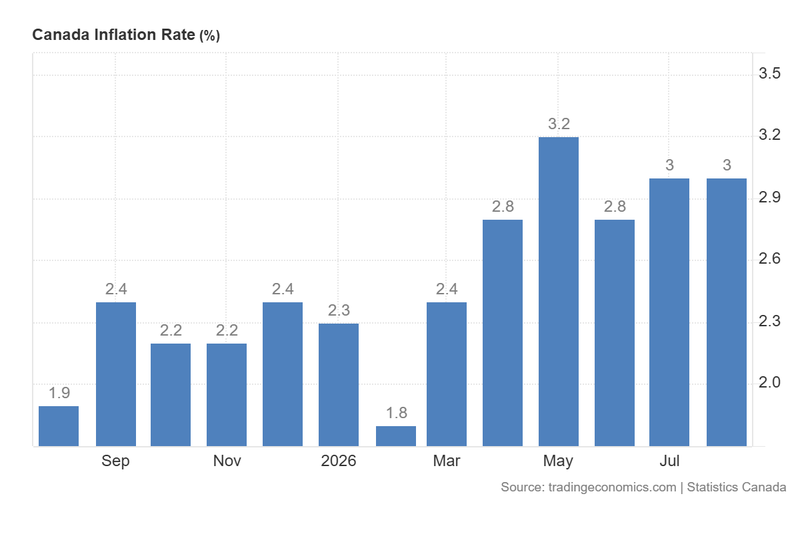
Figure 1. Canada Inflation Rate (2025–2026). Source: Data from Statistics Canada; chart obtained via Trading Economics.
Key economic events this week
Several critical economic indicators are scheduled for release this week, with the following of particular importance to market participants:
Monday
- Canada: Inflation Rate
- India: Inflation Rate
Tuesday
- China: Industrial Production
- China: Retail Sales
- United Kingdom: Unemployment Rate
- Germany: ZEW Economic Sentiment Index
- Japan: Balance of Trade
Wednesday
- United Kingdom: Inflation Rate
- European Union: Industrial Production
- US: Retail Sales
- US: EIA Crude Oil Stocks Change
- US: Fed Interest Rate Decision
- US: FOMC Economic Projections
Thursday
- United Kingdom: BoE Interest Rate Decision
- US: Building Permits
- Japan: Inflation Rate
Friday
- Japan: BoJ Interest Rate Decision
- United Kingdom: Retail Sales

