
 Support
 Daily discussion thread for September 3, 2026
Expectations of a Federal Reserve rate hike eased following dovish comments from US officials, fuelling a rally across major US equity indices, while robust ISM services PMI data signalled underlying economic strength.

The CME FedWatch Tool indicates that the implied probability of a September Fed rate hike fell to 50.5%, down from nearly 60%.
Comments from Vice President JD Vance generated concerns regarding central bank autonomy.
Major US equity indices rose by over 1%, as reduced rate-hike expectations boosted broad market sentiment.
US Services PMI reached 55.4 in August, outperforming forecasts and marking its highest level since February 2026.
Fed rate hike expectations ease following dovish comments from US officials
Expectations surrounding a potential interest rate hike at the Federal Reserve’s upcoming September meeting have softened. According to the CME FedWatch Tool, the market-implied probability of a rate increase ahead of the central bank's monetary policy decision dropped to 50.5%, down significantly from recent days when the likelihood hovered near 60%. Conversely, the probability of rates remaining unchanged rose to 49.5%. The Federal Reserve is scheduled to deliver its monetary policy decision on 16 September, with market participants closely monitoring the forthcoming employment and inflation reports to be released by the Bureau of Labor Statistics in the coming days.
This shift in sentiment followed dovish remarks from key US officials. According to reports from Reuters, Federal Reserve Governor Christopher Waller stated that he would support maintaining interest rates at current levels if inflation continues to decelerate. While these comments bolstered neutral expectations, his stance remains contingent upon upcoming economic data, notably the BLS inflation report scheduled for release on 11 September.
Concurrently, US Vice President JD Vance remarked that the Federal Reserve should cut interest rates to make housing more affordable, as quoted by CNBC. He added that "it would be nice to have some help from the Fed" amid a complex environment of government debt in the United States. While these comments could be interpreted as a call for constructive cooperation between the US administration and the central bank, they implicitly exert pressure to adopt a more accommodative stance, notwithstanding the Federal Reserve's primary mandate of inflation containment. Consequently, these statements may be interpreted as challenging the Fed’s institutional independence. In this context, upcoming employment and inflation metrics assume heightened critical importance ahead of the central bank's next meeting.
Following the officials' comments, US equity benchmarks rallied in tandem amid expectations of a monetary policy pause: the S&P 500 index advanced by 1.06% to 7,747 points, the Nasdaq 100 index gained 1.16% to reach 29,482, while the Dow Jones Industrial Average rose by 1.18% to 53,691 points.
US services PMI accelerates beyond analysts' forecasts
Data released by the Institute for Supply Management (ISM) showed that the US Services PMI accelerated from 54.1 in July to 55.4 points in August, surpassing the market consensus forecast of 54.3 points. This underscores the underlying resilience of the service sector, which has remained predominantly in expansionary territory in recent years. From a historical perspective, the current reading represents the highest level since February 2026, demonstrating robust sector performance. The ISM report signalled month-on-month gains across most sub-components, led by inventories, order backlogs, and imports.
Consequently, the encouraging PMI reading injected further optimism into US equity markets, which appreciated substantially amid waning expectations that the Federal Reserve could implement a more restrictive stance.
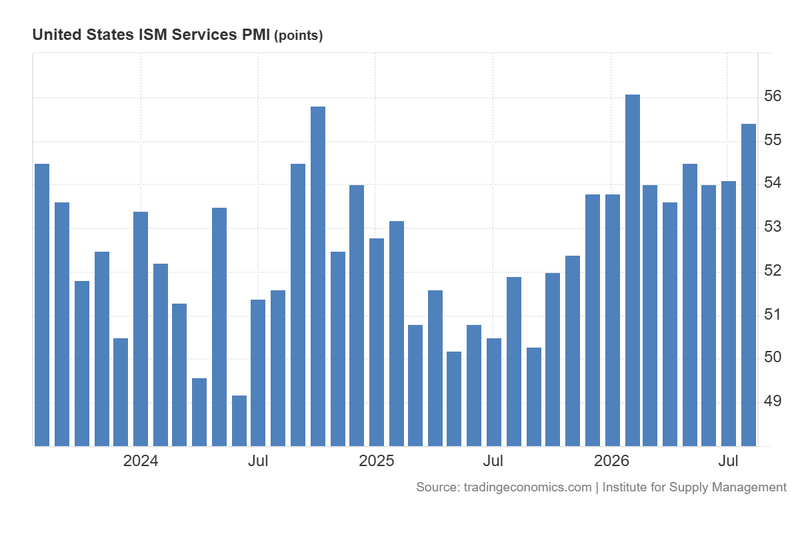
Figure 1. US ISM Services PMI (2023–2026). Source: Data from the Institute for Supply Management; chart retrieved from Trading Economics.
European Union PPI rises above market expectations
According to data published by Eurostat, the Producer Price Index (PPI) in the European Union advanced by 1.6% month-on-month in July, exceeding analysts' estimates of 1.2%. On an annual basis, headline PPI accelerated from 4.6% in June to 5.8% in July, highlighting underlying cost pressures for European firms. An analysis by Trading Economics indicates that the monthly surge in PPI was predominantly driven by energy costs, which escalated by 5.6% due to a sharp rise in European natural gas benchmark prices.
Following the Eurostat release, the EUR/USD currency pair rose firmly by 0.32% to $1.1625, driven by inflationary pressures from producer prices as well as broad-based weakness in the US dollar amid reduced expectations of a Federal Reserve rate hike.
