
 Support
 Fed turns hawkish, lifting US dollar and bond yields as stocks slide
The Federal Reserve kept interest rates unchanged at 3.75% but adopted a more hawkish tone, lifting the dollar and Treasury yields while equities declined. Updated projections pointed to weaker growth, higher inflation, and lower unemployment. Strong retail sales signalled resilience, while a sharp draw in oil inventories reinforced concerns over energy supply and inflation risks.

The Federal Reserve left rates unchanged at 3.75% but struck a hawkish tone, with markets pricing in the possibility of a 25-basis-point increase by September.
Updated projections lowered 2026 GDP growth to 2.2% and raised PCE inflation to 3.6%, underscoring slower growth and more persistent inflation.
Markets reacted defensively: the DXY rose by 0.87%, 10-year Treasury yields climbed to 4.49%, while the S&P 500, Dow Jones, and Nasdaq all declined.
Retail sales exceeded forecasts, but an 8.26 million-barrel draw in crude inventories highlighted strong demand, tight supply, and ongoing inflation risks.
Federal Reserve adopts a hawkish stance, boosting the dollar and yields while equities decline
The Federal Reserve decided to leave interest rates unchanged at the 3.75% level, although the tone it adopted was predominantly restrictive. At the same time, the central bank published updated economic projections showing several adverse effects associated with the conflict in the Middle East. On the one hand, the outlook for real GDP growth at the end of 2026 was revised downwards from 2.4% in the March estimate to 2.2% in the latest projection. In addition, the PCE inflation estimate increased sharply from 2.7% in the previous forecast to 3.6% in the update. Meanwhile, core PCE rose from 2.7% to 3.3%. By contrast, the only indicator showing an improvement was the unemployment rate, which was revised down from 4.4% to 4.3% in the current estimate.
Regarding the future path of interest rates, the new Chairman of the Federal Reserve, Kevin Warsh, emphasized that he would not provide forward guidance on the central bank’s next moves. In his view, it is inappropriate for financial markets to base their expectations on what could be perceived as central bank signalling. Another notable feature of the Fed’s new leadership was the more concise and less detailed nature of the policy statement compared with previous communications. This may suggest a deliberate reduction in the amount of information provided to financial markets regarding the likely direction of future policy decisions.
Consequently, according to CME Group’s FedWatch Tool, market-implied probabilities shifted meaningfully. Although the central bank is still expected to keep interest rates unchanged at the July meeting, the September meeting now shows a majority implied probability of 45% for a 25-basis-point increase to the 4% level.
In terms of market reaction, US equity benchmarks fell in tandem: the S&P 500 declined by 1.21%, the Dow Jones Industrial Average fell by 0.99%, and the Nasdaq 100 depreciated by 0.97%. In turn, the 10-year Treasury yield rose by 4.7 basis points to 4.49%. Meanwhile, the US dollar index (DXY) advanced by 0.87% to 100.38 points.
US retail sales rise firmly, above analysts’ expectations
According to data from the US Census Bureau, retail sales accelerated markedly from 4.8% in April to 6.9% in May on a year-on-year basis, reaching their highest level since January 2023. This move was driven by a 0.9% month-on-month increase in retail sales, above the previous reading of 0.4% and higher than analysts’ estimate of a 0.5% rise.
The acceleration in retail sales points to the continued strength and resilience of US consumption. According to a Reuters report, the strength in retail sales is largely explained by tax refunds, the rebound in the stock market, and the use of savings, all of which have supported consumer spending—particularly spending driven by higher-income households. However, it is important to note that inflationary pressures remain in place and that the savings rate has been trending lower over the past two years, which could imply a rebound in saving and weaker consumption if economic conditions become more challenging.
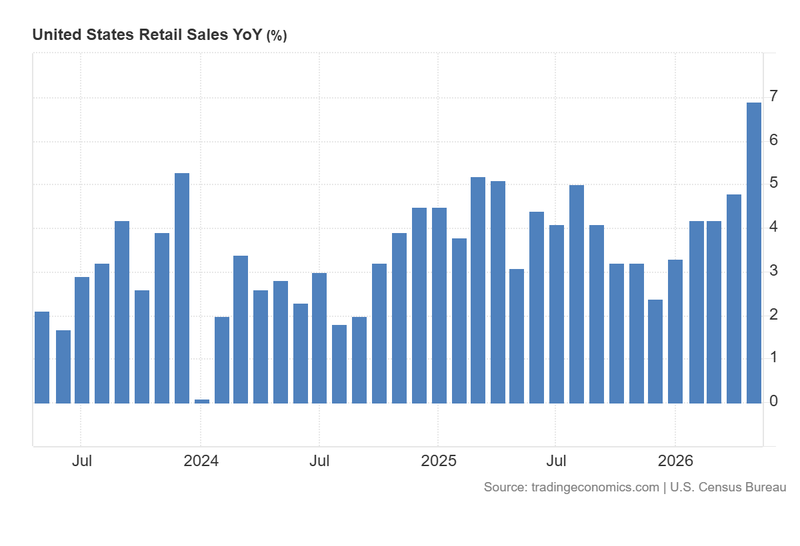
Figure 1. US Retail Sales (2023–2026). Source: Data from the US Census Bureau; figure obtained from Trading Economics.
EIA reports a sharp drop in crude oil inventories, exceeding market expectations
According to data from the US Energy Information Administration (EIA), crude oil inventories declined sharply in the latest weekly assessment by 8.26 million barrels, a steeper contraction than analysts had expected, with consensus pointing to a fall of 4.6 million barrels. The latest decline is the strongest since the second week of February 2026 and marks the eighth consecutive week of inventory contraction.
While the sustained decline in inventories reflects higher demand for crude oil—both domestic and international—as a result of supply-chain disruptions in the Middle East, it also points to a significant reduction in US strategic reserves, which could lead to a supply imbalance if inventories continue to fall steadily and sharply.

