
 Support
Oil rises on Middle East risks; UK retail sales weaken while Canadian sales improve
Crude oil prices surged amid fears of supply disruptions in the Middle East, while retail performance diverged between the United Kingdom and Canada.

Escalation concerns and strikes on Saudi infrastructure pushed Brent crude to $116.72 per barrel.
October marked a peak in maritime shipping attacks in the Strait of Hormuz, heightening risks to crude supply disruptions.
UK retail sales fell by 0.4% month-on-month in September, putting downward pressure on the British pound.
Canadian retail sales expanded by 0.7% month-on-month, strengthening year-on-year growth despite persistent inflation.
Date: 24 October 2026 (GMT+3)
Oil prices increase amid Houthi attacks on Saudi infrastructure
Oil prices jumped amidst renewed concerns regarding further energy supply disruptions in the Middle East as tensions between Houthi forces and Saudi Arabia persist. The Brent crude futures contract (BRN) surged by 3.14% to $116.72 per barrel, marking its highest closing level since June 2022.
Houthi attacks on Saudi Arabian territory have intensified, targeting key energy infrastructure. Notably, Saudi Aramco ordered the evacuation of its Dhahran headquarters during the week following facility damage attributed to Houthi strikes.
Against this backdrop, although energy flows have recovered to near-pre-conflict levels following the outbreak of US–Israel–Iran hostilities in February, October has proved to be the most severe month for commercial shipping attacks in the Strait of Hormuz, according to reports by Reuters. This escalation has driven crude prices higher, as energy exporters face ongoing uncertainty regarding a resolution that could restore normal export volumes.
Meanwhile, despite US President Donald Trump stated that Washington will not launch strikes against Iran prior to the upcoming mid-term elections, media reports indicate the possibility of a coordinated military operation involving the US and Israel following that period. Conversely, two senior Iranian security officials told Reuters that Tehran would target undersea communications cables in the Persian Gulf should military hostilities resume.
Consequently, persistent geopolitical friction continues to heighten market fears that the regional conflict is more likely to escalate further than achieve near-term stabilization.
UK retail sales ease considerably, missing analysts' expectations
According to data released by the UK's Office for National Statistics (ONS), retail sales volumes fell by 0.4% month-on-month in September, exceeding the 0.1% contraction anticipated by consensus forecasts. Consequently, year-on-year (YoY) retail sales growth slowed sharply from 2.7% in August to 0.8% in September, missing the market estimate of a 1.0% increase. Crucially, this deceleration represents a notable disruption to the broader upward trajectory that year-on-year retail sales had maintained over the past three years.
Following the ONS release, the British pound weakened against the US dollar by 0.15%, reflecting market concern over fragile UK domestic consumption. By the market close, the GBP/USD currency pair traded near $1.3372.
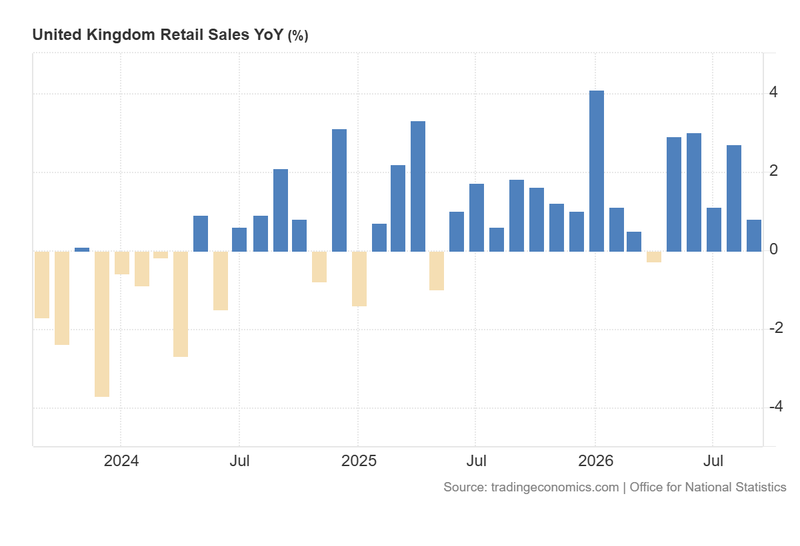
Figure 1. UK Retail Sales (2023–2026). Source: Data from the Office for National Statistics; figure retrieved via Trading Economics.
Canadian retail sales accelerate, demonstrating economic resilience
Data published by Statistics Canada reveals that monthly retail sales expanded by 0.7% in September, driving an acceleration in year-on-year growth to 5.4%, compared to 5.1% in August. This performance marks the strongest reading in three months and reinforces the positive trend observed over the past three years. In this context, the Canadian economy continues to demonstrate underlying resilience, even as inflationary pressures re-emerge as a key macroeconomic concern. The annual inflation rate currently stands at 3.1%, operating slightly above the Bank of Canada's 1.0% to 3.0% target control range.
Despite the acceleration in retail turnover, the USD/CAD currency pair fell marginally by 0.03% to 1.4002, reflecting modest underlying strength in the Canadian dollar.
