
 Support
 Oil rises on persistent geopolitical risks; Yen hits four-decade low
Oil prices rebounded as persistent US–Iran tensions kept supply risks elevated, despite talks over a possible interim agreement in Doha focused on the Strait of Hormuz. Meanwhile, the yen hit a forty-year low near ¥161.90, as Fed–BoJ policy divergence, higher energy costs, and dollar demand continued to pressure Japan’s currency.

Brent rose by 1.80% to $73.91 and WTI gained 2.21% to $70.73, as Middle East supply risks supported oil prices.
US–Iran tensions persisted, although technical teams may meet in Doha to discuss the Strait of Hormuz and possible de-escalation measures.
Israel–Lebanon peace efforts remain fragile, as Hezbollah has rejected disarmament, keeping regional risks elevated.
USD/JPY reached ¥161.90, its highest level since 1986, driven by Fed–BoJ rate differentials, energy costs, and dollar demand.
Persistent geopolitical tensions drive a short-term recovery in oil prices
Geopolitical tensions between the United States and Iran remain elevated. Several reports indicated that both sides exchanged attacks over the weekend following Iran’s targeting of a cargo vessel on Thursday, while hostilities between Israel and Hezbollah also persisted. Nevertheless, Reuters reported that Iranian and US technical teams may pursue an interim agreement aimed at containing further escalation. According to the report, a meeting could take place in Doha later this week, with discussions expected to focus on the management of the Strait of Hormuz and broader efforts to reduce regional tensions.
Reuters also reported that Israel and Lebanon have agreed to a US-mediated framework intended to support a lasting peace arrangement. The proposal would allow Israeli forces to remain in southern Lebanon until Hezbollah is disarmed. However, Hezbollah has rejected any suggestion that it would surrender its weapons, highlighting the significant obstacles that remain to achieving a comprehensive settlement. The security situation in Lebanon continues to be a key consideration in broader regional negotiations involving Iran, contributing to ongoing uncertainty over the prospects for a lasting ceasefire.
Against this backdrop, the main oil benchmarks moved higher. Brent crude futures (BRNU6) rose by 1.80% to $73.91 per barrel, while West Texas Intermediate (WTI) futures (CLQ6) gained 2.21% to $70.73 per barrel, as investors assessed the potential risks to energy supplies stemming from continued geopolitical instability in the Middle East.
Japanese yen reaches a forty-year low
The Japanese yen fell to a multi-decade low against the US dollar, reflecting a combination of monetary policy divergence, external inflationary pressures, and shifts in global risk sentiment. The USD/JPY pair rose by 0.11% to ¥161.90, its highest level since 1986.
One of the main drivers behind the yen’s depreciation is the widening interest rate differential between the United States and Japan. While the Federal Reserve maintains its policy rate at 3.75%, the Bank of Japan (BoJ) has kept its benchmark rate at 1.0%. Moreover, the Federal Reserve has recently adopted a more hawkish tone, signalling the possibility of further policy tightening should inflationary pressures persist. This stance continues to support the US dollar by attracting capital flows into higher-yielding dollar-denominated assets. By contrast, although the BoJ has started to normalise monetary policy through gradual rate increases, its pace remains considerably slower, limiting support for the yen.
At the same time, heightened geopolitical tensions in the Middle East, particularly those linked to the US–Israel–Iran conflict, have intensified energy price pressures globally. As a major net importer of energy, Japan has been particularly vulnerable to higher import costs, which have contributed to deteriorating trade dynamics and stronger imported inflation. This trend has been reflected in Japan’s Producer Price Index (PPI), which accelerated to 6.3% year on year in May, its highest level since March 2023. Rising import costs not only weigh on Japan’s trade balance but also reduce the purchasing power of the currency, adding further downward pressure on the yen.
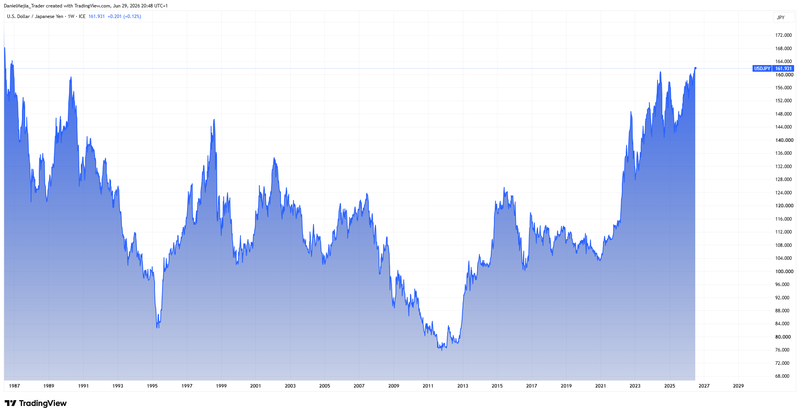
Figure 1. USD/JPY pair (1986–2026). Source: Data from the Intercontinental Exchange (ICE); figure obtained from TradingView.
Key economic events this week
Several critical economic indicators are scheduled for release this week, with the following being of particular importance to market participants:
Tuesday
- China: NBS Manufacturing PMI
- Germany: Inflation Rate
- US: JOLTs Job Openings
Wednesday
- Japan: Consumer Confidence
- European Union: Inflation Rate
- US: ISM Manufacturing PMI
- US: EIA Crude Oil Stocks Change
Thursday
- Australia: Balance of Trade
- US: Non Farm Payrolls
- US: Unemployment Rate
