
 Support
 US home sales rise despite high mortgage rates; Australian confidence weakens
US existing home sales rose despite high mortgage rates, while Australian business confidence fell to a four-month low.

US existing home sales rose 1.5% in September to 3.99 million, defying average 30-year mortgage rates reaching 7.40%.
US equity indices fell marginally as elevated borrowing costs and major bank earnings reports weighed on market sentiment.
Australian business confidence dropped to -13 points amid ongoing Middle East tensions and monetary tightening by the RBA.
German inflation accelerated to 3.3% driven by rising energy costs, boosting the EUR/USD currency pair.
US existing home sales increase despite multi-year high mortgage rates
According to data released by the US National Association of Realtors, existing home sales (seasonally adjusted annualised rate) increased from 3.93 million in August to 3.99 million in September, exceeding analysts' expectations of 3.95 million. This represents a monthly rise of 1.5%, marking a positive turn after three consecutive months of contraction. Although rising mortgage interest rates have dampened housing demand by making credit more expensive, accumulated inventory and liquidity requirements may have afforded buyers greater negotiating power during the month under review.
Data from the Federal Reserve Bank of St. Louis indicates that the 30-year fixed-rate mortgage average reached 7.40%, its highest level since November 2023. This upward movement has weighed heavily on the housing sector, with expectations of elevated costs persisting as mortgage rates remain closely linked to long-term Treasury yields.
Following the release of the US housing data, major equity benchmarks declined in tandem, as corporate earnings reports from major banks failed to foster positive market sentiment during the trading session. The Dow Jones Industrial Average fell by 0.35% to 51,675, the Nasdaq 100 slipped by 0.31% to 30,569, and the S&P 500 index decreased marginally by 0.02% to 7,805 points.
Australian business confidence deteriorates to a four-month low
The National Australia Bank reported that its Business Confidence Index deteriorated further from a negative reading of 9 points in August to -13 points in September, marking its lowest level in four months. This performance reflects a multi-month period of corporate apprehension following the US–Israel–Iran conflict in the Middle East that began in February. The escalation has caused severe global energy supply disruptions alongside underlying inflationary pressures that global central banks have yet to contain.
Against this backdrop, the survey points to decelerating third-quarter economic growth and softer labour demand in upcoming periods, as cited by Trading Economics. This highlights how ongoing geopolitical tensions in the Middle East continue to adversely affect Australian companies, with corporate attention focusing on rising inflation and the prospect of a more restrictive monetary policy stance from the Reserve Bank of Australia (RBA) aimed at curbing price pressures.
At its most recent meeting, the RBA decided to raise benchmark interest rates by 25 basis points, bringing the cash rate to 4.6%—its highest level in more than a decade. An environment of elevated interest rates tends to complicate corporate expansion projects as borrowing costs become increasingly expensive.
Nevertheless, following the business confidence release, the Australian dollar appreciated by 0.33% against the US dollar, with the AUD/USD currency pair closing at $0.6979.
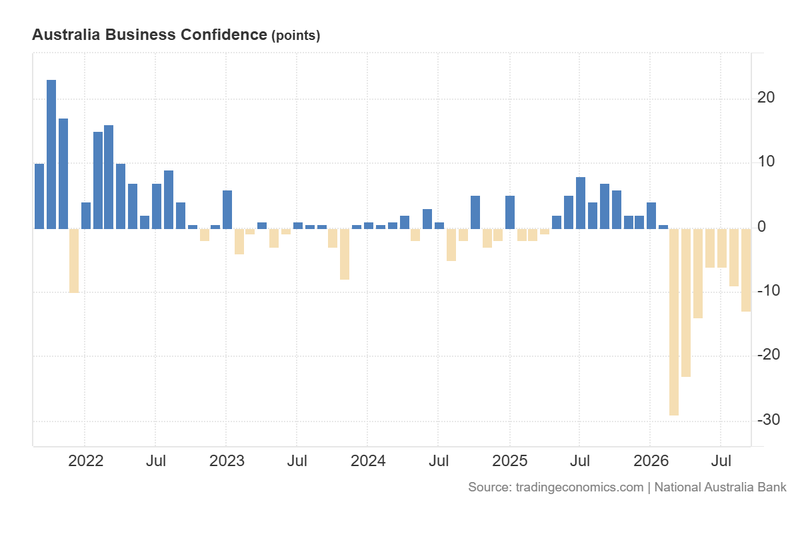
Figure 1. Australia Business Confidence (2021–2026). Source: Data from the National Australia Bank; chart retrieved from Trading Economics.
German inflation accelerates in line with analysts' expectations
According to data from Germany's Federal Statistical Office, the headline inflation rate accelerated sharply from 2.9% in August to 3.3% in September (final revision), aligning with analysts' forecasts. This represents the highest inflation rate recorded since December 2023. Notably, the report highlights that the price acceleration was primarily driven by rising energy costs amidst the persistent US–Iran conflict in the Middle East, as well as escalating tensions between Houthi forces and Saudi Arabia, which have heightened concerns over regional energy supply disruptions.
Consequently, the EUR/USD currency pair appreciated by 0.37% to $1.1198, as rising inflationary pressures across European economies could prompt further interest rate increases by the European Central Bank. Meanwhile, the DAX 40 equity index declined marginally by 0.07% to 25,259 points.
