
 Support
US labour market strengthens as Canadian jobless rate surprises higher
Robust US job gains and a falling unemployment rate have reinforced expectations of a monetary policy rate hike and bolstered the US dollar, contrasting sharply with Canadian job losses and rising unemployment driven primarily by trade tariffs.

US Non-Farm Payrolls rose to 165,000 in October, lowering the unemployment rate to 4.1%.
Solid US employment data heightened market expectations of an interest rate increase by the Federal Reserve.
Canadian unemployment rose to 6.7% alongside net job cuts, driven primarily by US trade tariffs.
US consumer confidence improved despite equity market volatility and lingering valuation concerns across the artificial intelligence sector.
Date: 7 November 2026 (GMT+3)
Bureau of Labour Statistics employment report displays robust non-farm payrolls and declining unemployment rate
According to data published by the US Bureau of Labour Statistics (BLS), Non-Farm Payrolls (NFP) advanced significantly from 60,000 in September to 165,000 in October, comfortably surpassing the 65,000 increase anticipated by consensus forecasts. Concurrently, the BLS reported that the unemployment rate fell from 4.2% to 4.1%, edging below analysts' estimates of 4.2%.
Consequently, both indicators highlighted ongoing resilience in the labour market, thereby reinforcing expectations that the Federal Reserve will implement an interest rate hike at its December meeting. With employment remaining robust, the central bank is expected to prioritize inflation containment over full employment preservation. As indicated by the CME FedWatch Tool, market-implied probabilities reflect a 78% likelihood of a 25-basis-point rate increase by the US central bank, up from 72% recorded some days prior.
Notably, the latest unemployment reading reinforced a broader downward trajectory observed over the past year. Meanwhile, Non-Farm Payroll gains were supported by solid job creation in Professional and Business Services (+70,000), Healthcare (+42,000), and Transportation and Warehousing (+25,000). Overall, the service sector and broader private market recorded the most substantial expansions.
Following the publication of the BLS employment report, the US Dollar Index (DXY) rose sharply by 0.70% to 102.27, bolstered by firming expectations of a more restrictive monetary policy stance from the Federal Reserve. In turn, benchmark US 10-year Treasury yields rose slightly by 1.6 basis points to 4.86%.
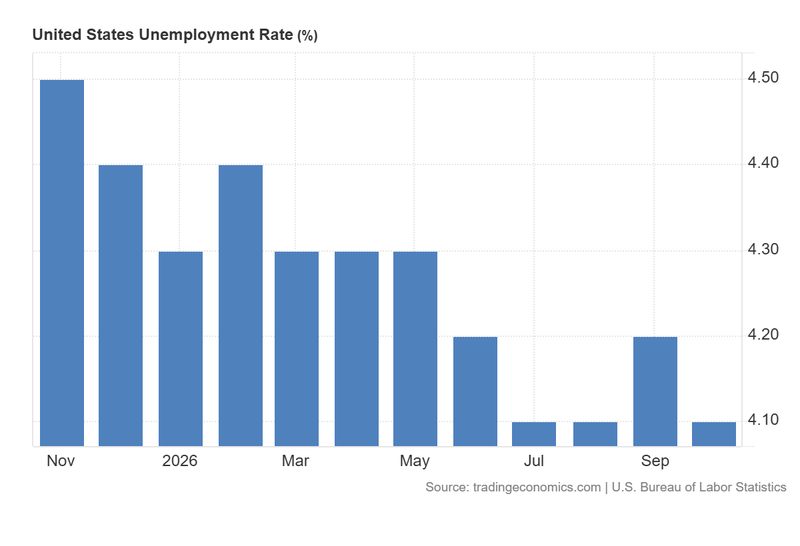
Figure 1. US Unemployment Rate (2025–2026). Source: Data from the US Bureau of Labour Statistics, figure retrieved from Trading Economics.
Canadian Unemployment Rate rises unexpectedly above market expectations
Statistics Canada reported that the national unemployment rate rose from 6.5% in September to 6.7% in October, significantly exceeding the market consensus estimate of 6.5%. Crucially, the deterioration in the jobless rate was driven primarily by the implementation of US trade tariffs, which continue to weigh heavily across multiple economic sectors.
The United States remains Canada’s principal trading partner in both imports and exports. Consequently, commercial friction between the two nations exerts severe pressure on the Canadian economy, prompting a potential push towards global trade diversification. Against this backdrop, Canada and the Eurozone have engaged in discussions regarding enhanced bilateral integration, enabling European economies to draw on Canadian energy supplies while allowing Canada to redirect exports of goods and services towards European markets.
Additionally, Statistics Canada revealed that net employment fell by 4,700 positions, missing market consensus expectations of a 13,600 increase. This contraction was driven primarily by a sharp drop in full-time employment, which declined by 18,100 positions.
Following the Canadian employment release, USD/CAD currency pair advanced firmly by 0.80% to 1.4126, placing severe downward pressure on the Canadian dollar. This market reaction reflects the sharp divergence between robust US employment data—which reinforced expectations of a more hawkish Federal Reserve—and the weakening outlook for the Canadian labour market.
University of Michigan consumer sentiment index improves as inflation expectations decline
According to the University of Michigan, the Consumer Sentiment Index improved from 48.0 in October to 51.0 points in November, surpassing analysts' forecasts of 48.0 points. Concurrently, the Current Economic Conditions Index rose from 46.7 to 51.0, while the Index of Consumer Expectations advanced from 48.8 to 50.9 points.
The survey findings revealed that this underlying improvement was driven by gains in expectations of personal finances and overall business conditions. However, the results also highlighted persistent anxiety regarding household equity portfolios amidst heightened volatility in US equity markets, where elevated valuations among artificial intelligence firms have sparked concerns over a potential sector bubble.
Conversely, consumer inflation expectations showed marked improvement. One-year-ahead inflation expectations decreased from 4.7% to 4.3%, while five-year-ahead inflation expectations edged down slightly from 3.5% to 3.4%.
Following the release of the University of Michigan data, major US equity indices closed mixed, indicating that market participants gave limited weight to the improvement in consumer sentiment. The S&P 500 advanced by 0.31%, while the Nasdaq 100 gained 1.35%. In contrast, the Dow Jones Industrial Average declined by 0.46%.
