
 Support
 US markets weaken amid concerns over AI valuations and geopolitical risks
US equity markets retreated as mounting fears of artificial intelligence (AI) overvaluation and escalating Middle East tensions unsettled investors. These developments subsequently triggered a rally in crude oil prices and pushed government bond yields higher, amidst shifting market expectations regarding the Federal Reserve’s interest rate trajectory.

Technology stocks led the broader market decline, with the Nasdaq dropping 1.77% driven by compounding anxieties over unsustainable AI valuations.
Recent attacks on maritime tankers in the Strait of Hormuz have threatened the fragile US–Iran ceasefire agreement.
Crude oil prices surged by approximately 3%, while CME FedWatch data now underscores a potential interest rate hike at the Federal Reserve's September meeting.
Canada's Ivey PMI moderated to 56.2, yet remained firmly within expansionary territory despite lingering cross-border trade uncertainties.
US equities decline on fears of overvaluation in AI-related stocks and geopolitical tensions; Oil reacts higher
US equities declined in tandem as renewed anxieties regarding the overvaluation of artificial intelligence (AI) companies sparked widespread doubts about the structural sustainability of the recent tech-driven rally. By the closing bell, the tech-heavy Nasdaq 100 index had fallen by 1.77% to close at 29,173 points, the broad-based S&P 500 index decreased by 0.45% to 7,503, and the blue-chip Dow Jones Industrial Average depreciated by 0.25% to settle at 52,930 points.
In addition to equity-specific head-winds, US indices faced significant downward pressure from renewed geopolitical frictions in the Strait of Hormuz, which threaten to destabilise the current ceasefire between the US and Iran. According to a report by Reuters, Qatar attributed responsibility to Iran for a recent attack targeting two commercial tankers within the Strait. Concurrently, Washington issued a warning, stating that a comprehensive diplomatic resolution must be achieved or the US would "finish the job", thereby intensifying concerns over potential military intervention. Although analysts broadly consider an absolute collapse of the US–Iran ceasefire to be a low-probability event, a sustained escalation in the region could severely disrupt the energy supply chain normalisation that had materialised over preceding weeks.
At the commodity market close, the Brent crude futures contract (BRNU6) advanced by 3.01% to $74.16 per barrel, while the West Texas Intermediate (WTI) futures contract (CLQ6) increased by 2.70% to $70.39 per barrel. Simultaneously, capital market implications shifted; data from the CME FedWatch Tool revealed that implied market probabilities now favour a potential interest rate hike at the Federal Reserve’s September meeting, marking a 52.7% likelihood as the dominant expectation. Furthermore, the FedWatch Tool signalled a 33.1% probability of a secondary interest rate hike occurring at the December meeting.
This hawkish shift in policy expectations demonstrates that market participants remain acutely concerned by renewed macroeconomic and geopolitical instability in the Middle East. This hypothesis is further substantiated by a notable spike in long-term borrowing costs at the session close, where the benchmark 10-year US government bond yield advanced by approximately 8 basis points to reach 4.55%.
Canadian Ivey PMI declines but remains in expansion territory
Data published by the Ivey Business School of Canada revealed that the headline Ivey PMI decreased from 58.2 in May to 56.2 in June, falling considerably short of market consensus forecasts which had anticipated an increase to 59.1 points. However, while this deceleration implies a marginal moderation in macroeconomic momentum, the index remains fundamentally healthy as it continues to print well above the critical 50.0 expansion-contraction threshold.
An analysis of underlying data via Trading Economics indicates that the most pronounced decelerations originated within the prices index, which eased from 78.0 in May to 73.7 in June, and the employment index, which moderated from 54.3 to 53.6 points. Concurrently, the supplier deliveries index deteriorated slightly, sliding from 44.7 to 44.3 points. Conversely, the inventories index offered a positive counter-weight, rising from 47.9 to 50.9 to re-enter expansionary territory.
While current economic indicators in Canada remain relatively stable, the uncertainty created by the United States' decision not to renew the USMCA for another 16-year term is clouding the outlook for the domestic economy. Many private-sector firms increasingly view this prolonged uncertainty surrounding the agreement as a significant risk to long-term capital investment decisions.
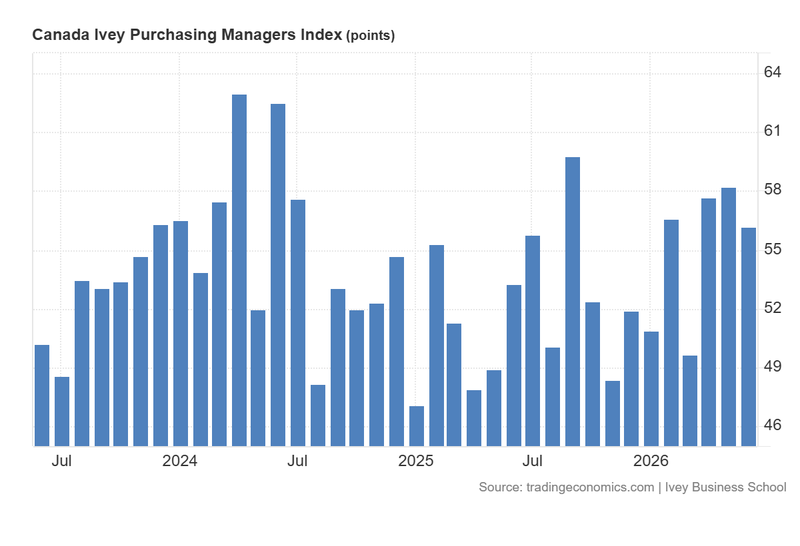
Figure 1. Canada Ivey PMI (2023-2026). Source: Data from the Ivey Business School. Figure obtained from Trading Economics.
