
 Support
 US PPI beats forecasts as oil inventories drop sharply; global industry weakens
Higher-than-expected US producer price inflation has reinforced interest rate hike expectations for December, whilst declining industrial output has highlighted persistent macroeconomic weakness across Japan and the European Union.

US Producer Price Index (PPI) rose by 6.3% year-on-year in September, driven higher by surging energy costs.
US crude oil inventories contracted sharply by 8.557 million barrels, propelling WTI futures to $97.97 per barrel.
Japanese industrial production fell by 2.4% in August, adding pressure to the Nikkei 225 index that tumbled by 4.90%.
Eurozone industrial output contracted by 1.1% year-on-year in August, marking three consecutive months of decline.
Date: 15 October 2026
US PPI accelerates significantly above forecasts as EIA crude inventories exhibit a sharp contraction
According to data released by the US Bureau of Labour Statistics (BLS), annual US producer price inflation accelerated from 5.6% in August to 6.3% in September, substantially exceeding the market consensus forecast of 5.3%. On a monthly basis, producer prices advanced by 1.3%, significantly surpassing the 0.5% increase anticipated by analysts. Consequently, the year-on-year reading represents the highest level since December 2022, whilst the monthly increase is the largest since March 2022, suggesting that supply-chain price pressures are deteriorating as geopolitical tensions between Washington and Tehran in the Middle East persist.
Against this backdrop, energy costs for US producers increased by 10.8%, transportation and warehousing costs advanced by 3.4%, and trade costs rose by 1.4%, according to data cited by Trading Economics. Notably, diesel costs have reached historical highs in recent weeks, accumulating a 60% year-on-year increase. Concurrently, the implementation of tariffs by the US administration continues to weigh heavily on producer prices.
Following the BLS report, market-implied probabilities showed no material shift in near-term monetary policy expectations, as investors anticipate that the Federal Reserve will hold interest rates unchanged at its October meeting. However, market pricing reflects a high probability of a 25-basis-point interest rate hike at the December meeting.
As a consequence, US equity markets closed mixed: the Dow Jones Industrial Average advanced by 1.08% to 52,183 points and the S&P 500 index gained 0.33% to 7,744 points, whereas the Nasdaq 100 index declined marginally by 0.05% to 29,935 points.
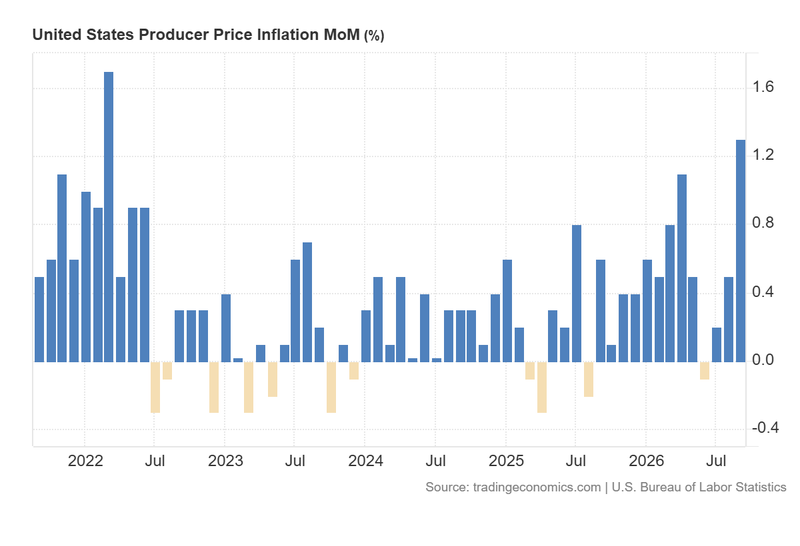
Figure 1. US Producer Price Inflation (2021–2026). Source: Data from the US Bureau of Labour Statistics; figure retrieved from Trading Economics.
Concurrently, the US Energy Information Administration (EIA) reported a sharp weekly drawdown in crude inventories of 8.557 million barrels, a decline that far exceeded the 0.3-million-barrel contraction expected by analysts. This represents the largest inventory decline since the second week of February, prior to the onset of the US–Israel–Iran conflict. Conversely, gasoline stocks expanded considerably by 3.518 million barrels. This divergence may reflect subdued domestic gasoline demand amid elevated fuel prices, as well as a potential increase in crude oil exports.
As the EIA report implied a substantial tightening in crude supply, West Texas Intermediate (WTI) futures contracts (CL) appreciated by 3.03% to settle at $97.97 per barrel.
Japanese industrial production contracts more than anticipated by analysts
The Ministry of Economy, Trade and Industry (METI) of Japan reported that industrial production contracted by 2.4% month-on-month in August, exceeding the 1.7% decline expected by analysts. This represents the sharpest monthly drawdown since January 2024, indicating that Japanese industrial output is struggling to gain growth momentum. Consequently, year-on-year industrial production growth decelerated from 3.9% in July to 2.7% in August. The METI report noted that this underlying weakness in industrial output was primarily driven by lower production across manufacturing sectors, alongside weaker export demand.
Nevertheless, at market close, the Japanese yen appreciated against the US dollar amid broad-based greenback weakness during today's session, with the USD/JPY currency pair declining by 0.22% to ¥157.99. Conversely, the benchmark Nikkei 225 equity index dropped sharply by 4.90% to 64,425 points as production indicators revealed underlying weakness in performance.
European Union industrial output falls, accumulating three consecutive months of contraction
According to data published by Eurostat, industrial production in the European Union fell by 0.5% month-on-month in August, missing consensus forecasts that had anticipated a flat reading. With this result, industrial output across the region has recorded three consecutive months of contraction, highlighting persistent difficulties in achieving expansion. On an annual basis, industrial output contracted by 1.1%, representing a sharper decline than the 0.1% contraction expected by market participants.
Despite the disappointing Eurostat release, the euro appreciated by 0.59% against the US dollar, with the EUR/USD pair closing at $1.1220. This movement was primarily driven by general weakness in the greenback relative to major currencies during today's trading session.
