
 Support
 US stocks end mixed amid diverging geopolitical signals; Yen stays under pressure
US stocks closed mixed as conflicting headlines from the Middle East reshaped risk sentiment: hopes of a ceasefire pushed oil prices lower, yet Hezbollah’s rejection and political friction in Washington preserved uncertainty. The Dow reached a record high, the Nasdaq declined, and the yen remained weak near ¥160.

US indices diverged: the Dow rose 1.73% to a record high, the S&P 500 gained 0.41%, while the Nasdaq fell 0.53% as geopolitical headlines split risk appetite.
Hopes of a ceasefire were offset by Hezbollah’s rejection and Israel’s refusal to withdraw, keeping Middle East uncertainty elevated.
Oil prices declined as truce hopes improved supply expectations; Brent dropped 2.48% and WTI fell 3.05% on easing fears of disruption.
USD/JPY tested ¥160 as Fed–BoJ rate differentials, firm US data, and demand for Treasuries supported the dollar and weighed on the yen.
Wall Street ends mixed as ceasefire rejection and US House vote shape geopolitical outlook
The main US equity benchmarks closed mixed amid diverging geopolitical developments that are driving significant movements across both stock and energy markets. According to Reuters, Israel and Lebanon stated that they had agreed to implement a ceasefire, raising hopes that a deal between the US and Iran could eventually be reached. However, further reports indicated that Hezbollah had rejected a new ceasefire in Lebanon, prompting an immediate response from Israel, which declared that it would not withdraw its troops from Lebanese territory. Tehran has stated that it will not enter into negotiations with the US until Israel ends its offensive in Lebanon.
Concurrently, Reuters also reported that the US House of Representatives approved a resolution aimed at preventing President Donald Trump from continuing the conflict against Iran in the Middle East. According to the report, the House voted 215 to 208, with four Republicans joining Democrats, reflecting growing tensions between segments of the Republican Party and Donald Trump. Nevertheless, it is important to note that, in order to take effect, the resolution would require Senate approval and two-thirds majorities in both chambers.
In response, oil benchmarks fell in tandem amid rising expectations that a ceasefire agreement could be achieved among the parties involved, thereby reopening the Strait of Hormuz and helping to normalise regional energy supply chains. The Brent futures contract (BRNQ6) declined by 2.48% to $95.03 per barrel. Meanwhile, the West Texas Intermediate futures contract (CLN6) fell by 3.05% to $93.04 per barrel.
Against this backdrop, US equity benchmarks closed mixed. The S&P 500 index rose by 0.41% to 7,584, while the Dow Jones Industrial Average advanced by 1.73% to 51,567, marking a new record high. By contrast, the Nasdaq index fell by 0.53% to 30,407 points.
Yen stays under pressure, testing a prominent high zone
The USD/JPY pair is testing a prominent multi-year high zone amid selling pressures that continue to undermine the Bank of Japan’s efforts to support its currency. At present, the Japanese yen is approaching the ¥160 per dollar level, raising doubts over the potential for official intervention.
Although the BoJ has adopted a hawkish tone regarding forthcoming monetary policy decisions, the Federal Reserve is moving towards a similar stance amid rising inflationary pressures resulting from the US–Israel–Iran conflict in the Middle East. At the same time, US economic indicators—most notably in the employment and production sectors—continue to show strength and resilience, reducing the need for interest rate cuts.
Additionally, the interest rate differential remains elevated, as the BoJ maintains its policy rate at 0.75% while the Fed remains around the 3.75% level. Consequently, many investors worldwide have shifted towards government bonds denominated in US dollars—such as US Treasuries—thereby supporting the greenback against the Japanese currency, which remains under pressure.
Market participants are now focused on the next Federal Reserve meeting, where it could become official that the US central bank could adopt a more restrictive stance, given that in previous meetings it had been more moderate, even signalling the possibility of lower rates. Conversely, the BoJ has been more emphatic in suggesting that the probability of future interest rate hikes is greater than that of lower rates.
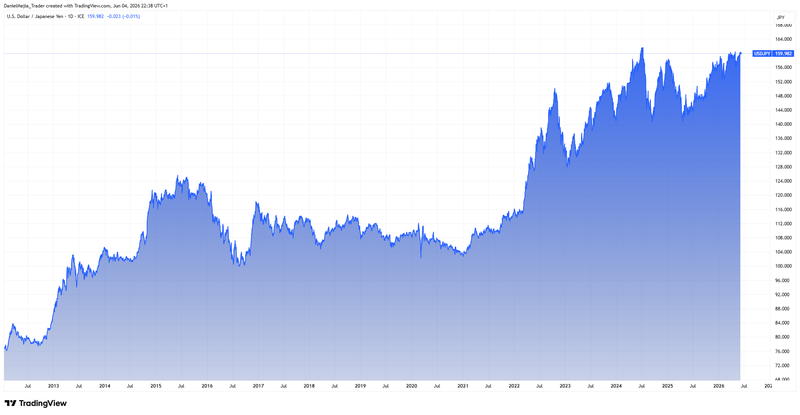
Figure 1. USD/JPY pair (2012–2026). Source: Intercontinental Exchange (ICE) data; Figure obtained from TradingView.

