Support
 AUD/USD forecast: RBA rate outlook, bond yields and key price levels
The Australian dollar has a yield advantage over the US dollar, but the gap is too small to guarantee further gains. After four rate increases this year, the Reserve Bank of Australia has pushed its cash rate to 4.60%, and Governor Michele Bullock is waiting to see how the tightening already delivered affects spending and inflation.

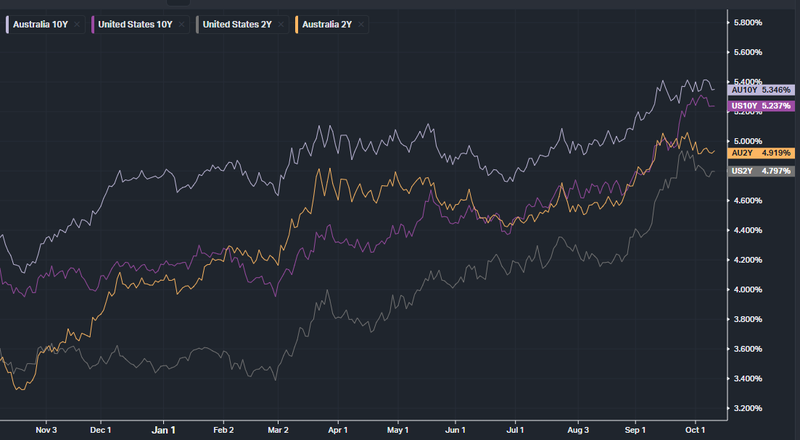
Australia’s 10-year government bond yield stands at 5.346%, compared with 5.237% in the US.
Bullock’s position is not an unconditional commitment to hold.
If AUD/USD breaks above 0.7000–0.7034, the recovery could extend toward 0.7100 and 0.7150.
The yield gap offers limited support
Australia’s 10-year government bond yield stands at 5.346%, compared with 5.237% in the US, leaving a spread of roughly 11 basis points. At the two-year end, the Australian yield is 4.919%, against 4.797% for the US, a difference of about 12 basis points.
Both spreads favour Australia, but only marginally. The gap suggests that investors are already pricing in relatively tight monetary conditions on both sides of the Pacific. For the Australian dollar, the question is not simply which country offers the higher yield, but whether that relative advantage is likely to increase.
The two-year spread is particularly useful because it is more sensitive to expectations for central-bank policy over the coming years. A widening spread in Australia’s favour could support AUD/USD, especially if markets expect the RBA to keep rates elevated while the Fed moves towards easing. If US yields rise faster, that support could fade even without a change in the RBA’s own rate.
Source: Koyfin
The RBA needs time, but inflation remains at risk
Bullock’s position is not an unconditional commitment to hold. Following the September increase, she stressed that monetary policy works with a lag and that the RBA needs to assess how the four rate rises feed through to the economy. At the same time, she warned that persistent domestic inflation and higher energy costs could require further tightening.
That leaves the Australian dollar caught between two forces. Another rate increase could widen the yield advantage and support the currency, but it could also signal that inflation is proving more persistent than expected. A pause would give households and businesses time to absorb previous increases yet could limit further currency support if US rates remain high.
The effect on AUD/USD will therefore depend on how markets interpret the data, not just the RBA’s decision. Evidence that inflation is easing without a sharp deterioration in employment would make a pause easier to justify. Persistent price pressure, particularly if domestic demand remains resilient, would keep the prospect of another hike alive.
What could move AUD/USD next?
The bullish case rests on Australia maintaining tighter policy relative to the US. If the RBA remains concerned about inflation while the Fed moves towards easing, the two-year spread could widen in Australia’s favour, providing a stronger foundation for AUD/USD.
The bearish case would emerge if US yields remained firm while Australian data begin to cool. A narrowing spread would weaken the currency’s yield advantage, leaving AUD/USD more dependent on global risk appetite and commodity prices. The RBA could also hold rates for longer than expected without the Australian dollar gaining much if US policy expectations shift in a more hawkish direction.
For now, Australia’s higher yields provide some support, but not a decisive advantage. The next sustained move in AUD/USD is likely to depend on which central bank has more reason to keep rates high. The yield spread is the signal to watch, and its direction matters more than the small advantage Australia currently holds.
Technical outlook
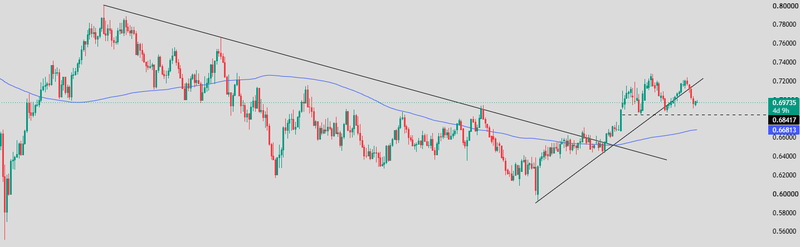
AUD/USD is trading around 0.6974, following a rejection from the 0.72 area. The pair has broken below its short-term rising trendline, weakening bullish momentum, although price remains above the longer-term rising trendline and the moving average near 0.6681.
The 0.6842 support is the immediate level to watch. Holding above it could allow AUD/USD to stabilize and retest 0.71–0.72. A break below this support would increase downside pressure toward 0.6681. The broader recovery remains intact, but buyers need to reclaim 0.71 to restore upward momentum.
Source: Trading view
Scenarios ahead
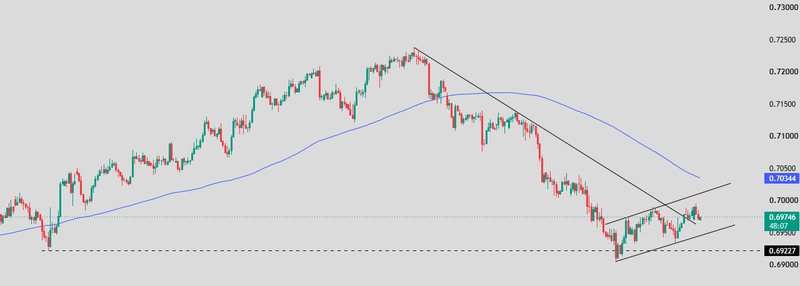
AUD/USD is trading around 0.6975 after rebounding from the 0.6900 area. The broader short-term structure remains bearish, with prices still below the descending trendline and the moving average near 0.7034. However, the latest recovery has formed a small rising channel, suggesting buyers are attempting to establish a base.
If AUD/USD breaks above 0.7000–0.7034, the recovery could extend toward 0.7100 and 0.7150. A sustained move above the moving average would weaken the current bearish structure.
Failure to reclaim 0.7000–0.7034 would keep the pair vulnerable to another test of 0.6923. A decisive break below 0.6900 would signal renewed selling pressure and potentially extend the decline.
The US September CPI report, RBA meeting minutes and Australian employment data could determine whether this rebound develops into a broader recovery or remains a temporary correction.
Source: Trading view