Support
 Brent approaches $110 amid persistent Middle East geopolitical tensions
Brent crude surged towards $110 per barrel as Middle East conflicts sparked supply fears.

Brent futures rose 3.72% to settle at $109.86, marking their highest close since 19 May 2026.
Houthi strikes on Saudi oil facilities and Iranian threats regarding the Strait of Hormuz continue to drive supply fears.
Short-term bullish momentum in Brent prices is testing a significant resistance area in its technical price action.
Date: 17 October 2026
Can Brent break $110 as Middle East tensions continue?
Brent crude futures surged by 3.72% to settle at $109.86 per barrel, approaching the psychologically significant $110 threshold after briefly touching that level during the trading session. This marked the highest closing price since 19 May 2026, reflecting renewed concerns over potential supply disruptions and the broader challenges facing global energy markets in returning to normal conditions. At market close, the Brent contract accumulates an appreciation of 80% approximately in the year-to-date (YTD) performance.
This upward trajectory has been primarily driven by persistent tensions in the Middle East related to the ongoing US–Iran conflict, which has escalated across the region and drawn in the Iran-aligned Houthi movement and Saudi Arabia.
During the week, the Houthis launched attacks on key Saudi Arabian territory, including Saudi Aramco's oil facilities as well as Riyadh's international airport—as reported by Reuters. Additionally, Iran stated that it is implementing tactics to target vessels transiting the Strait of Hormuz in an attempt to exert pressure on underlying energy inflation as the US midterm elections approach.
Consequently, persistent instability in the Middle East continues to exert upward pressure on energy prices, while the Brent contract tests key structural resistance in its price action.
Technical analysis of the Brent futures contract
From a technical perspective, the Brent crude futures contract is exhibiting a strong short-term bullish impulse. A detailed examination of the underlying market structure reveals several key observations:
- Trend Context: Over recent months, the Brent contract has entered a highly volatile price regime. Nevertheless, from a structural standpoint, the asset has advanced firmly above its 50-day, 100-day, and 200-day Simple Moving Averages (SMAs), indicating a prevailing bullish bias. In the short term, this upward momentum has gathered strength, with price action nearing the $110.00 threshold.
- Momentum Indicators: Both the Moving Average Convergence Divergence (MACD) and the Relative Strength Index (RSI) are currently trending upwards, signalling that short-term bullish momentum could persist. However, the RSI is approaching overbought territory, suggesting caution regarding the sustainability of this short-term bullish impulse.
- Bullish Scenario: Should short-term resistance at $110.00 be breached to the upside, the next major technical ceiling lies at $115.00. A decisive breakout above these levels would increase the probability of the contract trading at higher valuations, potentially advancing towards the $119.00 resistance mark.
- Bearish Scenario: In the event of a price retracement, the primary downside support levels are situated at $100.00 and $90.00 per barrel, representing the Volume Profile’s Point of Control (POC) and the 200-day SMA, respectively. A decisive breakdown below these levels would elevate the likelihood of a deeper market contraction.
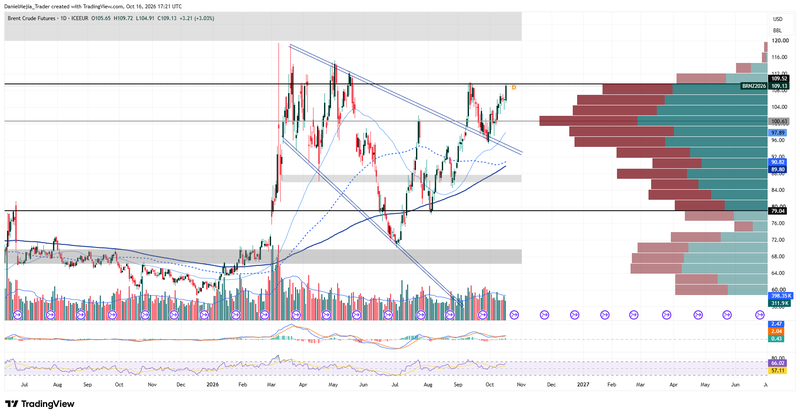
Figure 1: Brent Futures Contract (2025–2026). Source: Data from ICE Futures Europe; author's analysis conducted via TradingView.