Support
 Canadian dollar under pressure from a hawkish Federal Reserve and weaker oil prices
The Canadian dollar has weakened as hawkish Federal Reserve expectations continue to bolster the US dollar, while a 30% decline in Brent crude has impacted Canada’s commodity-linked revenues.

The USD/CAD pair has risen by approximately 4.20% over a two-month period, driven by hawkish Federal Reserve monetary policy expectations that have supported the greenback.
Brent crude oil prices have fallen by around 30% in two months, pressuring Canada’s terms of trade and dampening market sentiment toward the Canadian dollar (CAD).
Canada’s unemployment rate fell to 6.5%, while inflation has reached 3.2%, factors that may constrain the Bank of Canada’s (BoC) capacity for monetary easing ahead of its policy decision.
Canadian dollar weakens amid restrictive Fed stance and falling oil prices
The Canadian dollar has experienced pronounced selling pressure over the last two months, during which the USD/CAD pair appreciated by approximately 4.20%, marking a notable depreciation in the Canadian currency. This challenging environment can be attributed to a combination of several factors, most notably rising expectations that the Federal Reserve (Fed) will maintain a restrictive monetary policy stance in the coming months, alongside a sharp contraction in global crude oil prices. Historically, a more restrictive Fed policy triggers capital inflows into the US dollar as global investors seek the greenback to allocate capital into US Treasury bonds offering attractive yields, thereby driving a robust appreciation in the currency.
Why the Canadian dollar is pressured by weak oil prices
Concurrently, declining oil prices tend to affect the Canadian currency due to the nation's status as a major exporter of crude petroleum. When global oil prices drop, Canada experiences a contraction in export revenues. According to data from the Observatory of Economic Complexity (OEC), crude petroleum exports accounted for approximately 19.5% of the country's total exports in 2024. This substantial share underscores the critical role that oil plays in maintaining the nation's trade balance.
Over the last two months, the Brent crude futures contract (BRNU6)—a global benchmark for oil prices—declined by 29.5%. This correction was driven by diplomatic breakthroughs between the US and Iran regarding their military conflict in the Middle East. Figure 1 illustrates that the USD/CAD pair and Brent crude prices historically move in opposite directions on different time periods, demonstrating a strong inverse relationship across distinct time horizons. Over the past two months, this relationship has been clearly visible as the USD/CAD pair advanced solidly while the Brent futures contract fell sharply.
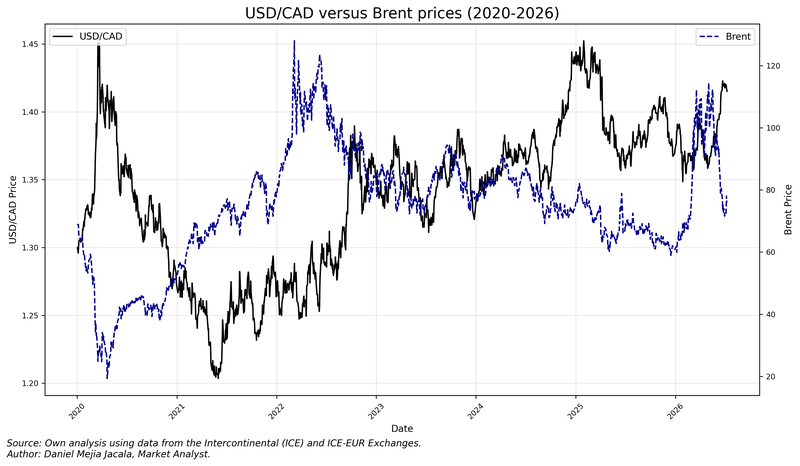
Figure 1. USD/CAD Vs. Brent Prices (2020-2025). Source: Own analysis using data from the Intercontinental Exchange (ICE) and ICE Futures Europe.
Canada’s unemployment rate falls, decreasing pressure on the BoC ahead of monetary policy decisions
In terms of the domestic macroeconomic landscape, Canada’s labour market is showing sustained resilience even as inflationary pressures build. According to data from Statistics Canada, the unemployment rate fell from 6.6% in May to 6.5% in June, beating market forecasts that anticipated the rate to hold steady. This reading represents the lowest unemployment level recorded in the past six months, reflecting a tight domestic job market.
Figure 2 highlights an inflection point that has established a downward trend since September 2025, thereby reducing the pressure on the Bank of Canada (BoC) to implement expansionary monetary policy measures in upcoming cycles. Conversely, Canada's annual inflation rate reached 3.2% in May, marking its highest level since December 2023.
Market participants are now focusing on the BoC's monetary policy announcement scheduled for next week, on 15 July. The consensus expectation is for the Canadian central bank to maintain its benchmark interest rate unchanged at 2.25%. However, policymakers may adopt a shift in tone, particularly given the Federal Reserve's recent adoption of a more restrictive hawkish stance at its latest meeting.
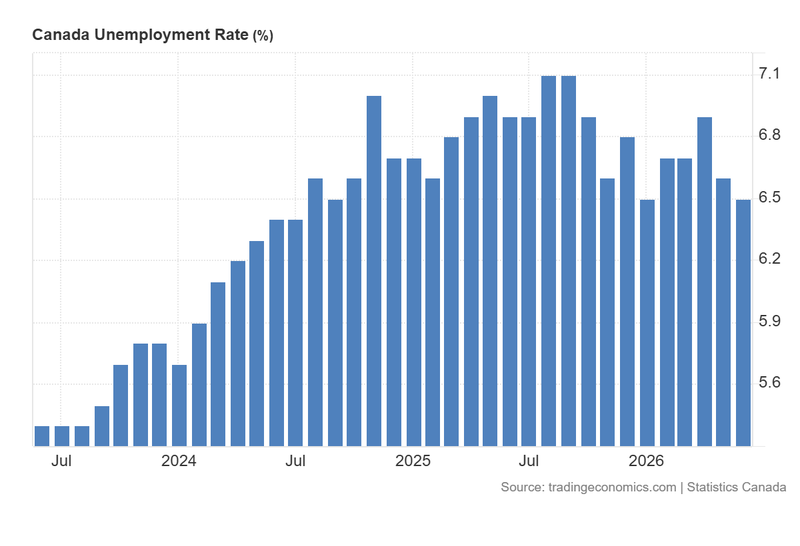
Figure 2. Canada Unemployment Rate (2023-2026). Source: Data from Statistics Canada. Figure obtained from Trading Economics.
Technical analysis of the USD/CAD pair
From a technical perspective, the USD/CAD pair has exhibited robust short-term bullish momentum over recent weeks. Key structural observations include:
- Trend Context: The USD/CAD pair has developed a prominent upward trajectory over the last weeks. The price is currently trading comfortably above its long-term simple moving averages (the 50, 100, and 200-period SMAs), reinforcing an underlying bullish bias.
- Resistance Levels: Should the immediate short-term resistance at 1.4250 be breached to the upside, the next major technical ceiling is identified at 1.4400. A decisive breakout above this zone would signal the potential for an extended rally into higher price territories.
- Support Levels: If the short-term support at 1.4120—which serves as a key pivot point—is invalidated to the downside, the next relevant support floor rests at 1.3950. A structural break below the 1.3950 handle would significantly increase the probability of a deeper market correction.
- Momentum Indicators: Both the Moving Average Convergence Divergence (MACD) and the Relative Strength Index (RSI) are currently trading deep within overbought territory, signalling a potential market reversal. This extreme positioning suggests caution regarding the immediate sustainability of the current upward move.
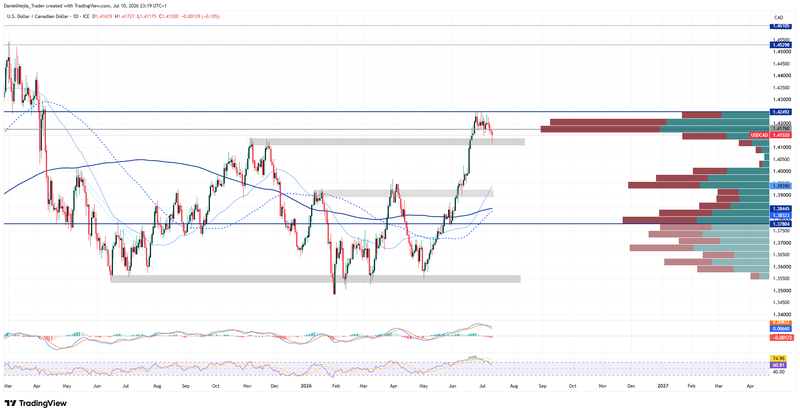
Figure 3. USD/CAD pair (2024-2026). Source: Data from the Intercontinental Exchange (ICE); Own analysis conducted via TradingView.