
 Support
Fed and BoJ policy paths keep pressure on the USD/JPY
The Japanese yen has struggled to build sustained momentum this year, even as investors increasingly expect the Bank of Japan to raise interest rates again before the end of 2026. The main reason lies outside Japan. If US interest rates remain well above those in Japan, the dollar continues to offer a more attractive return, encouraging investors to favour the dollar over the yen.
The wide yield gap between the US and Japan continues to support USD/JPY.
Markets expect Fed to deliver rate hike in September.
Markets expect BoJ's policy rate could reach 1.25% by December.
Yield differentials remain the market's main driver
Currency markets continue to take their cues from interest-rate differentials rather than official comments from policymakers.
The spread between US and Japanese two-year government bond yields currently stands at around 2.81 percentage points, underlining the significant yield advantage still available in dollar-denominated assets. That gap remains the key driver behind carry trades, where investors borrow in low-yielding yen to invest in higher-yielding US assets.
As long as this yield differential remains elevated, the incentive to hold dollars over yen is unlikely to disappear. That's why episodes of verbal intervention or optimism surrounding future Bank of Japan rate hikes have struggled to produce a lasting recovery in the Japanese currency. Until the yield gap begins to narrow meaningfully, interest-rate differentials are likely to remain the dominant force behind USD/JPY.
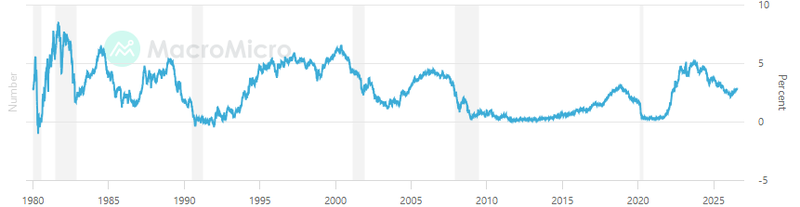
Source: MacroMicro
BoJ tightening is expected
The outlook for Japanese monetary policy has become gradually more hawkish. Inflation has remained above the Bank of Japan's target for an extended period, while wage growth has shown signs of becoming more durable. That has strengthened expectations that policymakers are not finished with policy normalization.
Most economists now expect the Bank of Japan to raise interest rates again during the second half of the year, with the policy rate projected to reach around 1.25% by December.
Additional tightening would narrow the interest-rate gap with the United States, but only gradually. Even if the Bank of Japan follows through with further increases, Japanese interest rates would remain well below those in the US, limiting the immediate impact on the yen.
The Federal Reserve is keeping the dollar supported
The other side of the equation remains equally important. Markets continue to expect the Federal Reserve to keep policy restrictive as inflation proves more persistent than policymakers would like. Current pricing implies roughly an 80% probability that rates will remain elevated through September, reinforcing the yield advantage enjoyed by US assets.
For currency markets, this means expectations for the Fed and the Bank of Japan are moving in the same direction both central banks are expected to maintain relatively tight policy. The difference is that the starting point remains dramatically different, leaving the US with a sizeable yield premium.
That premium continues to attract global capital into dollar-denominated assets and limits the scope for a sustained recovery in the yen.
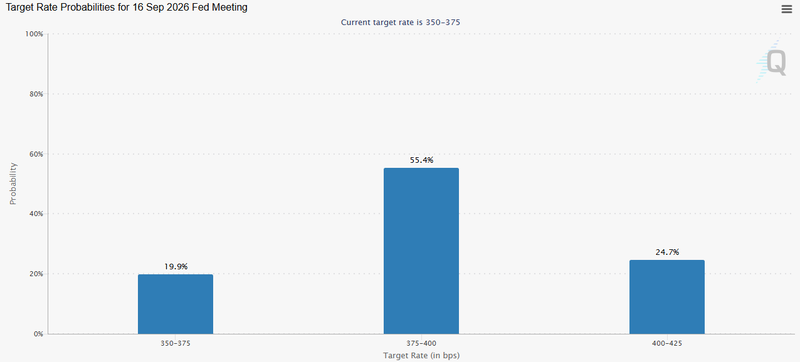
Source: CME Group
Technical outlook
USD/JPY remains in a clear uptrend, with buyers continuing to step in on pullbacks and preserve the broader bullish structure. The recovery from the 141 area has been characterized by a steady series of higher highs and higher lows, and the recent move back above 161.90 suggests the market is once again testing the upper end of its recent range near 164.00.
From here, 161.90 becomes the first level to monitor. Holding above it would indicate that buyers remain in control, while the rising trendline around 160.80–161.00 provides the next layer of support if profit-taking emerges. Below that, the 159.50–160.00 area remains an important technical floor, with a move into this region still consistent with a healthy correction rather than a broader reversal.
Scenarios ahead
USD/JPY trades above 161.90. If that support continues to hold, the focus stays on 164.00, with a break above that level exposing the 166.00–168.00 region over the medium term. Even so, upside momentum may become less linear as traders weigh the possibility of stronger rhetoric or direct intervention from Japanese authorities should yen weakness accelerate.
A different picture would emerge if the pair fell back below 161.90 and slips under the rising trendline near 161.00. That would shift attention to 160.00, where buyers would have an opportunity to reassert control. Only a decisive break below 159.50 would begin to challenge the broader uptrend, signaling that bullish momentum is fading and increasing the likelihood of a deeper retracement towards the 157.00–158.00 area.
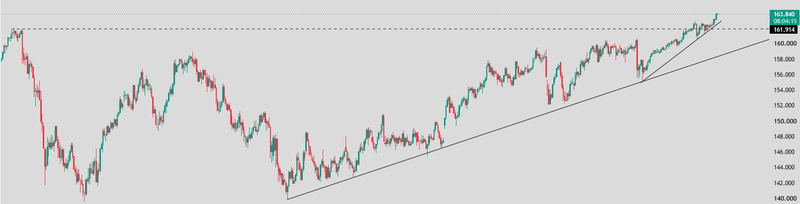
Source: Trading view


