Support
UK GDP growth supports BoE rate hike bets in December
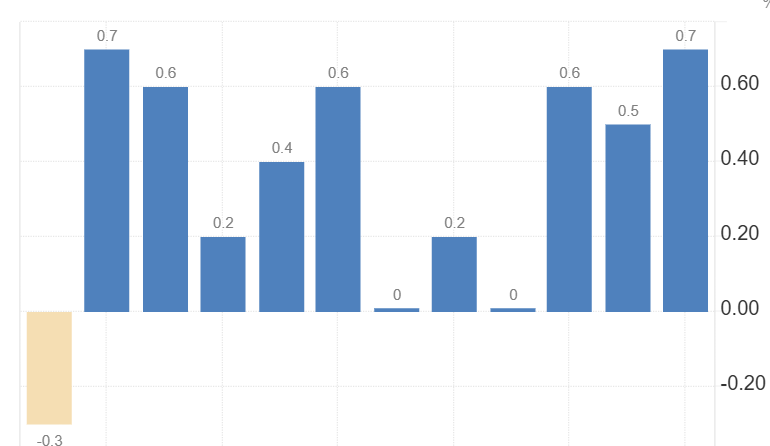
The UK saw steady economic growth of 0.7% within Q3 however this masks some key points. We saw growth from the tech sector and services, but we also saw higher imports leading to a larger trade deficit showing just how much the country relies on imports of energy and goods.

Quarterly GDP accelerated from 0.5% to 0.7%, matching forecasts.
The quarterly trade deficit widened by 6.2 billion to 10.4 billion.
Stronger growth supports another BoE hike, but the source of that growth leaves the 2027 outlook less convincing.
If we see a decisive close below the 1.3161 level, then this could indicate a breakdown of the larger triangle pattern.
Tech driven growth with cautious consumer spending
Overall, the UK had steady growth of 0.7%, however this increased by 1.9% compared to last year. Within September there was slower growth of 0.2%. However, since August has been revised to show stagnation, we can see that there was growth at the end of the quarter.
Most of the growth was driven by services with an increase of 0.9%. This was driven by growth in businesses in computer programming, cloud computing and AI. There was also good growth in computer and electronics manufacturing however there was a decline in construction.
This is important to note for the BoE
By investing in technology, they are increasing productive capacity without causing as much inflation as if households were spending more. This shows that the economy is resilient.
However, we did see a decline in retail sales
Consumer confidence fell the most in a month since April 2020. Whilst tech related businesses are still investing, households are becoming more cautious due to energy and borrowing costs.
Whilst this may not cause us to see a pause in tech driven growth, it will create additional pressure on the weaker part of the economy.
Source: Office for National Statistics
Trade deficit shows what the UK are paying for the growth
Looking at the trade figures for September we can see how the tech and energy story ties in. We saw exports of goods increase by 2.2 billion, but imports increased by 3.7 billion. Part of this increase came from machinery and telecoms equipment. This is in-line with companies investing in data centres, cloud computing and other tech projects.
We also saw an increase in fuel imports as the UK bought more crude oil and refined products. Overall imports for the third quarter increased by 3%. Exports only increased by 0.5%. This caused the overall deficit of goods and services to increase to 10.4 billion.
GDP helps the BoE, but inflation will determine what happens in December
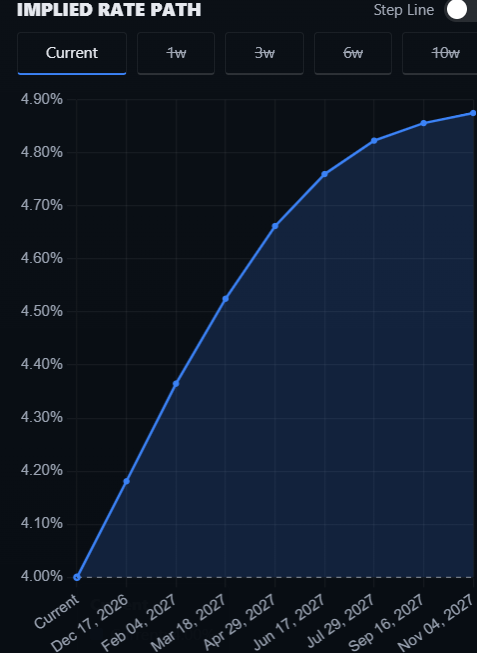
Last week the BoE voted 8-1 to increase Bank Rate to 4%. One member wanted to increase it further by half a point. Policymakers are concerned that energy costs will filter through to wages and services as the economy remains resilient.
Today’s GDP figures help reduce the risk that increasing rates further will cause the economy to go into recession. The market are now pricing in a 72% chance of a further increase in December.
However, this won’t be determined solely by tech investment. The BoE will pay more attention to wage growth, services inflation and whether companies are increasing their prices due to higher energy costs.
If these pressures increase, the resilient GDP gives the bank flexibility to increase rates. If household demand falls and oil prices continue to fall then the increase in November may be enough.
Source: Rate probability
Technical outlook
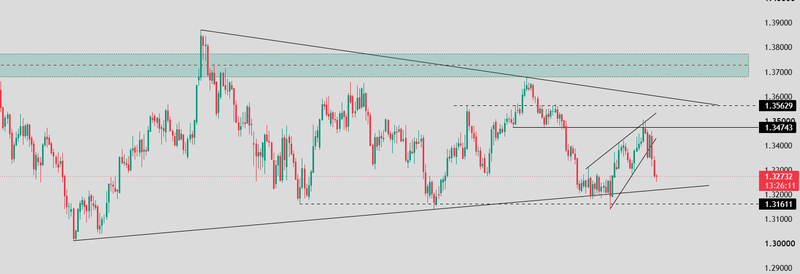
GBP/USD is currently trading around 1.3273 having failed to break above 1.3474 once again. The pair bounced off the 1.3160 area and made an attempt to rise back to 1.3450, however, as buyers tried to break through this resistance zone, it led to a sharp drop and saw prices fall below the short-term ascending trendline.
On a wider level, GBP/USD is trading within a large symmetrical triangle. This is formed by the falling resistance line from the 1.3870 area and the rising support line between lows from 1.3000. Whilst the pair has continued to make higher lows, there have been multiple failures to break above 1.3500/1.3563 as sellers have been active at higher levels.
Scenario ahead
The first key support is around 1.3200. This is where the wider ascending trendline has been seen to attract buyers. If this area can be broken below, then there will be increased pressure on the 1.3161 level.
If we see a decisive close below the 1.3161 level, then this could indicate a breakdown of the larger triangle pattern. This will cause weakness to the higher lows created since 1.3000.
However, before buyers can push the pair higher, they must defend the 1.3200/1.3161 support level and push back above 1.3400.
The more important level to watch is 1.3474. This is where the latest rally has come to a halt. If this can be sustained above, then it indicates buyers are taking control and could lead to another attempt to break above 1.3563.
This level is key as it sits just below the wider falling resistance line. If this can be confirmed above, then this will strengthen the bullish sentiment and could see the pair move towards the 1.3670/1.3770 resistance area. This is where we have seen previous highs and a key supply area which could cause renewed selling.
Source: Trading view