Support
 German consumer confidence improves on strong income expectations; Euro holds steady
German consumer confidence has improved, driven by rising income expectations. Although the index remains in negative territory, the result signals a potential economic recovery while the Euro holds steady.
German GfK consumer climate beat forecasts, rising from –29.4 in August to –26.6 for September.
Stronger income expectations reached a six-month high, aligning with an improved Ifo business climate index.
Despite recent gains, the indicator remains negative, reflecting sustained consumer caution since 2020.
The EUR/USD pair reflects market uncertainty while trapped inside a consolidation range pattern.
Date: 27 August 2026
What is behind the improvement in German consumer confidence?
According to data from Germany's GfK Group, the consumer climate index marked an improvement from –29.4 in August to –26.6 in September, outperforming the forecasted contraction of –29.6. An analysis by Trading Economics indicates that this improvement was driven primarily by stronger income expectations, which rose to a six-month high. Concurrently, economic expectations also improved, although the willingness-to-buy indicator remained unchanged.
This release follows a notable increase in the business climate indicator published by the Ifo Institute at the beginning of this week, which reached a multi-month high. Consequently, business and consumer confidence in Germany appear to be signalling an inflection point following a prolonged period of economic stagnation. In this context, as consumer confidence and business climate are forward-looking indicators rather than retrospective assessments, consumption and investment metrics could signal renewed strength in upcoming periods.
However, although the current reading marks an improvement, it is important to note that the GfK consumer climate indicator remains in negative territory. This suggests that the underlying sentiment of German consumers remains cautious, and that a sustained recovery in the index may require several consecutive periods to solidify. Figure 1 illustrates how German consumer climate dropped into negative territory in 2020 amid the global pandemic crisis and has not yet fully recovered.
Following the economic release, the euro held steady against the US dollar, with the EUR/USD pair settling near $1.1653. The euro has experienced a period of high market uncertainty as it continues to oscillate within a defined consolidation range.
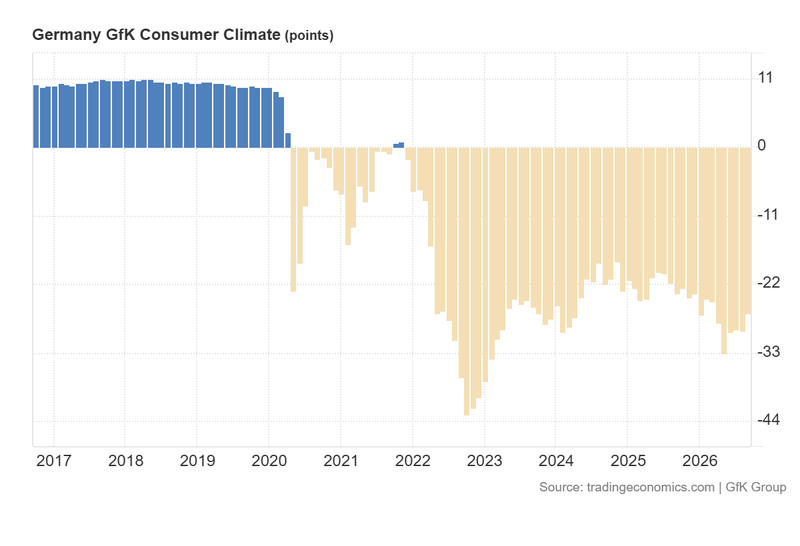
Figure 1. Germany GfK Consumer Climate (2016–2026). Source: Data from the GfK Group; figure obtained from Trading Economics.
Technical analysis of the EUR/USD pair
From a technical standpoint, the EUR/USD pair continues to signal market indecision as it oscillates within a defined consolidation range. Key observations include:
- Trend Context: Over the longer term, the pair remains bound within a sideways consolidation pattern, trading above its 100-day and 200-day Simple Moving Averages (SMAs) and reflecting market indecision.
- Resistance Levels: Should the current bullish impulse continue, the primary technical ceiling is identified at $1.1765—a prominent structural resistance level. A decisive breakout above this zone would signal the potential for further upside towards higher valuations, notably the $1.1900 level.
- Support Levels: In the event of a market retracement, two key support levels stand out at $1.1520 and $1.1367. A breach of these levels would significantly increase the probability of a deeper market correction.
- Momentum Indicators: The Moving Average Convergence Divergence (MACD) is exhibiting an upward trajectory, signalling that bullish momentum could persist. Nevertheless, the Relative Strength Index (RSI) is trading close to overbought territory, suggesting caution regarding further upward movement.
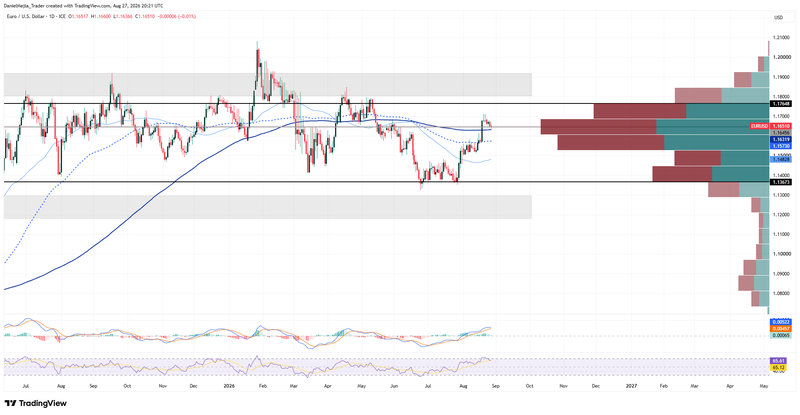
Figure 2. EUR/USD Currency Pair (2025–2026). Source: Data from the Intercontinental Exchange (ICE); author's analysis conducted via TradingView.