Support
 Germany’s trade surplus exceeds forecasts; Euro strengthens against dollar
Germany’s trade surplus widened sharply to €19.1 billion in May, beating forecasts as exports increased and imports declined. Stronger shipments to the US, China, and the UK signalled resilience in the external sector despite geopolitical uncertainty.

Germany’s trade surplus rose to €19.1 billion in May, well above the €14.8 billion forecast and April’s €14.7 billion reading.
Exports increased by 0.9% month on month, supported by stronger shipments to the US, China, and the UK.
Imports fell by 2.5%, with weaker purchases from EU countries and China helping to widen the surplus.
German trade balance surpasses expectations
According to data released by Germany’s Federal Statistical Office, the country’s trade surplus increased significantly from €14.7 billion in April to €19.1 billion in May, comfortably exceeding analysts’ expectations of €14.8 billion. The stronger-than-expected surplus was driven by a 0.9% monthly increase in exports, while imports declined by 2.5%, the latter marking their weakest performance in four months.
Analysis from Trading Economics indicates that the improvement in exports was primarily supported by higher shipments to key trading partners, notably the United States (+23.1%), China (+7.1%), and the United Kingdom (+0.4%). On the import side, purchases from European Union member states fell by 2.5%, while imports from China declined by 2.0%. As a result, the widening trade surplus suggests that Germany’s external sector remains resilient despite recent trade tensions and geopolitical uncertainty. The data may also indicate that the euro area’s largest economy is beginning to regain momentum after several months of economic headwinds, particularly in its trade relationship with the United States, Germany’s most important export market.
At market close, the euro appreciated by 0.12% against the US dollar to $1.1430. Despite this advance, the single currency has faced notable selling pressure over the past month, as the US dollar has strengthened amid growing expectations that the Federal Reserve could maintain a restrictive monetary policy stance for longer.
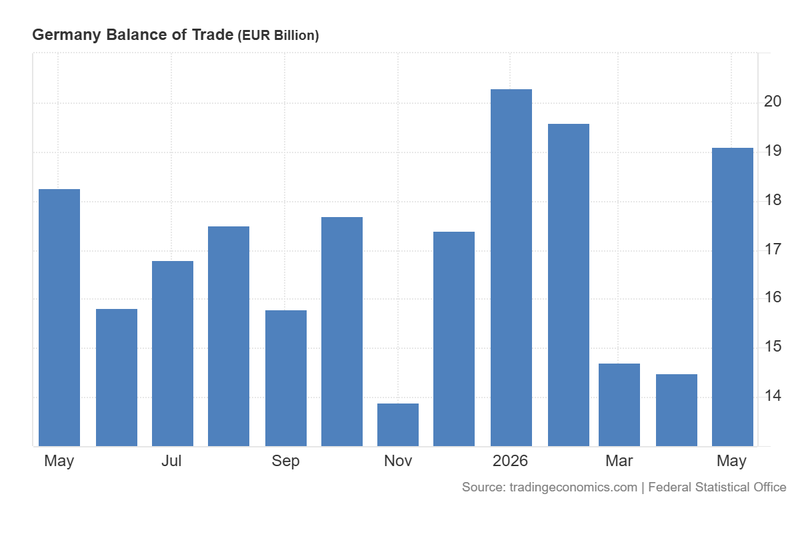
Figure 1. Germany Balance of Trade (2025–2026). Source: Data from the Federal Statistical Office; figure obtained from Trading Economics.
Technical analysis of the EUR/USD pair
From a technical standpoint, the EUR/USD pair maintains its long-term bullish trajectory, although immediate price action is navigating a consolidation pattern. Key observations include:
- Trend context: Over the long term, the pair is currently trading below its 50-day, 100-day, and 200-day Simple Moving Averages (SMAs), while compressed within a tight consolidation range over the last twelve months.
- Resistance levels: Should the short-term resistance at $1.1470 be breached to the upside, the next major technical ceiling is identified at $1.1650—a level where the 200-day SMA and the Point of Control of the volume profile converge. A decisive breakout above this level would signal the potential for a further extension towards higher valuations.
- Support levels: If the immediate support at $1.1370 is compromised, the next critical structural floor is situated at $1.1200. A breach of the $1.1200 zone would significantly increase the probability of a deeper market correction.
- Momentum indicators: Both the Moving Average Convergence Divergence (MACD) and the Relative Strength Index (RSI) are tracking within neutral territory, reinforcing the view that elevated market uncertainty is preventing the establishment of a predominant directional trend.
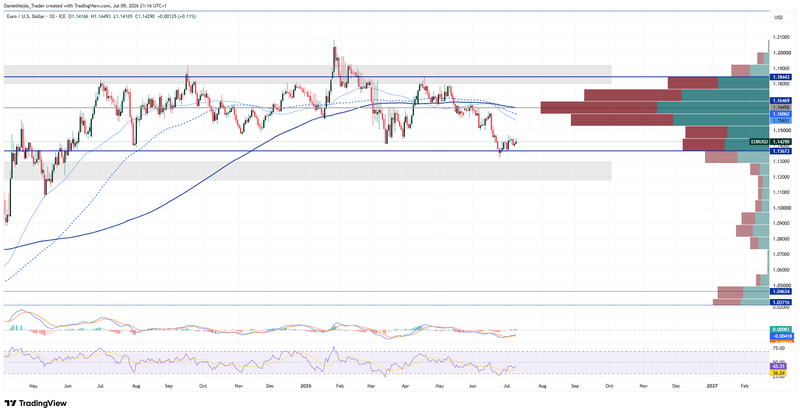
Figure 2. EUR/USD Pair (2025–2026). Source: Data from the Intercontinental Exchange (ICE); own analysis conducted via TradingView.