
 Support
Gold caught between fed uncertainty and easing oil prices
Gold has struggled to establish a clear direction as investors reassess the outlook for U.S. monetary policy. While geopolitical tensions initially fueled demand for safe-haven assets, easing energy prices and softer inflation have reduced expectations that the Federal Reserve will need to respond with another interest rate hike
Gold remains sensitive to changing expectations for U.S. interest rates.
Falling oil prices have eased fears of a sustained inflation shock.
The Fed is likely to remain patient as economic signals point in different directions.
Why lower oil prices matter for gold
When energy costs rise sharply, investors often worry that transportation, manufacturing and household expenses will follow, increasing the likelihood that central banks will keep interest rates higher for longer.
While geopolitical uncertainty can initially support gold through safe-haven demand, persistently higher interest rates typically become a headwind by strengthening the U.S. dollar and raising the opportunity cost of holding a non-yielding asset.
If oil continues to retreat, the risk of another inflation wave may continue to diminish, reducing pressure on the Federal Reserve to tighten policy further. That would likely create a more supportive backdrop for gold than another round of interest-rate increases.
Neither a hike nor a cut looks convincing
Markets continue to assign a modest probability to another rate increase later this year, but the latest data do not make a compelling case for immediate action. Lower oil prices have eased inflation concerns, while June's softer inflation reading suggests underlying price pressures are still moving in the right direction.
At the same time, there is little justification for cutting rates. The labor market remains resilient, unemployment is relatively low, corporate earnings continue to hold up and inflation is still above the Fed's target.
Markets pricing 35% probability of July rate hike
For policymakers, maintaining the current policy stance appears to be the most balanced option. Leaving rates unchanged gives the Fed more time to assess whether recent geopolitical tensions evolve into a sustained energy shock or simply prove to be a temporary disruption. It also allows officials to evaluate whether the current wave of AI-driven investment continues to support economic activity or begins to lose momentum as the investment cycle matures.
With markets pricing only around a 35% probability of July rate hike, investors increasingly expect the Fed to remain on hold while awaiting clearer evidence that inflation is either reaccelerating or moving sustainably back toward target.
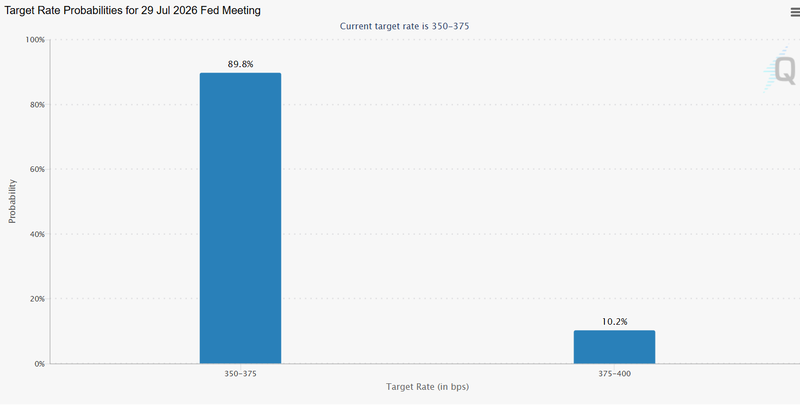
Source: CME Group
Technical outlook
Gold remains under pressure, with the broader downtrend still firmly intact despite several attempts to stabilize. Each rebound has so far been met with fresh selling before buyers can build enough momentum to challenge the dominant bearish structure, leaving the sequence of lower highs unchanged since the market failed to sustain gains above 4,560.
The latest recovery from the 3,940–3,970 demand zone follows a familiar pattern. Buyers managed to lift prices off support, but the advance lost momentum before reaching the descending trendline, suggesting that market participants are still using rallies as opportunities to reduce exposure rather than establish new long positions. Until those dynamic changes, any recovery is likely to be viewed as corrective rather than the start of a new uptrend.
Attention is now shifting to the 4,020 level, where gold is once again testing an area that has repeatedly attracted buying interest over recent weeks. More importantly, the broader 3,940–3,970 demand zone continues to underpin the market. As long as this region remains intact, the current decline can still be interpreted as a consolidation within the broader correction rather than the beginning of another sustained selloff.
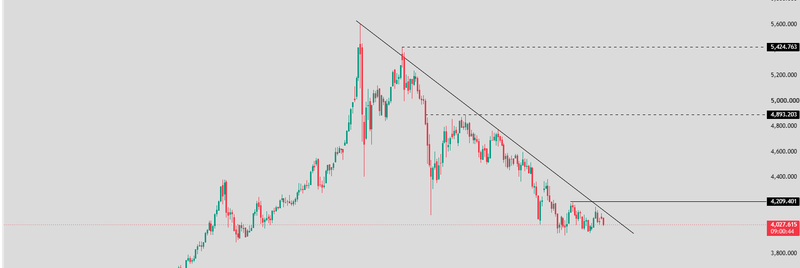
Source: Trading view
Scenarios ahead
The more constructive scenario depends on buyers successfully defending support around 4,020 while keeping prices above the broader 3,940–3,970 demand zone. Holding this region would suggest that demand remains present beneath the market, leaving room for another attempt to challenge resistance. A break above 4,166 would improve the near-term outlook, while a sustained move through 4,203 and the descending trendline would provide stronger evidence that bearish momentum is beginning to fade. In that case, attention could shift toward the next resistance zone around 4,350–4,370.
The bearish scenario becomes more convincing if gold loses the 4,020 support and sellers force a decisive break below the 3,940–3,970 demand area. Such a move would signal that demand is no longer strong enough to absorb selling pressure, increasing the likelihood of a deeper decline toward 3,885, the next major technical support on the chart.
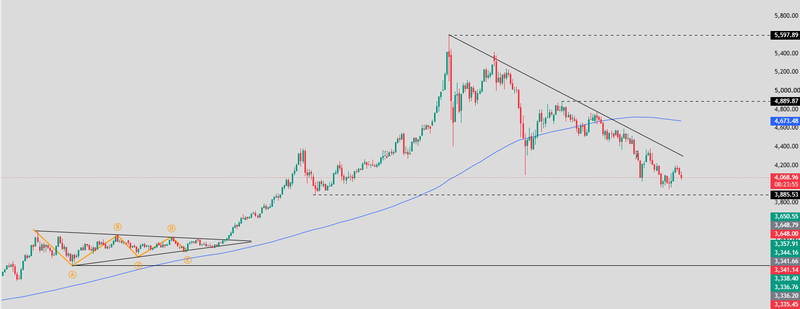
Source: Trading view


