Support
 Gold declines as geopolitical tensions reinforce expectations of a hawkish Fed
Gold fell to $4,501 as US-Iran tensions raised inflation fears, bolstering the US dollar. Expectations of a hawkish Federal Reserve interest rate policy increased the opportunity cost for the non-yielding bullion, overshadowing its traditional safe-haven appeal despite gold maintaining a strong long-term bullish technical structure.
US strikes on Iranian territory disrupted a ceasefire and spiked Brent crude by 3.57%, intensifying fears of persistent global inflation.
A stronger US dollar makes gold more expensive for international buyers, reducing global demand and applying downward pressure on bullion prices.
Gold remains above its 200-day SMA, but a short-term pattern of lower highs indicates a temporary moderation of its long-term bullish trend.
Gold falls amid renewed geopolitical concerns and restrictive Fed expectations
The gold futures contract (GCM6) on the COMEX exchange decreased by 0.46% to settle at $4,501 per ounce, driven by renewed concerns that the US-Israel-Iran conflict could widen following US military actions on Iranian territory. This geopolitical friction has fuelled market expectations that the Federal Reserve could maintain a more restrictive monetary policy stance for an extended period, consequently strengthening the US Dollar Index (DXY) and weighing on bullion performance.
According to a report by Reuters, Tehran stated that the United States violated their bilateral ceasefire agreement by launching airstrikes within Iranian territory, notably targeting a strategic region adjacent to the Strait of Hormuz. In response, Washington asserted that the strikes were defensive operations directed at missile sites and fast-attack vessels attempting to mine the maritime choke point. Concurrently, ongoing hostilities in Lebanon between Israel and Hezbollah underscore a persistent second front, indicating that the multi-layered conflict involving the US, Israel, and Iran may endure and further escalate.
Reflecting these developments, the DXY appreciated by 0.14% to 99.13 points. Market participants increasingly anticipate that the Federal Reserve could adopt a more restrictive "higher-for-longer" interest rate regime, with some speculating that the central bank might implement additional rate hikes if inflationary pressures intensify. Simultaneously, the Brent crude futures contract (BRNQ6) advanced by 3.57% to trade at $96.76 per barrel, driven by renewed anxieties regarding potential disruptions or closures within the Strait of Hormuz, a critical nexus for regional energy supply chains.
Bullion typically experiences downward pressure in a high-interest-rate environment, as fixed-income assets—such as US Treasury bonds—offer more competitive yields. Conversely, non-yielding assets like gold face a higher opportunity cost, reducing their attractiveness to investors. Furthermore, because gold is priced in US dollars, an appreciation of the greenback automatically increases the purchase cost for foreign currency holders, fundamentally suppressing international wholesale demand.
Technical analysis of Gold
From a technical perspective, gold futures maintain a robust long-term bullish trajectory. A detailed analysis of the current market structure reveals several key observations:
- Trend Context: On the daily timeframes, gold exhibits an intact primary bullish market structure defined by a clear sequence of higher highs and higher lows. The price action continues to respect the 200-day Simple Moving Average (SMA), confirming the underlying validity of the structural trend. Over recent months, however, short-term price action has entered a consolidative phase, establishing a series of lower highs that indicates a temporary moderation of upward momentum.
- Resistance Levels: Should immediate short-term resistance at $4,750 be breached decisively to the upside, the next significant technical ceiling is identified at the historical record high of $5,350. A sustained close above this threshold would signal a potential extension of price discovery into uncharted territory.
- Support Levels: In the event of a deeper price contraction, immediate short-term support is located at the psychological $4,500 boundary. If this level is invalidated, the next critical structural floor rests at $4,375. This zone carries significant technical weight, as it represents the confluence of the rising 200-day SMA and the support line of a long-term ascending trendline. A structural breach below $4,375 would notably increase the probability of a broader correction.
- Momentum and Volume: Both the Moving Average Convergence Divergence (MACD) and the Relative Strength Index (RSI) are currently tracking within neutral territory, reflecting a lack of predominant directional momentum and confirming the market's immediate phase of consolidation.
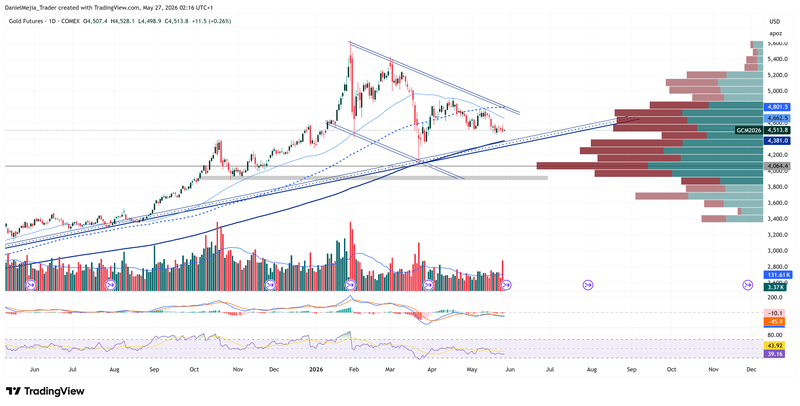
Figure 1. Gold Futures Contract (2025–2026). Source: Data from the COMEX Exchange; own analysis conducted via TradingView.