
 Support
 Nasdaq rises as hopes grow for Strait of Hormuz reopening and US-Iran talks
Nasdaq futures advanced as prospective US–Iran negotiations to reopen the Strait of Hormuz helped ease global inflation concerns.
Nasdaq futures gained 0.40% to reach 30,889 points amidst potential diplomatic progress between Washington and Tehran.
Reopening the Strait of Hormuz could mitigate global inflationary pressures and allow central banks to ease restrictive monetary policies.
The long-term bullish market structure of the Nasdaq remains intact as the index tests historic record highs.
Date: 26 September 2026
Could US–Iran talks fuel further Nasdaq gains?
The Nasdaq futures contract (NQ) advanced by 0.40% to trade at 30,889 points amid renewed market optimism that diplomatic talks between the US and Iran could result in the reopening of the Strait of Hormuz—a crucial maritime corridor for global energy transit.
Iranian Foreign Minister Abbas Araghchi proposed reopening the Strait of Hormuz and resuming nuclear negotiations with Washington within a seven-day window, provided the US administration meets Tehran's conditions, as reported by CNBC. Furthermore, according to a Reuters report, US and Iranian negotiators are exploring a phased exit from conflict, aiming for the reopening of the Strait alongside an end to the blockade against Iran.
Against this backdrop, the reopening of the Strait of Hormuz could alleviate persistent inflationary pressures, which have driven restrictive monetary policy decisions globally. Additionally, in the lead-up to the US mid-term elections, the coming weeks represent a crucial window for negotiations. Elevated inflation remains a primary driver behind the decline in US President Donald Trump’s approval ratings—a political dynamic that Tehran may be leveraging to re-engage in diplomatic talks.
A macroeconomic environment in which interest rates remain stable is favourable for equities, as corporations can execute growth initiatives without elevated borrowing costs compressing net profit margins. Furthermore, sustained high interest rates tend to weigh heavily on equity valuation metrics, as higher discount rates diminish the present value of future cash flows within discounted cash flow models.
Technical analysis of the Nasdaq futures contract
From a technical perspective, the Nasdaq index maintains its long-term structural bullish trajectory. However, a detailed evaluation of the chart highlights nuanced shifts in underlying momentum:
- Trend Context: Over a broader time horizon, the Nasdaq exhibits a classic ascending structure characterised by a sequence of higher highs and higher lows. The index continues to trade above its 50-day, 100-day, and 200-day Simple Moving Averages (SMAs), reinforcing its primary upward trend. Currently, the index is testing key structural resistance near its record highs, which could serve as a major catalyst for subsequent market direction.
- Resistance Levels: Should the index decisively break above the historical high near 31,000 points, the primary structural resistance level is the 32,000-point mark—a key psychological barrier. A confirmed breakout above this threshold would open the probability towards higher valuation zones.
- Support Levels: Conversely, if the 31,000 resistance level triggers a downside rejection, key support zones lie at 29,000 and 27,400 points—the second level converges with the 200-day SMA. A decisive breach below these support zones would increase the likelihood of a deeper market correction.
- Momentum Indicators: Both the Moving Average Convergence Divergence (MACD) and the Relative Strength Index (RSI) display an upward trajectory, indicating that short-term bullish momentum could continue. Nevertheless, the RSI is approaching overbought territory, signalling caution regarding the sustainability of the immediate upward impulse.
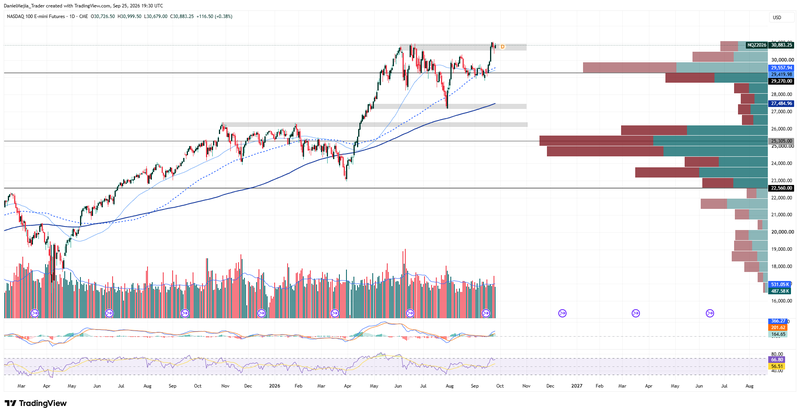
Figure 1. Nasdaq Futures Contract (2025–2026). Source: Data from the Nasdaq Exchange; author's analysis conducted via TradingView.


