
 Support
 Natural Gas advances as Middle East tensions raise supply concerns
Natural Gas futures have surged 157% year-to-date, driven by escalating Middle East tensions, Qatari supply cuts, and impending winter demand across Europe.
Concurrent conflicts in the Middle East, Ukraine, and Russia territories continue to impact critical Qatari and Russian gas export flows.
Impending winter heating demand from both Europe and Asia threatens to exacerbate existing global supply tightness.
Dutch Title Transfer Facility (TTF) natural gas price action maintains strong bullish momentum, despite entering a highly volatile trading regime.
Date: 24 September 2026
What is driving Natural Gas prices higher?
The Natural Gas futures contract (TFMV6)—the primary benchmark in Europe—has exhibited a strong upward trajectory over recent months. On a year-to-date (YTD) basis, the contract has appreciated by 157% amidst restricted market supply that is deteriorating as Middle Eastern geopolitical conflicts persist. Export volumes from Qatar, one of the world's largest natural gas suppliers, have fallen considerably.
Against this backdrop, supply concerns are intensifying as winter approaches, which could further exacerbate ongoing market tightness, particularly if regional geopolitical friction persists over the coming months.
Furthermore, natural gas traders are pricing in potential supply reductions due to two concurrent regional conflicts operating in parallel: the crisis in the Middle East, which is disrupting standard export flows from major exporters such as Qatar, and the Russia–Ukraine war, which continues to curtail pipeline flows from Moscow. Compounding this, two prominent consuming regions—Europe and Asia—are competing for the crucial commodity. This dynamic could create further challenges for European nations if Russian gas exports are prioritised towards Asian partners rather than European buyers.
During the trading session, the Natural Gas contract rose by 2.76%, trading at approximately $74.
Technical analysis of the Natural Gas futures contract
From a technical perspective, the Natural Gas crude futures contract is navigating a period of heightened market volatility, although the underlying bullish momentum remains predominant. A detailed examination of the market structure reveals several key observations:
- Trend Context: Over recent months, the Natural Gas contract has transitioned into a high-volatility price regime. Nevertheless, from a structural standpoint, the asset continues to trade above its 50-day, 100-day, and 200-day Simple Moving Averages (SMAs), confirming that the primary bullish bias remains intact. In the short term, price action is testing a structural pivot point; a bullish rejection at this level would reinforce the broader upward bias.
- Resistance Levels: Should upward momentum persist, the next major technical ceiling lies at $83.50—the immediate structural high within the bullish expansion. A decisive upside breach of this level would increase the probability of price discovery at higher valuations.
- Support Levels: In the event of a price retracement, primary downside floors are situated at $68.70 and $64.80. These levels represent the 50.0% and 61.8% Fibonacci retracement levels of the current upward impulse. A decisive breakdown below these technical boundaries would materially increase the likelihood of a deeper market correction.
- Momentum Indicators: Both the Moving Average Convergence Divergence (MACD) and the Relative Strength Index (RSI) are exhibiting downward trajectories, suggesting that short-term consolidation or corrective movement could continue. Nevertheless, fundamental drivers are expected to remain the primary catalyst shaping near-term price direction.
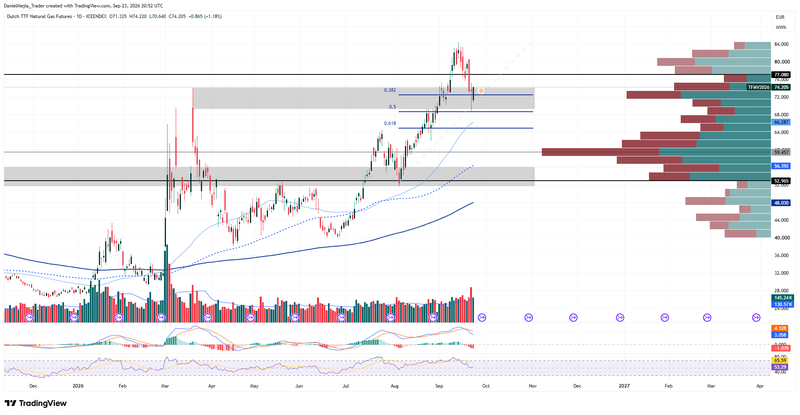
Figure 1: TTF Natural Gas Futures Contract (2025–2026). Source: Data from ICE-ENDEX Exchange; author's analysis conducted via TradingView.


