Support
 Nikkei reaches fresh record high amid robust economic releases
The Nikkei 225 climbed 2.53% to a historic record high of 66,329, propelled by better-than-expected Japanese economic data. Surpassing market forecasts, strong gains in retail sales, industrial production, and consumer confidence highlighted the economy's underlying resilience.

Japanese retail sales grew by 2.1% year-on-year in April, beating the 1.3% market forecast and signalling highly resilient domestic consumption.
Industrial production expanded by 0.8% in April, vastly outperforming analyst expectations of a 0.9% contraction.
Japan's consumer confidence index rose to 33.6 points, showing widespread sentiment improvements across employment, income, and livelihood.
From a technical perspective, the index trades well above its major simple moving averages (SMAs), though overbought MACD and RSI signals warn of a potential short-term pause.
Japan’s consumer confidence, industrial production, and retail sales top forecasts; Nikkei climbs to record peak
The benchmark Nikkei 225 index achieved a new record high, driven by a series of robust macroeconomic releases covering consumption, industrial output, and consumer confidence.
According to data released by the Ministry of Economy, Trade and Industry (METI) of Japan, retail sales growth accelerated from 1.4% in March to 2.1% in April on a year-on-year basis. This print came in significantly above the market forecast, which had anticipated a more modest 1.3% increase. On a month-on-month basis, the retail sector exhibited an advance of 1.3%, reinforcing the narrative of a resilient Japanese consumer. Concurrently, METI revealed that industrial production rose by 0.8% month-on-month in April, defying the consensus analyst estimate of a 0.9% contraction. Following this unexpected rebound, industrial output on a year-on-year basis registered an increase of 2.3%, down marginally from the 2.4% recorded in the prior period.
In tandem with the hard economic data, the Cabinet Office of Japan reported an improvement in forward-looking sentiment. The consumer confidence index rose to 33.6 points in May from 32.2 in April, comfortably beating the market consensus forecast of a slight decline to 32.0 points. An analysis from Trading Economics indicates that Japanese household sentiment improved across all four major survey categories: overall livelihood, income growth, employment prospects, and the willingness to purchase durable goods.
Triggered by this comprehensive display of macroeconomic strength and domestic resilience, the Nikkei 225 equity index surged by 2.53% to close at 66,329, marking an all-time high.
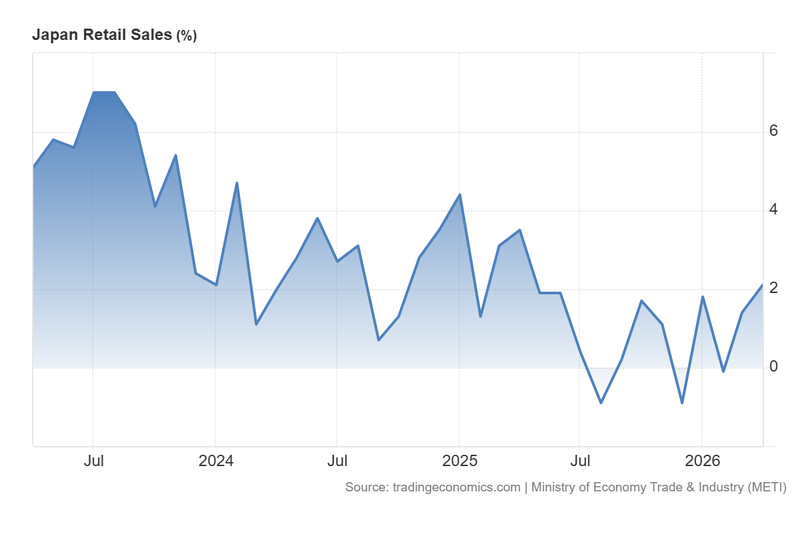
Figure 1. Japan Retail Sales (2023–2026). Source: Data from the Ministry of Economy, Trade & Industry (METI); Figure obtained from Trading Economics.
Technical analysis of the Nikkei 225 index
From a technical perspective, the Nikkei 225 continues to demonstrate a robust long-term bullish trajectory. A detailed analysis of the current market structure reveals the following key observations:
- Trend Context: Over the long term, the index remains locked in a clear uptrend, characterised by a structural sequence of higher highs and higher lows. Prices are currently trading comfortably above the 50-day, 100-day, and 200-day Simple Moving Averages (SMAs), confirming strong underlying momentum. However, short-term momentum indicators are embedded in overbought territory.
- Resistance Levels: Should the index maintain its current bullish velocity, the next significant technical level is identified at the prominent psychological threshold of 70,000 points. A decisive close above this level would signal a potential extension into uncharted price territory.
- Support Levels: In a scenario where the market undergoes a short-term retracement, immediate support is established at 63,500 points. Should this structural floor be invalidated, the next critical area of support is located at 59,500 points. A breach of the 59,500 zone would significantly heighten the probability of a deeper market correction.
- Momentum Indicators: Both the Moving Average Convergence Divergence (MACD) and the Relative Strength Index (RSI) are presently trading in overbought territory, suggesting the possibility of a short-term market pause, retracement, or consolidation phase ahead.
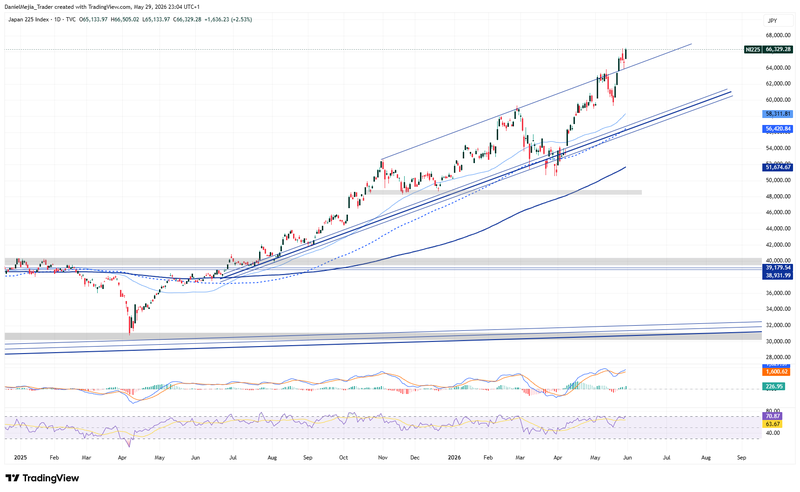
Figure 2. Nikkei 225 Index (2025–2026). Source: Own analysis conducted via TradingView.