
 Support
 OPEC+ agrees to raise oil output from August; Brent declines slightly
OPEC+ agreed to raise output quotas by 188,000 barrels per day from August, adding to earlier increases and pressuring oil prices as flows through the Strait of Hormuz normalise. Brent edged lower, extending a sharp two-month decline.

OPEC+ will raise production quotas by 188,000 barrels per day from August, following nearly 800,000 barrels per day in increases between April and July.
Brent slipped by 0.14% to $72.01, extending a 28% two-month decline as supply conditions improved.
The reopening of the Strait of Hormuz, weaker Chinese imports, and IEA reserve releases added pressure to crude benchmarks.
OPEC+ expands oil output from August; Brent edges lower
According to a Reuters report, the Organisation of the Petroleum Exporting Countries and its allies (OPEC+) have agreed to raise their production quotas by 188,000 barrels per day from August. This follows cumulative quota increases of nearly 800,000 barrels per day between April and July.
The decision is expected to exert downward pressure on oil prices, as it signals a gradual increase in global crude supply alongside the reopening of the Strait of Hormuz, which is helping to restore normal export flows and ease disruptions to energy supply chains. However, the increase in quotas does not necessarily imply an equivalent rise in actual production, as output will continue to depend on members’ production capacity and export conditions.
At the same time, weaker Chinese crude imports and the release of strategic petroleum reserves by the International Energy Agency (IEA) have added further pressure on oil benchmarks. Together, these factors point to a market characterised by improving supply conditions and relatively subdued demand, reinforcing expectations of softer oil prices.
At market close, the Brent futures contract (BRNU6) fell marginally by 0.14% to $72.01 per barrel. The Brent contract has accumulated a depreciation of around 28% over the last two months, reflecting sharp selling pressure amid rising supply and limited demand.
Technical analysis of the Brent futures contract
From a technical perspective, the Brent futures contract is undergoing a volatile period of consolidation. Key observations include:
- Trend context: In the short term, the Brent contract has experienced a highly volatile regime over recent months. Currently, the contract is trading below its 50-day, 100-day, and 200-day Simple Moving Averages (SMAs). Notably, the price has declined by around 28% over the last two months, reflecting sharp selling pressure.
- Resistance levels: Should buyers successfully reclaim the immediate structural resistance at $75, the next major technical ceiling is identified at the $80 threshold. This level represents both a psychological barrier and a pivotal resistance zone within the current market structure.
- Support levels: If the structural support at $68 fails to hold, the next significant floor is located at $60 per barrel, representing a prominent psychological and technical support level. A definitive breach of the $60 zone would significantly increase the probability of a broader and deeper market correction.
- Momentum indicators: Both the Moving Average Convergence Divergence (MACD) and the Relative Strength Index (RSI) are trading in oversold territory. Notably, the MACD indicator is exhibiting a bullish crossover, suggesting that a potential price recovery could occur. However, regardless of these technical configurations, fundamental and geopolitical developments are expected to remain the dominant catalysts for near-term market direction.
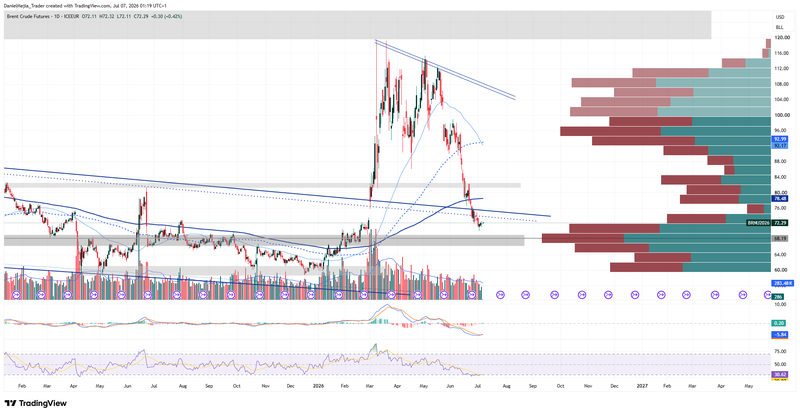
Figure 1. Brent Futures Contract (2025–2026). Source: Data from the ICE-EUR Exchange; own analysis conducted via TradingView.


