Support
 US dollar weakens amid disappointing private payrolls data
Disappointing ADP private payrolls data signalled a slowdown in US job growth, weighing on the US Dollar Index. Consequently, market expectations of a Federal Reserve interest rate hike moderated, shifting investor focus towards upcoming official employment and inflation reports.

August ADP private payrolls added only 38,000 jobs, falling short of the market consensus forecast of 47,000.
The CME FedWatch tool indicated that the probability of a September Fed rate hike fell from 67% down to 62%.
The US Dollar Index slipped marginally by 0.08% to 99.57 points following the weaker-than-expected reading.
Upcoming Bureau of Labor Statistics (BLS) employment and inflation reports remain critical for the Fed’s September monetary policy decision.
Date: 2 September 2026
Why does a weak ADP employment reading reduce expectations of a Federal Reserve rate hike?
A weak private employment report has reduced market expectations of a Federal Reserve interest rate hike, as macroeconomic evidence indicates moderating labour market performance alongside persistent inflationary pressures.
Automatic Data Processing (ADP) Inc. published its monthly assessment of private payrolls, reporting an employment increase that decelerated from 46,000 in July to 38,000 in August, underperforming the market consensus forecast of 47,000. Sectoral analysis reveals that the most prominent gains occurred in "Education and health services" (+45,000) and "Leisure and hospitality" (+16,000). Conversely, the most pronounced contractions were observed in "Manufacturing", which shed 17,000 jobs, and "Professional and business services", which cut 16,000 positions.
Consequently, the latest ADP report highlighted underlying vulnerabilities in its recent reading. From a longer-term perspective, the indicator reflects a broader downward trajectory, pointing to a sustained deceleration in the US private labour market.
Accordingly, market expectations of an interest rate hike declined, though a rate increase remains the prevailing scenario. According to the CME FedWatch Tool, the market-implied probability of a Federal Reserve rate hike at its September meeting decreased from 67% to 62%. Conversely, the likelihood of policy rates remaining unchanged rose to 38%. Furthermore, for the December meeting, the highest probability distribution suggests the US central bank will adjust benchmark rates to 4%, carrying a 39.6% probability, compared to the current benchmark rate of 3.75%.
In this context, market reactions reflect how sensitive monetary policy expectations remain to labour market data, even as inflation pressures continue to be the Federal Reserve's underlying priority. For upcoming periods, the US Bureau of Labor Statistics (BLS) will release its official employment report on 4 September, followed by its inflation assessment on 11 September. These data releases will be crucial for the next Fed monetary policy decision on 16 September.
Following the release of the ADP report, the dollar index—which measures greenback performance against major currencies such as the euro, British pound, and Japanese yen—fell marginally by 0.08% to 99.57 points, amid lowered expectations of an interest rate hike at the Fed’s September meeting.
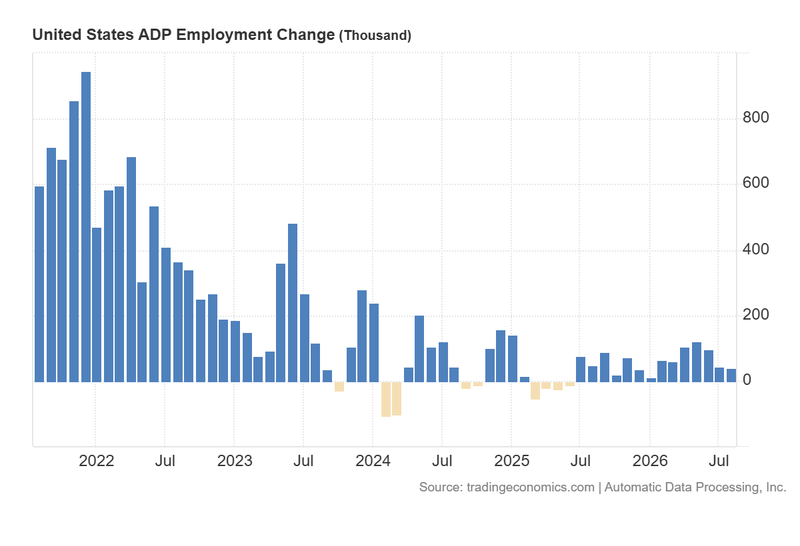
Figure 1. US ADP Employment Change (2021–2026). Source: Data from Automatic Data Processing Inc.; chart obtained from Trading Economics.
Technical analysis of the dollar index (DXY)
From a technical perspective, the Dollar Index exhibits market uncertainty across its short-term trajectory. Key observations include:
- Trend context: Over the medium term, the index remains within a range-bound pattern. However, price action continues to trade above its 200-day Simple Moving Average (SMA), signalling that a bullish bias could remain predominant in the short term.
- Resistance levels: To the upside, the 100.00 level represents a significant technical hurdle and a key psychological barrier. A decisive breakout above this threshold could shift market focus towards the 101.50 handle. A sustained move above 101.50 may signal a broader transition into a higher trading range, probably the 104.00 resistance level.
- Support levels: On the downside, should selling pressure persist, key structural support lies at 98.70. A breach of this floor could bring the next critical area of interest at 96.50 into focus, representing a prominent long-term structural support floor. A breakdown below 96.50 would likely trigger a deeper bearish correction.
- Momentum indicators: Both the Moving Average Convergence Divergence (MACD) and the Relative Strength Index (RSI) are trending upwards, suggesting that short-term bullish momentum could continue. However, macroeconomic fundamentals are expected to act as the primary catalysts dictating future price action.
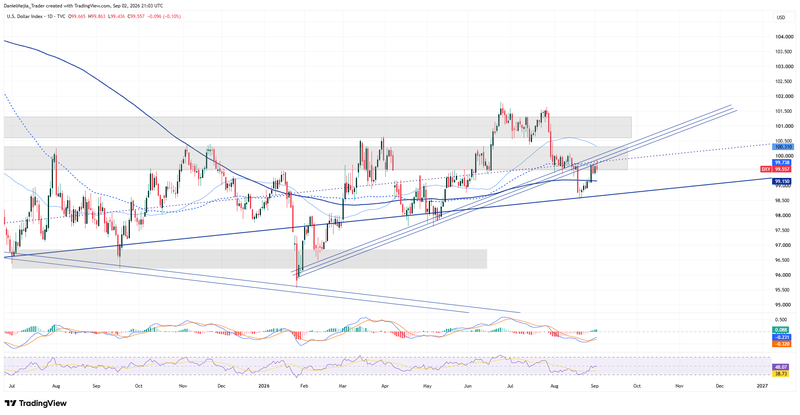
Figure 2. Dollar Index (2025–2026). Source: Intercontinental Exchange (ICE) data; author's analysis via TradingView.