
 Support
 USD/CHF tests a key resistance level; a fundamental and technical overview
The USD/CHF currency pair is testing a key resistance level as hawkish Federal Reserve rate-hike expectations contrast sharply with the Swiss National Bank’s dovish policy stance, widening interest rate differentials and reinforcing bullish momentum.
Elevated US inflation has driven CME FedWatch market-implied probabilities for a Fed rate hike to 93.5%, strengthening the US dollar.
The Swiss National Bank has maintained benchmark interest rates at 0.0% amidst subdued 0.8% inflation and rising 3.0% unemployment, weighing on the Swiss franc.
Upward momentum has propelled USD/CHF to test short-term resistance at 0.8200, with simple moving averages confirming a sustained bullish trend.
Date: 14 September 2026
Could the USD/CHF pair continue its bullish momentum?
The USD/CHF currency pair is currently testing a critical technical zone. This momentum is being driven by mounting expectations that the Federal Reserve (Fed) may adopt a more restrictive monetary policy stance, whereas the Swiss National Bank (SNB) faces little macroeconomic pressure to tighten policy.
According to the CME FedWatch Tool, market-implied probabilities indicate a 93.5% chance of an interest rate hike at the Fed’s meeting this week, with a second rate increase anticipated with higher probability at the December meeting. These expectations point to 25-basis-point rate increases, which would considerably elevate the Fed's current benchmark policy rate of 3.75%. This stems from persistent inflationary pressures in the United States, where headline inflation stands at 3.4% and the Personal Consumption Expenditures (PCE) price index—the Fed's primary inflation indicator—sits at 3.7%. Both metrics remain well above the central bank’s 2.0% target.
Conversely, Switzerland's headline inflation rate stands at 0.8%—its highest level since September 2024, yet remaining comfortably within the 0.0% to 2.0% price stability target range defined by the SNB. Furthermore, unemployment in Switzerland has risen to 3.0%, marking a three-year elevated zone compared to mid-2023 when the jobless rate dropped to 1.9%. Consequently, the Swiss National Bank is likely to prioritise supporting the labour market and economic growth over inflation containment. Notably, Switzerland's benchmark interest rate remains at 0.0%, a level the central bank has held since June 2025.
Against this backdrop, the interest rate differential between both economies is substantial and could widen further should the Federal Reserve adopt a more hawkish stance across its remaining monetary policy decisions in 2026. Additionally, the SNB's 0.0% policy rate offers limited yield for global investors seeking an optimal risk-adjusted return, exerting ongoing selling pressure on the Swiss franc.
Technical analysis of the USD/CHF pair
From a technical perspective, the USD/CHF currency pair continues to maintain a bullish bias, reflecting sustained upward momentum. The following technical factors are particularly relevant to the analysis.
- Trend Context: The pair maintains a bullish structure defined by a sequence of higher highs and higher lows. Furthermore, USD/CHF continues to trade above its 50-day, 100-day, and 200-day Simple Moving Averages (SMAs), reinforcing the prevailing upward bias. Meanwhile, price action is testing a key technical resistance level that could accelerate bullish momentum if breached.
- Resistance Levels: Should the short-term resistance zone near 0.8200 be cleared to the upside, the next critical resistance level lies at 0.8330, marking a prominent structural ceiling. A decisive daily close above these levels would heighten the probability of further upside expansion.
- Support Levels: If the 0.8200 resistance holds and prices are rejected downward, primary demand floors are located at 0.8075 and 0.8000—a prominent psychological level that converges with the 100-day SMA and an ascending trendline. A breach below these support zones would increase the likelihood of a deeper market correction.
- Momentum Indicators: Both the Moving Average Convergence Divergence (MACD) and the Relative Strength Index (RSI) display upward trajectories, suggesting that short-term bullish momentum could persist. Nevertheless, macroeconomic releases and geopolitical developments are expected to remain the primary drivers of price direction.
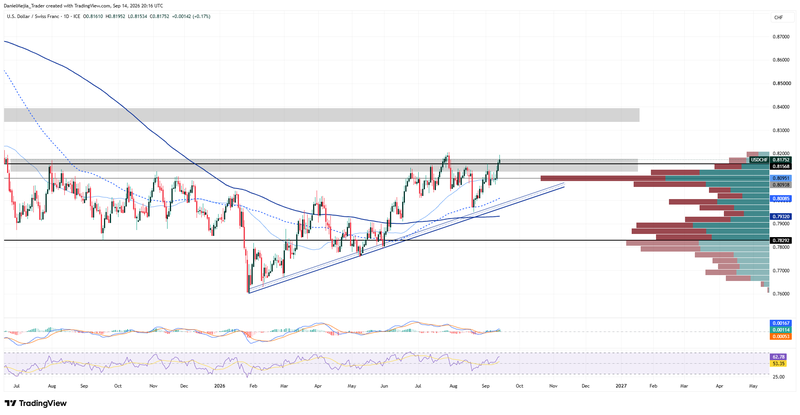
Figure 1. USD/CHF Pair (2025–2026). Source: Data from the Intercontinental Exchange (ICE); author's analysis conducted via TradingView.


