Support
Week ahead: fed rate hike expectations, US retail sales and global inflation in focus
Markets spent the week adjusting to a more hawkish fed without completely abandoning the idea that inflation could ease in 2027. Hot US inflation strengthened the case for a December hike, while weaker housing activity and falling oil prices showed why the tightening cycle may not continue indefinitely.

US core inflation exceeded forecasts, while Waller opened the door to a 50-basis-point hike.
UK growth gave the BoE more room to raise rates again in December.
Finance Minister Satsuki Katayama responded with another warning against disorderly currency moves
Oil headed for a second weekly decline as rising US inventories offset supply risks in the Middle East.
What drives the market this week?
US inflation changed the December calculation
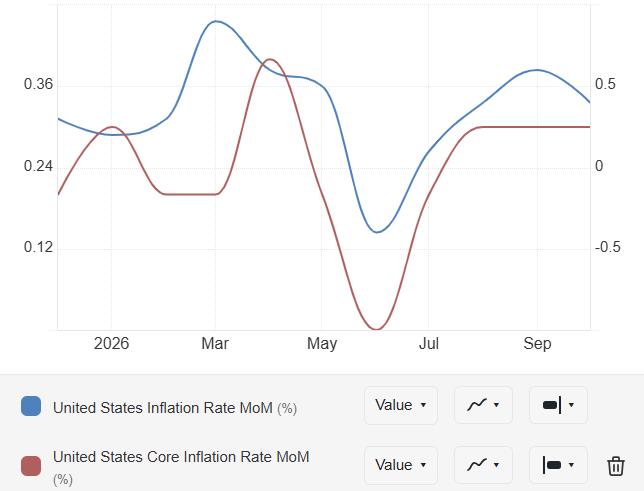
Headline CPI came in at 0.4% against the 0.3% expected, while core CPI remained at 0.3% instead of declining to 0.2% as anticipated.
Prior to the CPI release, markets had already priced in a 25-basis point increase. The more significant market reaction occurred after Waller, the first FOMC member to suggest a 50-basis point hike, commented that core inflation at 0.3% justified the larger hike.
With the 25-basis point hike already baked into the markets, investors saw more potential downside and risk if the Fed was to surprise with a larger hike. The dollar and treasury yields rose as investors positioned for an upside move, although a larger hike was expected to occur in a subsequent meeting.
Source: U.S. Bureau of Labor Statistics
Housing showed the cost of higher rates
As the US housing market continues to falter, the Fed hawks circled to raise rates, especially as headline inflation was beginning to show signs of cooling. The S&P Corelogic Case-Shiller National Home Price Index shows prices remained strong.
Existing-home sales fell 5.5% from September to October and were 8.8% lower than a year earlier. Sales reached an annualized rate of 3.75 million, their lowest level since August 2010.
Mortgage rates were one of the major factors in cooling the housing market. The lack of sales has largely not been reflected in home values. The median price was still 0.4% higher than a year earlier.
While the case for a rate hike is strengthening due to persistent inflation, the housing market is showing signs of already being negatively impacted by restrictive rates. The Fed may be taking a bet that the harm caused by continued hikes will be more moderate and concentrated.
BOE hikes were also supported by growth in the UK
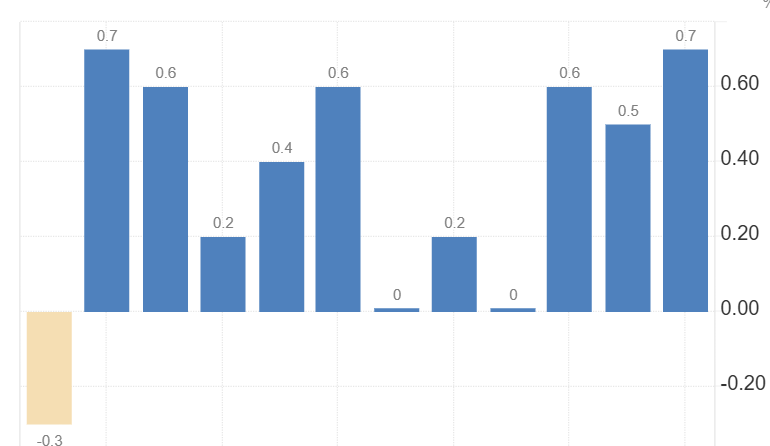
Growth in the UK was better than expected with the third quarter GDP coming in at 0.7% from 0.5% the previous quarter. Annual growth was 1.9% from 0.2% the previous year. The services sector was the primary driver of the growth.
The BoE raised interest rates by 25 basis points to 4%, with markets looking ahead to the possibility of another increase in December, and the probability is reflecting a 73% probability of another hike by year end.
Growth remains uneven. Investment in technology is supporting output. But that’s not the case for households. Energy costs and borrowing costs are rising.
Another interest rate hike could put more downward pressure on retail spending and other interest-rate sensitive parts of the economy.
Source: The office of statistics
The yen broke 160 to the dollar
USD/JPY moved above 160 as expectations of further Fed tightening widened the rate advantage in favour of the dollar.
Finance Minister Satsuki Katayama responded with another warning against disorderly currency moves, but verbal intervention alone may struggle to reverse the trend while US yields remain elevated and the BoJ continues to move cautiously.
The move leaves the pair caught between two opposing forces
The rate gap still supports further upside, but every advance above 160 raises the probability of direct intervention.
That may limit the speed of the rally without changing its direction unless the BoJ adopts a more hawkish position or expectations for US rates begin to fall.
Oil dropped despite geopolitical risks in the Middle East
WTI traded below $88.50, prices were on track for a second weekly decline. Trump said he would keep up the blockade on Iranian oil shipments. Meanwhile, Saudi energy facilities were attacked and oil tankers in the Gulf of Oman were again targeted.
Traders, however, didn’t view these events as foreshadowing a large-scale geopolitical event that would impact the oil market.
The physical market also weakened, US crude inventories increased by 4.7 million barrels, with expectations only for a 1.1-million-barrel decrease. The geopolitical premium was capped with the increase in oil stocks and the softer demand for refined products.
What will drive markets next week?
Canada's CPI will be in focus
Annual inflation is expected to rise slightly from 3.1% to 3.2%, so a modest increase is unlikely to surprise the Bank of Canada.
The market reaction will depend more on whether core inflation shows that higher energy costs are spreading into services and other domestic prices.
Persistent underlying pressure would strengthen the case for another hike, while softer core readings could suggest that October’s increase was enough for now.
Oil makes the Canadian dollar’s reaction less straightforward
Lower crude prices could ease future inflation and reduce the need for further tightening, but they would also weaken Canada’s export income. If CPI undershoots while oil continues falling, USD/CAD could rise even without a broader advance in the US dollar.
US consumers face a higher-rate test
The housing market is already adjusting to higher borrowing costs, but that doesn’t indicate the broader economy is contracting.
Will the same be true for consumers? Expectations of persistently high inflation and continued strong spending signal to the fed that they will likely raise interest rates beyond December.
A weak report may make the case for increases after December less likely. The Fed is concerned with tightening into a weak demand.
The Fed would then be tightening into weaker demand, increasing the risk that the next hike slows the economy more sharply than intended.
Eurozone inflation will see its last read
A final reading isn't likely to move the markets, but it will show inflation to be roughly 4%. The important consideration is if inflation remains solely in energy, which was up 20.8% in the latest flash estimate, or if it spreads to other areas of the economy.
If upward revisions to services inflation indicate that cost pressures are feeding through to wages and business prices, the ECB may conclude that further policy tightening is warranted.
If 4% inflation is largely an energy story, and underlying inflationary pressures are more subdued, the euro may struggle to benefit as markets may view the inflation surge as being temporary.
Warsh may shift expectations for December
Markets have already absorbed the likelihood of a December hike. Warsh’s speech therefore matters less for the direction of the next move than for its possible size.
If the Fed chair supports Waller’s willingness to consider 50 basis points, the larger move would become an institutional possibility rather than one policymaker’s warning. That could lift short-term yields and the dollar even if 25 basis points remains the base case.
If Warsh continues to favour gradual tightening, markets may reduce the premium attached to a larger move without abandoning expectations for December.
The FOMC minutes may reveal the appetite for more tightening
The focus will be the reasoning behind the Fed’s decision to hold rates even as inflation accelerated from September and core pressure remained firm.
Markets will want to know whether most officials viewed the increase as temporary, believed the September hike needed more time to work, or preferred to wait for another CPI report before tightening again.
The language around growth will also matter. The Fed moved from describing activity as expanding at a “solid pace” in September to a “strong pace” in October, making the decision to pause harder to explain through economic weakness.
The minutes may therefore show that the hold was about timing rather than a change in direction particularly as two members preferred an immediate 25-basis-point increase.
Bailey will need to weigh stronger growth against weak households
The UK’s 0.7% third-quarter growth gives the BoE more room to raise rates without immediately pushing the economy into recession. It does not, however, settle whether another hike is necessary.
Bailey’s interpretation of that growth will matter. If technology investment is expanding productive capacity while households remain cautious, stronger GDP may not create much additional inflation.
If the BoE believes growth will keep wages and services prices elevated, the case for a December hike becomes stronger. The question is no longer whether the economy grew, but whether that growth adds to inflation or helps the economy absorb it.
Gold - technical outlook
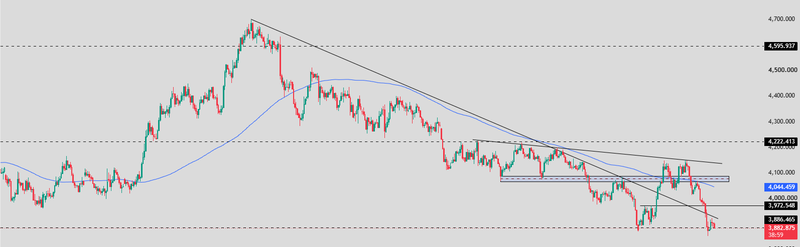
Gold is trading near $3,883 after breaking below $3,972 and retesting the major $3,886 support. The broader trend remains bearish, with lower highs and prices trading below the declining moving average near $4,044.
A sustained close below $3,886 would confirm further weakness, potentially extending losses toward $3,850 and $3,800.
If gold reclaims $3,886 and buyers defend this area, a recovery toward $3,972 could follow. A break above this resistance would open the way toward $4,044–$4,085, although the broader bearish trend would remain intact.
Source: Trading view
Crude oil - technical outlook
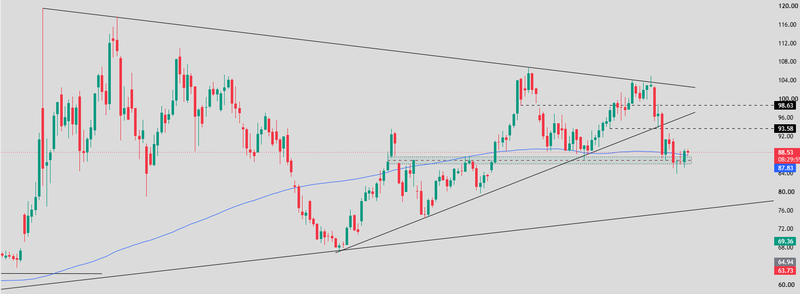
Crude oil is trading near $88.53 after breaking below the ascending trendline and losing the $93.58 support level. The decline from $104 has weakened the recovery structure, leaving prices consolidating around the $87–$89 zone, close to the moving average at $87.83. Selling pressure remains dominant below $93.58.
A sustained break below $87 could extend losses toward $80, followed by the rising support near $77.
Holding above $87 and reclaiming $93.58 could support a recovery toward $98.63, with $103–$104 remaining the next major resistance area.
Source: Trading view