Support
Week ahead: persistent inflation keeps central banks cautious as growth signals diverge
Markets enter the new week facing an increasingly difficult economic picture. Growth is losing momentum in several major economies, while persistent inflation continues to limit the room for central banks to ease monetary policy.
Japan's annual inflation rate accelerated to 2.3% from 2.1% in the previous month
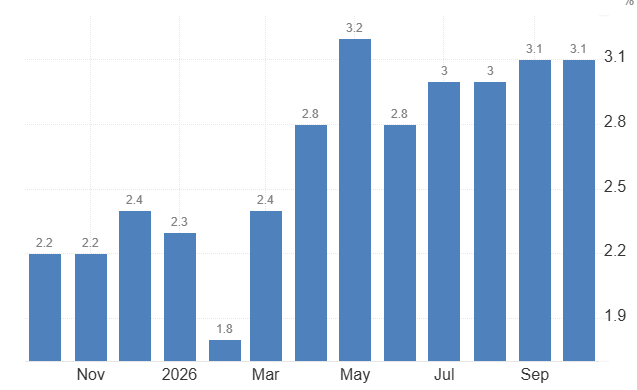
Canada's annual inflation rate stood at 3.1% in October, slightly below expectations of 3.2%.
The US, China and Russia announced plans to increase refined petroleum product supplies.
UK unemployment declined to 4.6% from 4.7%, while inflation increased to 3.6%.
What drove markets this week?
Japan's rising inflation strengthens BoJ next hike expectations despite stalled growth
Japan's economy was flat in the latest quarter, down on the 0.4% growth of the previous quarter and falling short of the 0.1% growth that was expected. The weaker reading makes it harder for the BoJ to move towards normalizing policy.
Higher borrowing costs could put further pressure on household spending and business investment at a time when economic activity is already stagnating.
Meanwhile, Japan's annual inflation rate accelerated to 2.3% from 2.1% in the previous month, reaching its highest level since November 2025. The increase adds pressure on the BoJ to continue tightening monetary policy, even as economic growth loses momentum.
Markets are pricing in an 84% chance of a BoJ rate hike, suggesting that inflation concerns continue to outweigh the weaker growth outlook.
The challenge for policymakers will be determining whether wage growth and underlying inflation are strong enough to justify higher interest rates without putting further pressure on an already weak economy.
Canada's inflation holds at 3.1%, giving the BoC room to wait
Canada's annual inflation rate came in at 3.1%, a bit below the 3.2% that people had been expecting but still well above the Bank of Canada's 2% target. The weaker reading does at least provide some comfort that price pressures aren't picking up.
A modest inflation miss is unlikely to change the BoC's outlook on its own, policymakers would need to see a sustained slowdown in underlying price pressures before becoming more comfortable with easing.
If inflation stays right where it is though, the case for keeping rates restrictive for longer may be stronger.
Source: Statistics Canada
UK inflation climbs to 3.6% as consumer spending strengthens
UK unemployment declined to 4.6% from 4.7%, while inflation increased to 3.6%. Retail sales also exceeded expectations, rising by 0.7% month on month and 2.3% annually, compared with forecasts for no monthly growth.
Stronger retail sales suggest that households continue spending despite elevated borrowing costs. Combined with lower unemployment and rising inflation, resilient consumer demand could make it harder for the Bank of England to bring inflation back toward its 2% target.
Markets are pricing in a 78% probability of a BoE rate hike, suggesting that investors expect policymakers to maintain a restrictive approach as inflationary pressures persist.
For sterling, the BoE's guidance on future policy decisions could therefore have a greater influence on the pound than the rate increase itself.
US retail sales slow as households keep spending
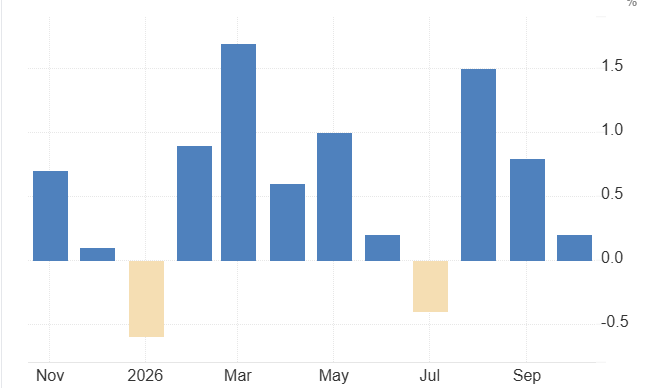
US retail sales increased by 0.2% month on month, matching expectations but slowing from the previous 0.8%. Annual growth reached 6.8%, exceeding forecasts.
The figures suggest that consumer demand remains resilient despite slower monthly momentum. For the fed, continued household spending supports economic growth but could also make inflation more difficult to contain.
Although higher borrowing costs may be gradually slowing demand, the annual increase gives policymakers little reason to assume consumption is weakening significantly.
Source: U.S. Census Bureau
Fed minutes reveal how close October came to a rate hike
The Federal Reserve's October meeting minutes revealed a more hawkish discussion than the decision to hold rates initially suggested.
Most policymakers considered further tightening likely to be appropriate if inflation remained above target. Some viewed the decision to hold as a close call, while a larger increase could become necessary if upcoming inflation data proved unfavorable.
Policymakers also raised concerns about rapid investment in artificial intelligence and related technologies.
While AI investment could improve productivity over time, heavy borrowing to finance projects with uncertain future returns presents financial risks. Rapid spending on data centres, electricity infrastructure and computing equipment could also add to inflationary pressures.
If investment returns disappoint, highly leveraged projects could result in financial losses and tighter credit conditions, creating another challenge for the Fed alongside persistent inflation.
Eurozone prices edge above forecast as growth remains fragile
The eurozone consumer price index increased to 104.8 from 104.31, slightly exceeding expectations of 104.77, however annual eurozone inflation reached 4.0% in October, up from 3.8% in September.
Markets are pricing in a 97% probability of an ECB rate hike, suggesting that investors expect further tightening despite fragile economic growth.
With a hike already widely anticipated, the euro's reaction may depend more on the ECB's guidance. Signals of further increases could support the currency, while indications that tightening is approaching its end may limit gains.
US, China and Russia pledge more fuel without setting supply targets
The US, China and Russia announced plans to increase refined petroleum product supplies following volatility in global fuel markets, particularly diesel, where supply disruptions have raised concerns about shortages and higher prices.
Additional supplies could ease pressure on fuel prices, but the impact will depend on refinery capacity, crude oil availability and whether increased volumes reach markets facing shortages.
Diesel remains particularly important for transportation, manufacturing and agriculture, meaning prolonged shortages could raise business costs and contribute to broader inflationary pressures.
What to watch next week
Australia's underlying inflation could strengthen the case for another RBA hike
Australia's annual headline inflation reached 4.3% in September, while underlying inflation remained elevated, the expectations for October headline inflation to rise to 4.8%, with trimmed mean inflation increasing from 3.6% to 3.7%.
A stronger reading could reinforce expectations of further RBA tightening, particularly after the central bank raised its policy rate to 4.85% earlier this month.
For the AUD, the higher-than-expected inflation could provide some support via rate expectations. Softer data on the other hand could have the opposite effect and reduce the chances of further tightening.
US GDP will show how well growth is holding up under higher rates
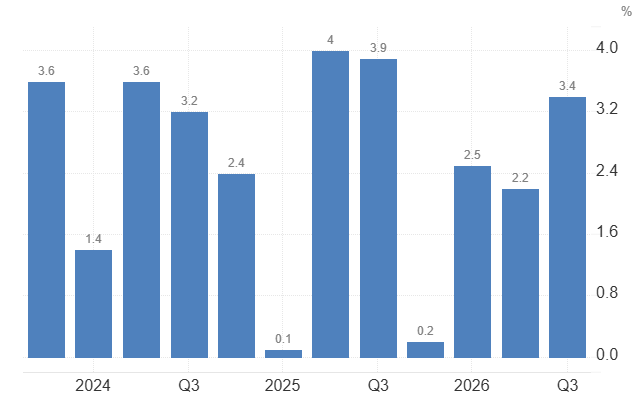
The US economy expanded at an annualised rate of 3.4% in the third quarter, accelerating from 2.2% previously. Next week's second GDP estimate will show whether the initial reading is revised.
Stronger growth would point to the economy continuing to weather the higher interest rates, thus giving the Fed more scope to keep policy on the restrictive side. However, the growth will also be important in terms of its composition.
Strong household spending and solid business investment would be an indication of resilient domestic demand. Growth which is inventory driven or growth which is purely a temporary trade effect would be far less impressive.
For the dollar, stronger GDP could provide some support by reinforcing the view that rate cuts aren't imminent.
Source: U.S. Bureau of Economic Analysis
US PCE could put the Fed in a bind if inflation rises as spending falls
US core PCE is expected to increase from 3.1% to 3.2%, personal consumption is set to fall by 0.1% so there's a suggestion that household spending is losing steam.
Higher than expected inflation coupled with very strong underlying spending could be fueling expectations of further Fed tightening which in turn would support the dollar and Treasury yields and put more pressure on equities and gold
However, with weaker consumption and softer month on month inflation it could be that the restrictive policy is beginning to reduce the demand pressures.
The tougher outcome would be inflation persisting while consumption was falling, leaving the Fed with less room to deal with inflation without further slowing the economy.
Gold – technical outlook
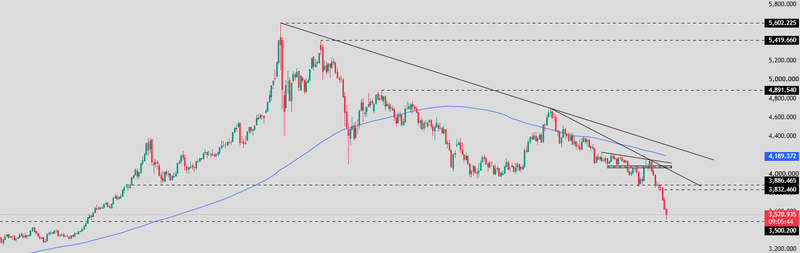
Gold has fallen below the critical support levels at $3,886 and $3,832 and is now aiming for $3,586. The decline below the support levels comes after gold broken down from a descending triangle pattern.
A clear break below $3,500 would open the door to lower levels, with immediate support expected at $3,400 and second support potentially located at $3,300. The bearish view will remain in place while gold is trading below $3,832.
A positive scenario could play out if gold defend the $3,500 level and trades above $3,832. A move above $3,832 would allow for a relief rally to test $3,900.
A sustained break above the descending trendline at $4,050 would weaken the bearish outlook and suggest that buyers are beginning to regain control, potentially opening the door to a broader recovery.
Source: Trading view
Crude oil – technical outlook
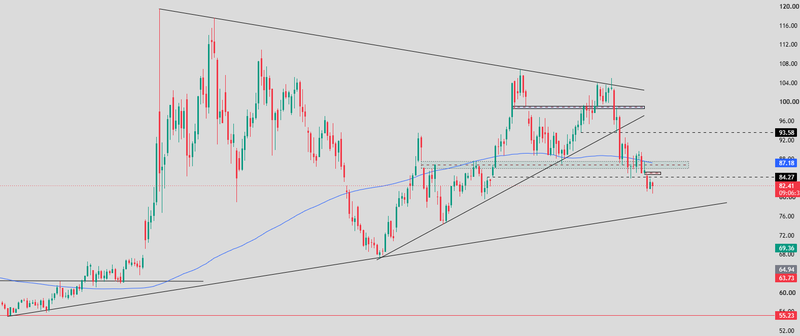
The price of crude oil is currently trading at $81.63, having broken through the $86 support zone and the $84.27 level. The trend from $104 has seen a series of lower highs. The previous breakdown from the rising trendline confirmed a deterioration in the buying momentum.
A break below the $80.90 level would open the door to the $79-78 area, which is supported by the long-term ascending trendline. Further losses below this level could see prices fall to $75, and possibly to $69.36.
If buyers defend $78–$79 and push prices back above $84.27, a recovery toward $87–$88 could follow. A sustained break above this resistance zone would improve the outlook and bring $93.58 back into focus.
Source: Trading view