Support
Week ahead: US inflation, UK GDP and political shifts put markets to the test
Markets head into the week with a tough set of factors in terms of price. The US manufacturing and labour market data are all pointing to continued strength in the economy, but inflation is still high enough to leave the Fed with very little room to ease. All the same, the political developments in Washington, the big fall in oil prices and the renewed pressure on the tech names are all forcing investors to look at risks outside the economic cycle.

US manufacturing and labour market indicators were up, though services activity was a bit softer.
Inflation in the Eurozone picked up to 4.0% in October, retail sales were down.
Democratic gains at the state and local level could see AI infrastructure projects under the microscope.
Crude oil went down 17% as markets repriced the Middle East and the geopolitical risk premium.
What drove the markets this week?
US economic data – resilience leaves the Fed with little room to relax
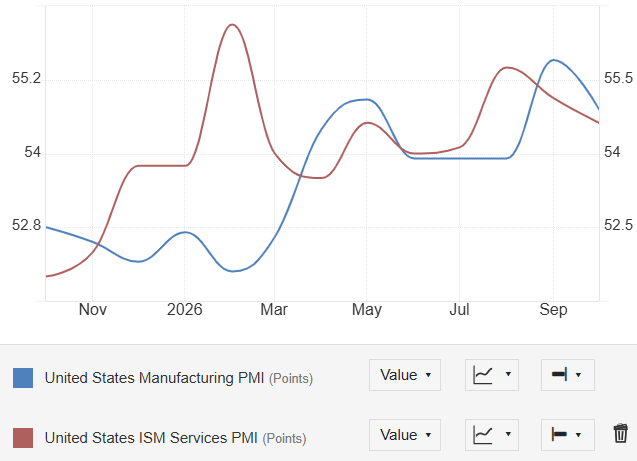
The latest US data has once again confirmed the view that the economy is still very much on a roll. The ISM Manufacturing PMI climbed to 55.5 (vs 54.6 expected), JOLTS job openings were up to 7.523m vs 7.1m expected, ADP employment was up 86k vs 69k expected and initial claims fell to 189k.
The services sector was a bit more mixed
The ISM Services PMI was 54.5, slightly below the 54.8 forecast, but still in expansion. The data taken together don't suggest an economy that's in any real danger of losing momentum.
That's important for the Fed as resilient demand and employment will continue to exert pressure on wages and prices, making it very difficult to justify a rate cut whilst inflation is still above target.
Source: S&P Global
RBA – inflation is narrowing the room for policy easing
The RBA raised its cash rate by 25bps to 4.85% (its highest level since 2008). The 6–3 vote was more interesting than the 25bps itself. Three of the committee members preferred to hold rates at 4.60% which suggests there is a clear division of opinion as to how much further the economy can absorb rate tightening.
The Boe also hiked Bank Rate by 25bps to 4%
Eight voted in favour, Catherine Mann preferred a bigger increase to 4.25%. The Bank of England's worry is that inflation which was 3.5% in Sep could then feed into 2027 wage setting and become more entrenched.
That's a very difficult balancing act: you need to prevent inflation from being embedded in the wage bill, but you also don't want to go any further with tightening as that would add further pressure on households and firms who are already under enormous pressure from high levels of debt.
Eurozone – higher inflation meets weaker consumption
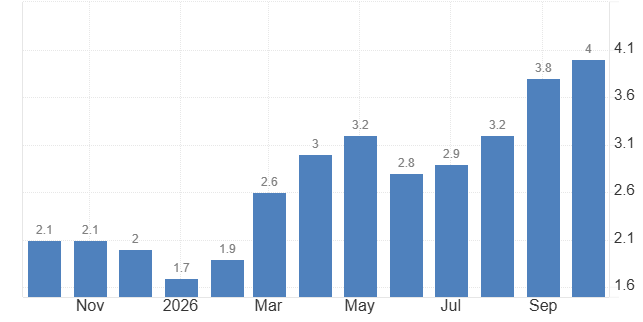
Eurozone inflation picked up to a flash estimate of 4.0% in October highest level in 3 years. Energy inflation was up 20.8% y/y and services inflation went up slightly to 3.3%. Core inflation stayed flat at 2.5%.
The headline inflation split is important
The acceleration was primarily due to energy rather than a broad-based rise in underlying prices. The pressure is by no means to be ignored though, especially if the higher energy costs start to filter through into transport, production and household spending.
Retail sales were down 0.7% month on month vs a expected 0.1% fall with annual growth at 0.4%. The data suggests the consumer sector is having some difficulty in maintaining momentum as the cost of living is still very high.
For the ECB this is a very uncomfortable mix
Cut rates too soon and you risk letting energy price rises get transmitted, cut them for too long and you risk exacerbating the consumption weakness.
The persistence of services inflation will be key in determining whether the latest headline rise changes the policy trajectory.
Source: Eurostat
US midterm elections – a new constraint on Washington
Democratic gains in both chambers of Congress are a major shift in the political balance of Washington. That will almost certainly lead to greater scrutiny of the Trump administration's spending and policy, though the actual limits on what the executive can do will be down to the legislation and oversight that is ultimately enacted.
For markets the implications go well beyond the realm of party politics
A more divided Congress would make fiscal policy far less predictable and would make it much harder for the administration to get its economic agenda through. It would also add another layer of uncertainty to the government's approach to spending, regulation and foreign policy.
The election result doesn't necessarily mean a reversal of the policies we've already got in place. Investors will have to work out the difference between political pressure, proposed legislation and what in fact can be delivered.
Technology stocks – AI investment faces a tougher test
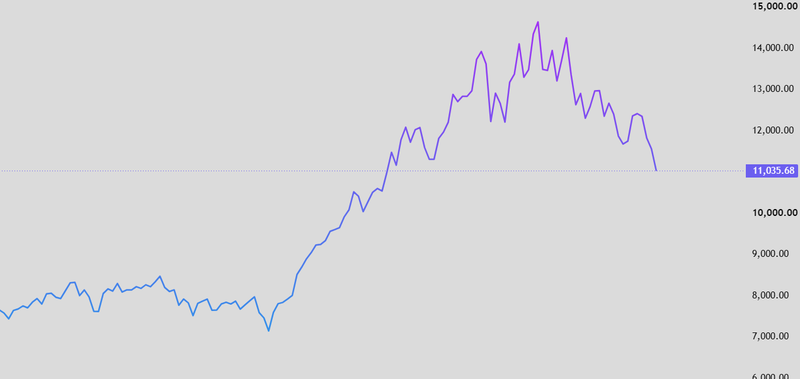
Technology shares were in freefall with the Nasdaq down 5.5% and the Philadelphia Semiconductor Index down over 12%.
The sell-off reflects increasing concern that the economics of AI infrastructure may not be as rosy as the sheer scale of investment would suggest. Data centres must have power, water, grid connections and planning.
Anyone of those can cause a project to be delayed and the cost of capital continues to be a drag on the returns that you're expecting from such a large capital outlay. Democratic gains at the state and local level add a regulatory dimension.
A great deal of the decision making around land use, power supply and construction permits happens at state and local level and that level of scrutiny could well be a brake on the expansion of data centre capacity.
This in no way removes the need for AI computing
It simply raises a different question: how quickly can that demand be turned into revenue and cash flow? For companies who are throwing down the kind of capital we're talking about here, delays in that process can have an impact on financing costs and the timing of the return. That distinction is increasingly important to the investors who are valuing the sector.
Source: TradingView
Crude oil – the geopolitical risk premium unwinds
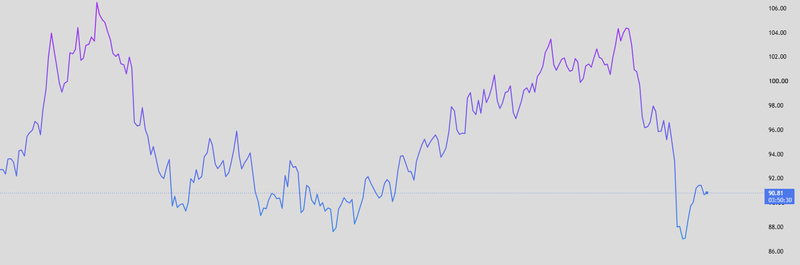
Crude fell 17% as traders re-evaluated the chances of de-escalation in the Middle East. The prospect that political shifts in Washington might constrain the extent of foreign military funding decisions may also have played a part.
The sheer scale of the decline suggests that investors had been carrying a significant geopolitical risk premium into oil prices.
As the risk of further disruption diminished, that premium was effectively wiped out. However, a change in political expectations is not in itself a sign of an improved physical supply.
A sustained decline will be down to whether diplomatic progress leads to a reduction in the risk of disruption to production and to shipping. Until that happens oil is still very much subject to a further bout of volatility.
Lower prices could go some way towards easing inflation worries by reducing the cost of energy, though the impact on central bank expectations will depend on whether the fall continues and works its way through to consumer prices.
Source: TradingView
Strong US jobs report raises expectations for a December fed rate hold
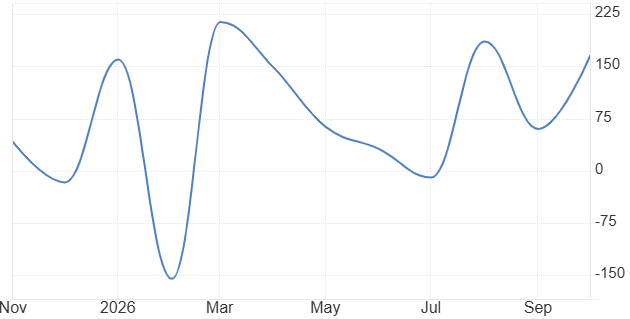
The US labour market delivered a stronger-than-expected report, reinforcing the case for the Federal Reserve to keep interest rates higher for longer. Nonfarm payrolls increased by 165,000, well above the 65,000 forecasts, while the unemployment rate edged down to 4.1% from 4.2%, against expectations of no change.
Wage growth added to the inflation concern, with average hourly earnings rising 0.4% month on month, compared with the 0.3% forecast. The combination suggests that employment demand remains resilient and wage pressures have not eased as quickly as policymakers would prefer.
That makes a December rate cut harder to justify, particularly if inflation remains sticky. Markets responded by raising the implied probability of a December rate decision that leaves borrowing costs unchanged to around 80%. The report does not rule out future easing, but it gives the Fed less reason to rush into another cut.
Source: U.S. Bureau of Labor Statistics
What to watch next week
US inflation – will the data confirm a moderation?
US headline CPI is due to slow from 0.6% to 0.3% monthly, core inflation is forecast to fall from 0.3% to 0.2%. The annual headline rate is expected to stay at 3.7%.
A gentler monthly reading would have suggested that the price rise in September wasn't carried forward at the same rate. A moderation in core inflation would be more important for the Fed as it would imply some easing of price pressures outside of energy and food.
The market reaction will be down to the make-up of the report
If services and the other underlying components are still solid, then a lower headline number may provide only modest comfort.
A stronger than expected release on the other hand could be enough to push Treasury yields higher and support the dollar, especially following this week's employment and manufacturing data.
UK GDP – is growth strong enough to sustain restrictive policy?
UK GDP growth is due to be 1.7% year on year (up from 1.4%) with monthly growth rising from 0.1% to 0.2%. A more robust reading would be that the economy is taking the high borrowing costs far better than we'd anticipated.
That would give the BoE a bit more scope to keep its restrictive policy in place, especially given the concerns of the policymakers around inflation making it into the 2027 wage round.
A more modest result would of course increase the cost of that approach. It could feed expectations of further rate cuts and put some pressure on the pound, though the inflation outlook would still be the key factor in the BoE's decision.
US PPI – are higher input costs finally starting to ease?
Monthly producer price inflation is expected to fall from 1.3% to 0.4%. Following the sharp rise in September that would have been a cause for concern in terms of higher business costs being passed on to consumers, a slowdown would be a welcome development.
Producer prices don't pass straight through to the CPI though and not in full. Margins, demand and pricing power all have an impact on how much of the increase gets to the consumer. A softer PPI would therefore be a positive sign but wouldn't be sufficient evidence that inflation is on its way back to a sustainable level.
Gold – technical outlook
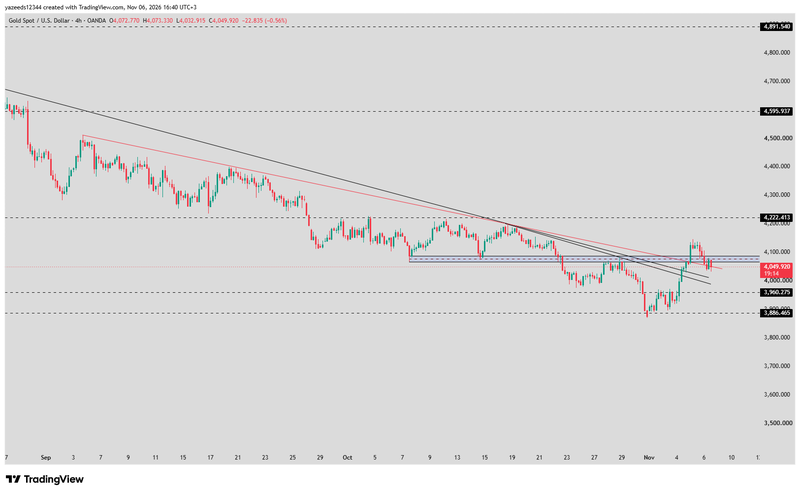
Gold rebounded strongly from the $3,886 area, recovering towards $4,120 and briefly moving above the descending resistance structure.
However, the latest move has been rejected, bringing the price back to $4,050.
This suggests that buyers have not yet established control and that the broader corrective structure remains in place.
If gold holds above $4,000 and recovers the $4,070–$4,085 zone, the rebound could extend towards $4,120. A break above that recent high would strengthen the recovery and bring $4,222 back into focus.
However, failure to reclaim the resistance band, followed by a break below $4,000, would expose $3,960. A sustained move below that level could bring the recent low near $3,886 back into focus.
Source: Trading view
Crude oil – technical outlook
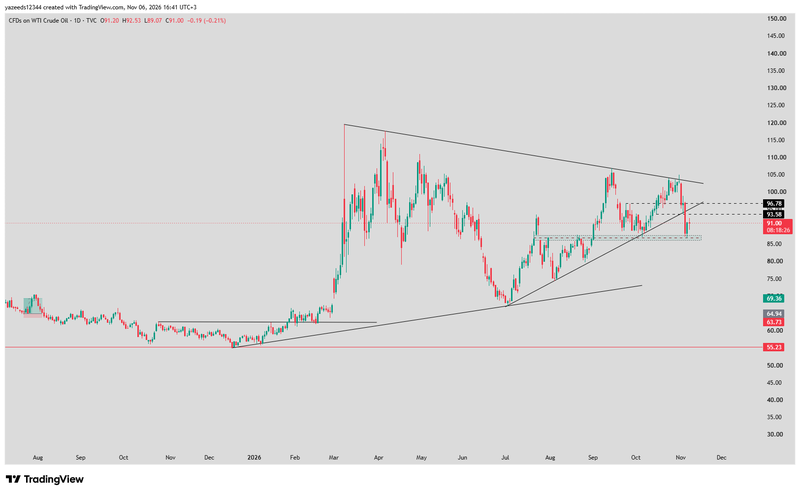
WTI has weakened considerably after failing to break above the descending resistance trendline near $104–$105. The latest decline has taken the price below the rising support trendline that had guided the recovery since July. It has also moved below the marked $96.78 and $93.58 levels.
WTI would need to recover $93.58 and then reclaim $96.78 to ease the immediate selling pressure. A sustained move above this second level could open the way towards $100–$105, although the descending trendline remains a major obstacle.
However, if the price remains below $93.58, sellers could retain control and push crude towards the $85–$87 support zone. A decisive break below that area would expose the broader support region around $75–$69.
Source: Trading view
Nasdaq – technical outlook
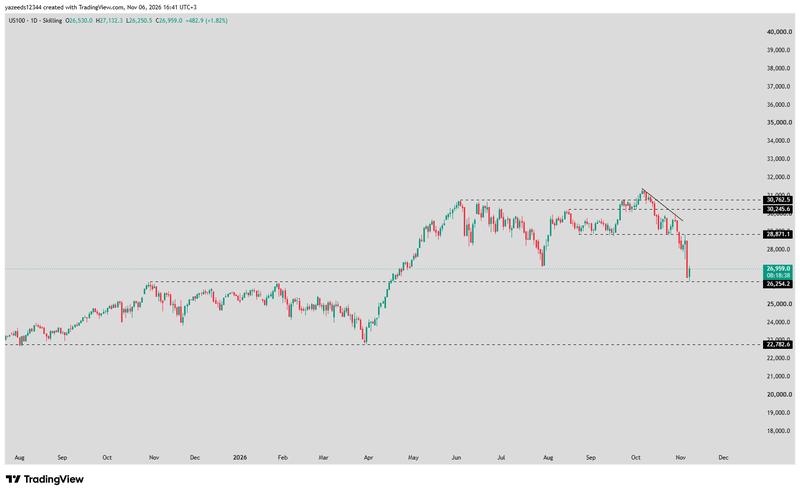
Nasdaq 100 remains under strong bearish pressure after breaking below the key support at 28,871, confirming a deterioration in the short-term trend.
The sharp decline toward 26,254 has brought the index to a critical support area, where buyers are attempting a rebound.
Holding above 26,254 could support a technical recovery toward 28,871. A sustained break above this resistance would be needed to improve the outlook and open the way toward 30,245.
However, a daily close below 26,254 would confirm further downside pressure, potentially extending the decline toward the next major support at 22,782.
Source: Trading view