Support
Week ahead: US tariffs, Fed rate hikes and jobs data in focus
Markets faced renewed pressure as proposed US tariffs and persistent inflation reinforced Fed tightening expectations. The Nasdaq fell amid AI valuation concerns, while weaker US consumer spending contrasted with strong GDP growth. Meanwhile, rising inflation in Australia and Japan added to global monetary policy pressures.

The US has proposed Section 301 tariffs on 14 trading partners.
US third-quarter GDP growth was revised up to 4.3% annualized from 3.4%.
October core PCE inflation rose to 3.3% annually, from 3.1% in September.
Tokyo's core inflation accelerated to 2.9% from 2.6%.
What drove markets this week?
New US tariffs could bring another inflation shock
The US has proposed Section 301 tariffs on 14 trading partners, including China, the EU and Japan, with public hearings scheduled for January 2027.
The proposals arrive while the Fed is still struggling to contain inflation and importers facing higher duties would have to choose between raising prices and accepting smaller margins or passing costs to consumers could weaken demand, while absorbing them would leave companies with less money to invest or hire.
A one-time tariff increase would raise prices without necessarily causing inflation to accelerate indefinitely, but the consequences could extend beyond imported goods if higher costs feed into domestic production, transportation and eventually wages.
The Fed has limited tools to address that kind of inflation, because raising rates would restrain demand but do little to reverse the original increase in import costs and the economy could therefore face weaker spending without an equally rapid decline in inflation.
Nasdaq sell-off puts AI investment returns under scrutiny
Nasdaq lost approximately 7.3% this week, as investors became less willing to pay elevated valuations for technology stocks.
The selling comes despite continued business investment and US equipment investment increased 21.8% annualized in the third quarter, while spending on intellectual property products rose 13.6%.
On the other hand, AI infrastructure requires substantial upfront investment, with profits that may not arrive for several years, and with yields remain elevated, investors start reducing exposure and that will put additional pressure on prices even before companies report weaker earnings.
For a lasting recovery, the market needs either more convincing evidence that AI spending is producing profits or lower yields that make future earnings more valuable.
Strong GDP masks a loss of momentum in services
US third-quarter GDP growth was revised up to 4.3% annualized from 3.4%, and flash services PMI, however, fell to 54.7 from 56.1.
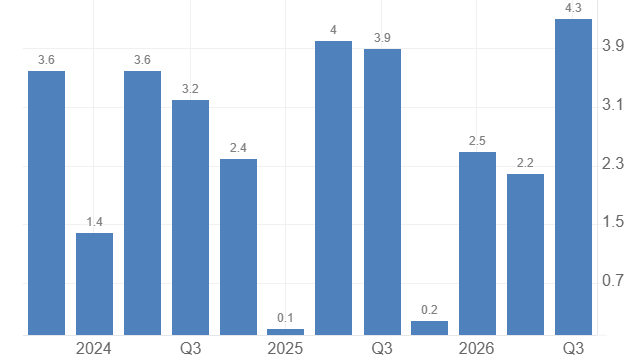
Source: U.S. Bureau of Economic Analysis
The economy remains in expansion, but investors now must decide how much weight to place on the strong third quarter when more recent indicators are pointing toward slower activity.
That creates a potential problem for Fed expectations, because strong GDP gives policymakers room to keep raising rates, but November's weaker services reading suggests that the economy could enter 2027 with less momentum than the headline growth figure implies.
If the slowdown begins affecting hiring and business investment, markets may start questioning how much additional tightening the economy can withstand.
Inflation remains high while real consumer spending weakens
October core PCE inflation rose to 3.3% annually, from 3.1% in September. Consumer spending, meanwhile, increased just 0.3% in nominal terms and declined slightly after adjusting for inflation.
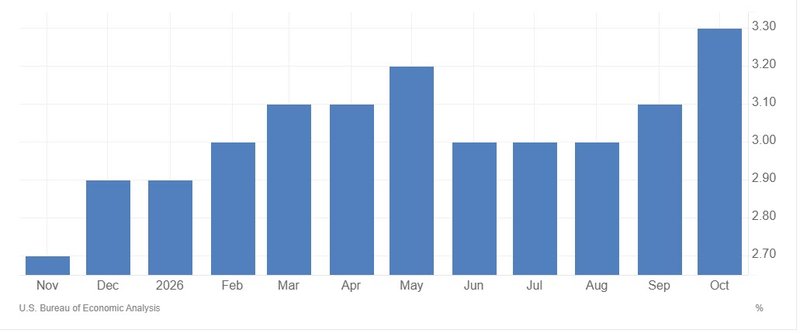
Source: U.S. Bureau of Economic Analysis
Households are paying more without purchasing more, and for businesses, that limits the ability to keep raising prices without losing customers, especially in discretionary spending categories.
Yet slower consumption may not bring immediate relief from inflation because wages, imported materials and financing costs can remain elevated even as sales weaken.
The greater risk heading into 2027 is that household demand loses strength before inflation falls sufficiently, then the Fed could find itself raising rates into a weakening economy, with companies facing pressure from both slower sales and higher borrowing costs.
Australian inflation puts more pressure on the RBA
Australia's annual inflation rose to 4.9% in October from 4.3%, while trimmed mean inflation increased to 3.8% from 3.6%.
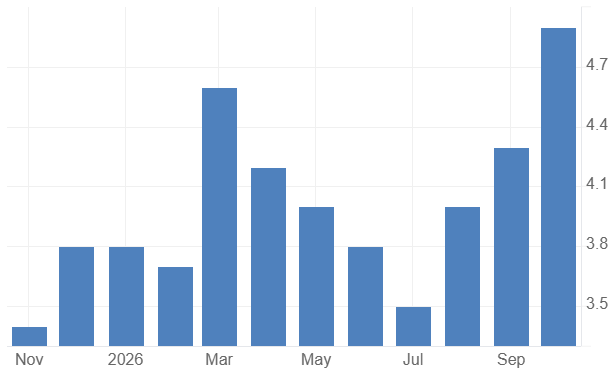
Source: Australian Bureau of Statistics
The acceleration in underlying prices leaves the RBA with a stronger case for further tightening and Australia's exposure to variable mortgage rates and that means higher borrowing costs could quickly reduce household spending.
That creates a limit to how much support higher rates can provide the Australian dollar. AUD/USD may benefit if Australian yields rise relative to US yields, but weakening domestic demand could eventually undermine that advantage.
Tokyo inflation rises, but the yen struggles to recover
Tokyo's core inflation accelerated to 2.9% from 2.6%, largely because of higher energy prices.
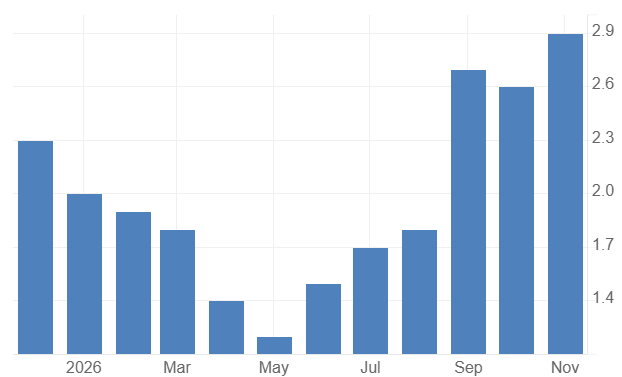
Source: Statistics Bureau of Japan
The weak yen is part of Japan's inflation problem, because more expensive imports increase household costs, yet the resulting pressure on consumption makes aggressive BoJ tightening harder to justify.
Markets already expect a December rate hike, but USD/JPY remains near 160
A 25-basis-point increase may accomplish little for the currency if the Fed raises rates by the same amount. The interest-rate gap would barely change, leaving dollar assets attractive to investors borrowing in yen.
A sustained yen recovery would require that gap to narrow or a change in expectations large enough to encourage investors to unwind carry trades.
What will drive markets next week?
US payrolls could change expectations for 2027
November nonfarm payrolls are expected to rise by around 90,000, compared with 165,000 in October. Unemployment is forecast to remain at 4.1%.
With a December Fed hike widely expected, Friday's report could matter more for the policy outlook in early 2027.
Payroll growth below 85,000, accompanied by higher unemployment, would suggest that tighter monetary policy is beginning to affect hiring.
Yields could fall as investors reduce expectations for additional hikes, and that might initially support gold and equities.
Payrolls above 110,000 alongside firm wage growth would tell a different story, because labour demand would still be holding up, giving the Fed more reason to maintain its tightening path.
The market reaction will depend on whether investors welcome resilient growth or become more concerned about the additional rate increases it could justify.
ISM manufacturing: are companies losing pricing power?
The ISM Manufacturing PMI is expected to moderate from October's 55.5 reading while remaining above 50.
The headline will matter less than new orders, employment and prices paid, because if orders remain strong while costs rise, manufacturers may still have enough demand to pass those costs on to customers.
Weakening orders alongside elevated input prices would be more troubling than companies could face shrinking margins without relief from production costs, increasing the risk of reduced hiring and investment.
Eurozone data could challenge the dollar's advantage
Eurozone unemployment is expected near 6.5%, while retail sales will show whether household spending recovered after September's 0.7% monthly decline.
Weak consumption would strengthen the case for a less restrictive ECB, provided inflation allows it. If US employment also remains resilient, expectations of a wider interest-rate gap could put additional pressure on EUR/USD.
The opposite combination would be more supportive of the euro: improving European consumption alongside weaker US hiring could narrow expected policy differences.
Gold – technical outlook
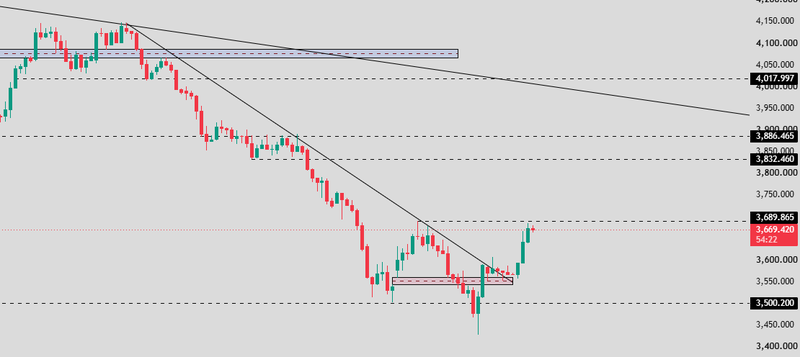
Gold is trading near $3,669 after rebounding from the $3,500 support level and breaking above the short-term descending trendline, showing that buying pressure is improving after the recent selloff.
However, the broader trend remains bearish, with gold continuing to form lower highs below the longer-term descending trendline.
A sustained close above $3,689 would strengthen the recovery and open the way toward $3,886, where previous consolidation could attract renewed selling.
However, a failure to overcome $3,689 could trigger profit-taking toward $3,550–$3,560., and a break below this support would weaken the recovery and open the door to retest $3,500.
Source: Trading view
Nasdaq – technical outlook
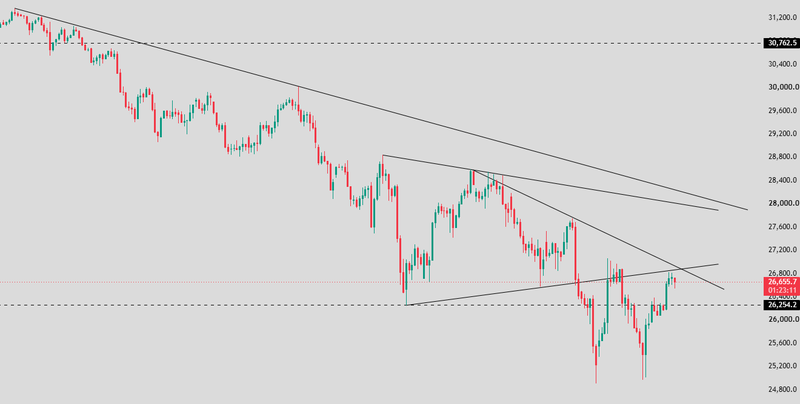
Nasdaq trading near 26,666 after rebounding from the 25,000 zone, however, despite the recovery, the broader trend remains bearish, with lower highs extending from 31,200.
Nasdaq also broke below its previous ascending support line, which is now acting as resistance around 26,800–27,000.
A sustained close above 27,000 would weaken the immediate selling pressure and could extend the recovery toward 27,800–28,000, where the descending trendline remains a major obstacle.
However, a failure to reclaim 27,000 could attract renewed selling toward 26,254, and a decisive break below this support would expose the recent lows around 25,000, reinforcing the broader downward trend.
Source: Trading view