Support
 Black Swan event: meaning, examples and trading impact
A Black Swan is an atypical event characterized by extreme volatility and unpredictability that triggers severe downturns across financial markets. By causing asset correlations to spike rapidly, it significantly diminishes the effectiveness of traditional portfolio diversification.

Black Swans are fat-tailed, outlier events that challenge conventional risk frameworks such as Value at Risk (VaR) and Conditional Value at Risk (CVaR) owing to their inherent unpredictability.
During a market crash, the dramatic increase in correlation across asset classes causes widespread, simultaneous losses, effectively neutralizing the benefits of standard diversification.
Essential defensive mechanisms include dynamic hedging through options contracts and scenario-based stress testing designed to withstand severe market shocks.
What is a Black Swan event?
A Black Swan event represents an aggressive, anomalous market movement that is exceptionally difficult to anticipate, primarily because its underlying catalyst is often obscured in its initial stages. Consequently, a Black Swan event typically exerts a profound financial impact on macroeconomic stability and institutional capital.
Black Swan characteristics
Among its defining traits, a Black Swan event reflects severe randomness and complex causal dynamics, characterized by three primary features:
- Atypical phenomenon: A Black Swan is considered a complete statistical outlier, meaning it is rarely captured accurately by traditional risk management models in investment management. This limitation leaves portfolio strategies vulnerable, as the extreme price swings characteristic of a Black Swan can inflict severe structural damage on a portfolio's net asset value.
- High volatility and correlation: Black Swans tend to inflict extreme capital losses across financial markets. This impact is exacerbated because uncorrelated assets suddenly move in tandem, losing value simultaneously. As a result, substantial losses occur regardless of whether an investment portfolio maintains high structural diversification.
- Low predictability: The root causes of Black Swan events tend to be fundamentally unpredictable. This uncertainty often triggers cascading selloffs driven by widespread pessimistic sentiment, as well as the forced liquidation of highly leveraged long positions that can no longer meet margin or liquidity requirements.
Dispersion analysis in Black Swan events
Financial variables—such as individual stock returns or market index variations—tend to exhibit heavy or "fat" tails; that is, their return distributions depart significantly from a normal distribution due to extreme price dispersion. Beyond the baseline volatility of financial time series, Black Swan events operate as extreme statistical outliers, making them notoriously difficult to model within standard risk management frameworks like Value at Risk (VaR) or Conditional Value at Risk (CVaR).
This dynamic creates a challenging environment for portfolio management. Since Black Swan events exercise a disproportionate impact on investment portfolios regardless of established diversification protocols, they are typically accompanied by intense, broad-based selling pressure across both equities and government securities. This can severely deteriorate portfolio performance, particularly if fund managers are forced to liquidate positions prematurely to satisfy immediate liquidity demands.
Black Swan events: historical analysis
Throughout the history of financial markets, several market dislocations have been categorized as Black Swans due to the extraordinary severity of their downturns. The following cases represent some of the most prominent examples.
Impact of the Dot-Com bubble (2000–2002)
In the early 2000s, unrestrained speculation drove market valuations of technology companies to unsustainable highs within the US equities market. Following this period of extreme overvaluation, the tech-heavy Nasdaq Composite index plummeted by approximately 78% over a 30-month period. This dramatic contraction unfolded in an environment where market participants had failed to price in such a severe downside scenario prior to the market top.
The global financial crisis of 2007–2008
The US subprime mortgage crisis is widely regarded as one of the most devastating global financial crises in modern history. The collapse and bankruptcy of major investment banks triggered systemic contagion, adversely affecting global employment, consumer spending, and corporate investment. In October 2008 alone, the S&P 500 index lost nearly 20% of its value in just two weeks as the extent of subprime exposure became clear. Accumulatively, the S&P 500 depreciated by approximately 57% over an 18-month period.
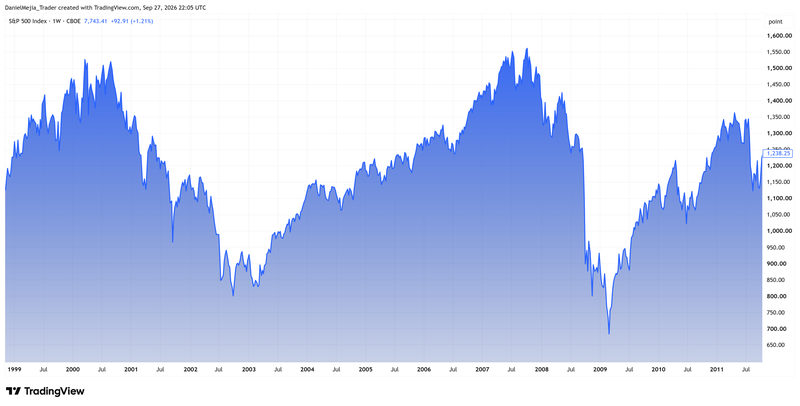
Figure 1. S&P 500 Index (1999–2011). Source: Data from the CBOE Exchange; Figure obtained from TradingView.
The COVID-19 market collapse
At the onset of 2020, the S&P 500 index plunged approximately 33% within a single month following the official declaration of the COVID-19 global pandemic. This rapid decline occurred as market participants rapidly priced in the widespread shutdown of global supply chains resulting from government-mandated lockdowns. Although US equity benchmarks subsequently staged a swift recovery, the initial crash was one of the most aggressive in market history in terms of velocity and intensity.
Risk management for Black Swan events
Although Black Swan events are inherently unpredictable and manifest as extreme tail-risk phenomena, robust protective mechanisms—such as derivative hedging and stress testing—can mitigate their impact.
Risk hedging tools
Risk hedging is a strategic framework designed to insulate an investment portfolio from severe drawdowns during adverse market regimes. The operational logic within an equity portfolio is straightforward: while maintaining a core long-equity allocation, the portfolio manager purchases derivative contracts—such as put options or short futures—so that if the core portfolio declines during a broad market contraction, the derivative overlay appreciates in value, thereby offsetting equity losses.
However, while the conceptual framework is simple, execution in practice is complex. Because systemic market contractions are exceptionally difficult to forecast, managers must structure sophisticated derivative overlay strategies that balance downside protection against the ongoing drag on portfolio yield. Flawed execution or mispriced derivatives overlay strategies can significantly impair an investment portfolio's compound returns over time.
Stress testing
To manage the unpredictability of Black Swan events, portfolio managers rely on scenario analysis and stress testing to establish predefined operational protocols. For example, a manager might simulate a scenario where broad market indices decline by more than 20% within a condensed timeframe, establishing quantitative alerts that trigger preventive or corrective portfolio rebalancing.
Additionally, managers run stress tests simulating scenarios where asset correlations increase, exceeding maximum allowable risk thresholds. Analysing these tail-risk conditions in advance enables institutions to formulate execution strategies that limit downside capture and protect overall portfolio solvency.
Conclusion
Black Swan events present profound challenges to financial stability due to their unpredictability, extreme volatility, and fat-tailed distribution properties. Since these market shocks invalidate standard assumptions of normal distribution and render basic asset diversification ineffective, modern portfolio management demands a proactive defensive architecture. Incorporating structured derivative overlays alongside rigorous, ongoing stress testing is vital for identifying systemic vulnerabilities, preserving capital, and ensuring institutional resilience against extreme market disruptions.
If you're interested in trading indices, foreign exchange, or commodities, consider exploring the CFD contracts offered by Equiti Group. Please note that trading leveraged derivatives involves a high level of risk and may not be suitable for all investors.
FAQs
What exactly is a Black Swan event?
A Black Swan is a rare, highly unpredictable market event characterized by extreme volatility and severe market drawdowns. It is exceptionally difficult to forecast due to the complexity of identifying its underlying causes in real time. Black Swans exert a profound financial impact, threatening broader macroeconomic stability and destabilizing asset market dynamics.
Why does traditional diversification fail during a Black Swan?
During a Black Swan event, asset correlations spike dramatically toward 1.0, causing typically unrelated asset classes to lose value simultaneously regardless of how broadly a portfolio is diversified. Furthermore, because these events represent extreme statistical outliers in non-normal, fat-tailed distributions, standard risk management models like VaR and CVaR fail to accurately forecast or account for the magnitude of the losses.
What tools are available to manage the risk of these events?
Portfolio managers mitigate Black Swan risks primarily through derivative hedging (such as buying put options or shorting futures) to offset equity losses during market contractions. Additionally, they employ stress testing to model extreme scenarios—such as sudden market drops exceeding 20% or severe correlation spikes—allowing them to establish automated risk limits and execute timely defensive adjustments.