Support
 How inflation affects stocks: Why prices, interest rates, and profits all matter
Inflation can move stocks well before it shows up in company earnings. When prices rise across the economy, consumers lose purchasing power, businesses face higher costs and interest rates often move higher. That combination can change both how much companies earn and how investors value those earnings.

Inflation reduces the purchasing power of money, making real returns more important than nominal returns.
Higher inflation often leads to higher interest rates, which pressure stock valuations.
Rising business costs can squeeze profit margins before companies raise prices.
Companies with strong pricing power usually cope better with inflation.
The 2022 post-pandemic inflation shock showed how quickly rising rates can reshape the stock market.
What inflation means for stock investors
Inflation is the rate at which the general price of goods and services increases over time. As prices rise, the same amount of money buys less.
That is why investors often look beyond cash during periods of high inflation. An investment needs to produce a return that keeps pace with rising prices, otherwise the value of that money is falling in real terms.
Stocks can help protect purchasing power over the long run because companies can increase sales, raise prices and grow profits. But stocks are not automatically protected from inflation. What happens depends on the company's costs, pricing power, debt and expected growth.
Nominal returns vs. real returns
One of the biggest misconceptions in investing is assuming that a positive return automatically means wealth has increased.
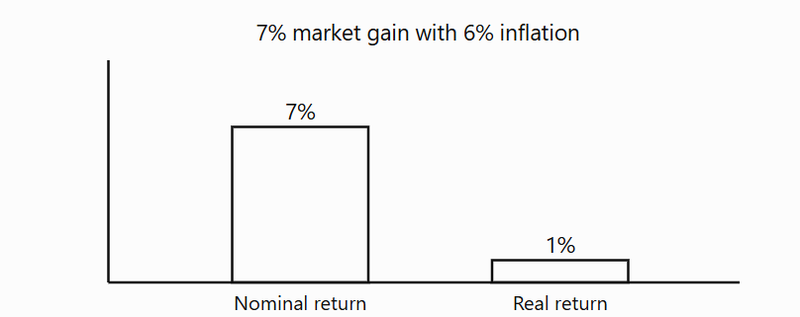
What matters is real return, which adjusts investment gains for inflation. Imagine the stock market gains 7% during a year when inflation reaches 6%. On paper, the portfolio has grown, but purchasing power has increased by only about 1%.
This distinction becomes even more important during periods of elevated inflation because markets can post positive returns while investors experience only modest improvements in their actual buying power.
Three ways inflation attacks stock prices
Inflation does not usually hurt stocks through a single mechanism. Instead, it affects valuations, profits, and monetary policy at the same time.
Higher inflation raises the discount rate
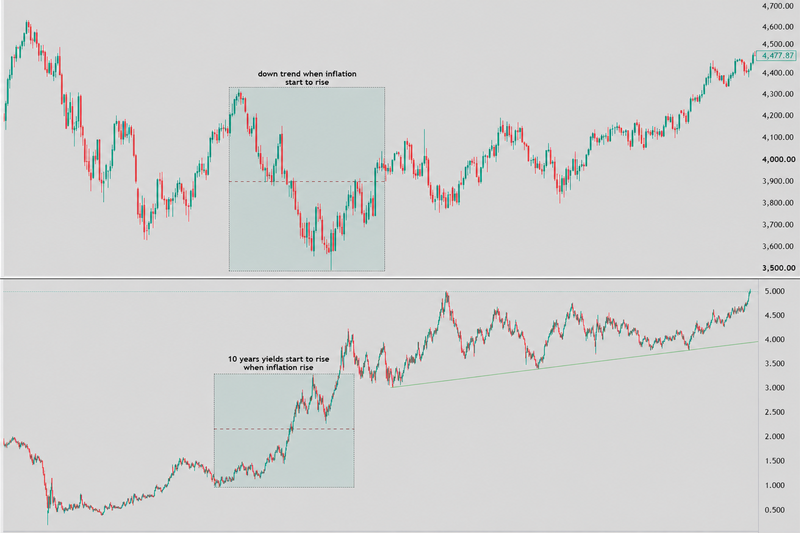
This is one of the biggest links between inflation and stock prices. Investors value companies partly by estimating how much their future profits are worth today. When interest rates rise, those future cash flows are discounted at a higher rate, reducing their present value.
The effect is usually stronger for companies where a large part of the expected earnings sits far in the future. That is why high-growth stocks can come under more pressure when inflation pushes interest rates higher.
Business itself may not have changed much. The price investors are willing to pay for its future earnings can still change sharply.
Higher costs can squeeze profit margins
Inflation also hits companies through their expenses. Energy, wages, raw materials, transport and other operating costs can all rise. The problem comes when those costs increase faster than a company can raise its own prices.
A manufacturer, for example, may face higher electricity, shipping and labour costs. If it cannot pass those increases on quickly, its profit margin falls.
That makes pricing power important
A company that can raise prices without losing too many customers has a better chance of protecting profits. A company operating in a highly competitive market may have much less room to do so.
Central banks respond by slowing demand
The effect does not stop at company costs. When inflation becomes too high, central banks may raise interest rates to reduce borrowing and slow demand. Consumers may cut spending, while businesses may delay investment and expansion.
That creates another pressure point for stocks. Companies are dealing with higher costs while customers may be becoming more cautious.
Source: Trading view
Why does pricing power matter so much?
Pricing power is simply a company's ability to raise prices without causing a major drop in demand.
Businesses selling essential products and services can sometimes pass higher costs more easily because customers still need what they provide. Utilities, healthcare, household goods and some energy companies can have this advantage, depending on the market they operate in.
Other businesses have less flexibility
Companies selling discretionary products may find that customers cut spending when prices rise. Growth companies can also face valuation pressure from higher rates even when their products continue to sell well. That is why two companies can experience the same inflation environment and produce very different results.
What did the 2022 inflation shock show?
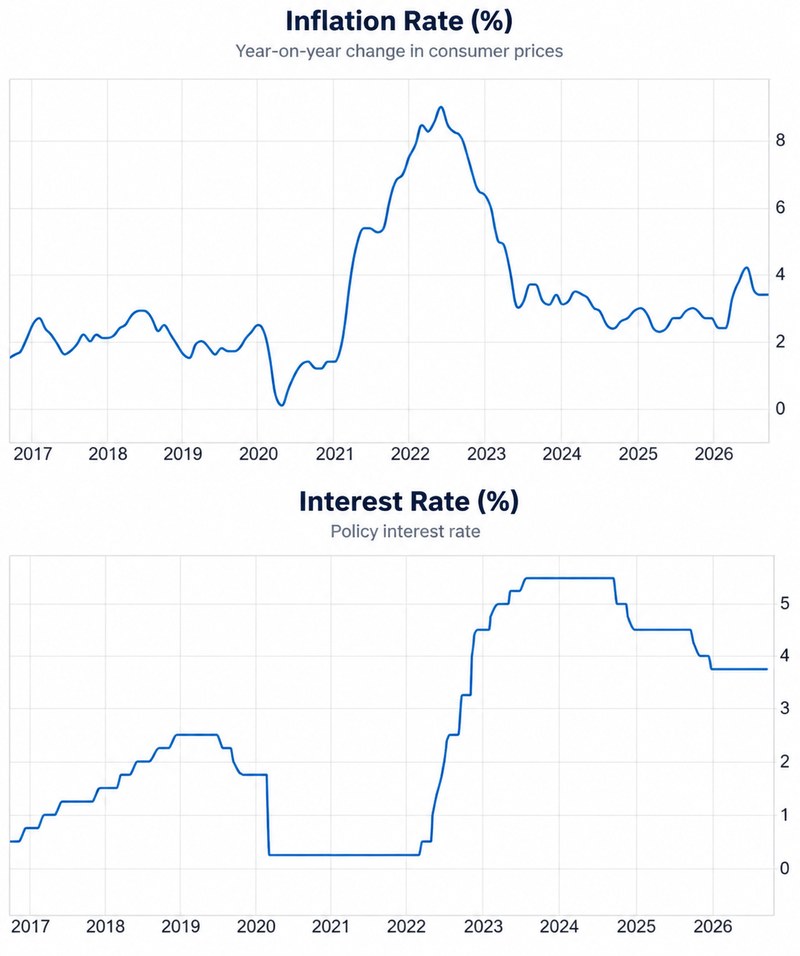
The post-pandemic period provides a clear example. Supply-chain problems, strong consumer demand, labour shortages and higher energy prices pushed inflation sharply higher. The Federal Reserve responded with aggressive interest-rate increases during 2022.
Stocks reacted unevenly
Growth stocks came under heavy pressure as rising yields reduced the value investors placed on future earnings. More defensive parts of the market generally held up better because their revenues were often less dependent on distant growth and some companies had more ability to raise prices.
The important lesson was not that inflation automatically causes stocks to fall. It was that high inflation combined with rapidly rising interest rates can change the entire way the market values companies.
Source: Federal reserve
How should investors think about inflation?
Inflation is easier to understand when you stop looking at it as just one number. Investors need to watch the inflation data alongside interest rates, Treasury yields, central-bank decisions and corporate earnings. A small rise in inflation may not matter much when rates are stable. The same inflation increase can matter far more when a central bank is preparing to tighten policy.
The businesses that tend to handle inflation better are usually those that can raise prices, protect margins and continue generating strong cash flow without relying heavily on cheap financing.
The main point is simple: inflation changes both sides of the stock-market equation. It affects what companies earn and what investors are willing to pay for those earnings. Understanding both is what explains why some stocks hold up while others struggle when prices begin rising faster.
FAQs
How does inflation affect stocks?
Inflation affects stocks by reducing purchasing power, increasing business costs, and often leading to higher interest rates. These factors can lower company profits and reduce stock valuations, especially for businesses that rely heavily on future growth.
Why do stocks fall when inflation rises?
Stocks can fall during periods of rising inflation because investors expect higher interest rates. Higher rates make future corporate earnings less valuable in today's dollars and can slow economic growth by increasing borrowing costs.
What is the difference between nominal and real stock returns?
Nominal return is the percentage gain shown by an investment, while real return adjusts that gain for inflation. For example, a 7% stock return during 6% inflation produces a real return of roughly 1%.
Which stocks perform best during inflation?
Companies with strong pricing power often perform better during inflation because they can pass higher costs on to customers. Businesses selling essential goods and services, such as consumer staples, utilities, and some energy companies, are often considered more resilient.
Which stocks are most vulnerable to inflation?
Growth stocks are often more sensitive because much of their value depends on future earnings. When inflation pushes interest rates higher, those future cash flows become less valuable, which can pressure valuations.