Support
 How to read an earnings report: a beginner's guide
An earnings report reflects the audited quarterly and annual performance of public companies under international regulatory frameworks. It enables the analysis of revenue growth, profitability (as measured by Earnings Per Share, or EPS), and forward guidance, offering investors the necessary foundations to understand market volatility and dynamics.

Earnings reports are regulated by entities such as the SEC to ensure quarterly audited data and reliable information.
Sales (revenue) analysis exposes the rate of growth, competitive advantage, and prevailing demand within an industry.
EPS standardises net profits, allowing investors to evaluate real profit and efficiency against competitors.
Forward guidance provides crucial context for investors, directly influencing price reactions and post-publication volatility.
What is an earnings report and why is it important?
An earnings report is the official disclosure of audited quarterly financial statements by public companies listed on global stock exchanges. This provides investors with greater transparency regarding corporate performance, enabling them to make investment decisions grounded in verifiable fundamentals.
Regulatory framework for earnings reporting
The disclosure of financial information by listed companies is subject to rigorous regulatory requirements aimed at promoting transparency and facilitating informed decision-making by investors.
For instance, in the United States, the Securities and Exchange Commission (SEC) establishes and monitors periodic disclosure obligations for entities under its jurisdiction. In the United Kingdom, the Financial Conduct Authority (FCA) sets financial reporting requirements for specific listed issuers.
Notably, public companies are bound by periodic disclosure obligations, the frequency of which depends on the relevant jurisdiction and applicable regulations. These obligations may include quarterly, half-yearly, and annual reports that present financial information for the reporting period, as well as cumulative figures and consolidated financial statements where applicable.
What are the main metrics that investors track in earnings reports?
While quarterly reports demand significant depth of analysis because they encompass the primary financial statements—namely the balance sheet, the income statement, and the cash flow statement—investors and traders tend to focus primarily on the following core factors: revenue, earnings per share, the press release, and the earnings call.
Revenue
Total revenue refers to a company's consolidated sales over a specific period (either quarterly or annually). This metric is vital because it reflects an enterprise's growth trajectory. If a firm is expanding its market share, its revenue will typically grow—either due to rising demand across the sector or because its offerings are successfully differentiating themselves from those of competitors.
In this context, investors analyse both the total volume of sales achieved and the intrinsic growth rate in revenue. This allows them to ascertain the market share the firm commands, alongside the speed at which its revenues are expanding. For example, if a business generates $5 billion in sales during a given period within an industry totalling $50 billion, it holds a 10% market share. Continuing with this illustration, if revenues increase year-on-year from $4 billion to $5 billion, the enterprise achieves a 25% growth rate, highlighting its ongoing expansion potential.
Earnings Per Share (EPS)
Earnings Per Share is a fundamental profitability metric widely utilised by investors and market traders. It is calculated using the following operation:
- Basic EPS = (Net Income - Preferred Dividends) / Common Shares Outstanding
EPS standardises a company's net profits, allowing for direct comparison against competitors within the same sector or industry. For example, if two peer companies are evaluated and one generates an EPS of $3 while its competitor achieves $6, this offers a clear indication of their relative capacity to generate net profits after covering operating costs, expenses, and tax liabilities.
Additionally, investors frequently evaluate changes in EPS over consecutive periods to analyse underlying growth. For instance, if a company reports an EPS of $6 compared to $5 in the preceding period, it has achieved a 20% growth in earnings (quarterly or annually). This reflects enhanced business performance stemming from higher total revenues, improved cost efficiency, or a combination of both factors.
Earnings press release and earnings call
The earnings press release is an informative document summarising a company’s operational and financial achievements over the quarter. This publication generally focuses on key operational highlights, performance metrics, growth figures, and forward guidance. Forward guidance is closely scrutinised by investors because it outlines executive projections regarding expected revenue and earnings for subsequent quarters, thereby revealing internal growth expectations.
Furthermore, the earnings call complements the written disclosures through an executive presentation accompanied by a Q&A session for stakeholders. This event allows management to clarify nuances and provide greater detail on aspects that may not have been fully explored in the initial release document.
Market dynamics and price anomalies
The reaction of a share price immediately following a quarterly earnings release can be aggressive, driving up volatility and creating price gaps. This dynamic is predominantly driven by discrepancies between estimated and reported results, alongside shifting forward expectations that modify broader market sentiment.
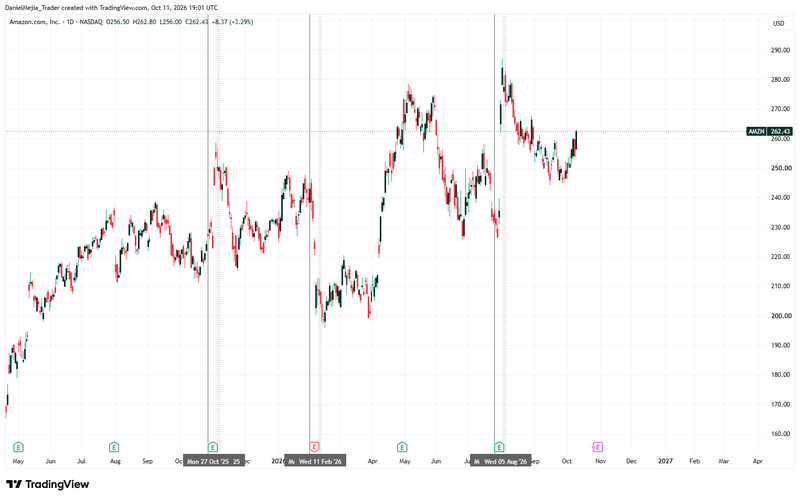
Figure 1. Amazon Market Reaction (Example). Source: Data from the Nasdaq Exchange; Own analysis conducted via TradingView.
Published data vs market forecast
Quarterly reports are typically accompanied by market consensus forecasts covering both revenue and earnings per share. In this context, when a company beats analysts' expectations, a positive share price reaction frequently follows, as the results demonstrate fundamental strength within the firm. Conversely, figures that fall short of estimates often trigger pessimistic sentiment and immediate selling pressure.
However, asset prices occasionally react counterintuitively despite results exceeding consensus estimates. This divergence can stem from specific underlying details within the published financial statements or from future outlooks that fail to satisfy market expectations. When a company issues forward guidance that falls short of future growth or efficiency projections, the share price often experiences a setback due to the failure to meet forward expectations.
Conclusion
Understanding earnings reports is essential for assessing a company's true financial health and making well-informed investment decisions. Beyond core historical metrics such as revenue and earnings per share, investors must evaluate future projections expressed through forward guidance. Recognizing that the market responds to both hard figures and forward expectations allows investors to interpret volatility more analytically and capitalize on emerging opportunities across the financial markets.
If you're interested in trading indices, foreign exchange, or commodities, consider exploring the CFD contracts offered by Equiti Group. Please note that trading leveraged derivatives involves a high level of risk and may not be suitable for all investors.
FAQs
What is an earnings report and what is its importance for investors?
An earnings report is the official disclosure of a public company's audited quarterly financial statements. It is essential because it provides transparency regarding corporate financial performance, allowing investors to base their decisions on verifiable data regarding profitability and operational health.
Which bodies regulate the publication of financial statements of listed companies?
Financial disclosures are strictly supervised by regulatory authorities, such as the Securities and Exchange Commission (SEC) in the United States or the Financial Conduct Authority (FCA) in the United Kingdom. These institutions mandate the publication of periodic audited financial reports to maintain market integrity, transparency, and efficiency.
What are the key metrics that investors analyse in these reports?
Investors focus primarily on total revenue (which measures sales volume and market share) and earnings per share (EPS, which assesses profitability). Furthermore, they examine the earnings press release, the executive earnings call, and executive forward guidance.
Why can a stock price react unexpectedly after publication?
Market reactions are heavily driven by the variance between consensus expectations and actual reported figures. However, even if a company beats current estimates, its share price may decline if its forward guidance fails to meet market projections or if negative details emerge within the broader financial statements.